FORCES
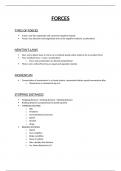
TYPES OF FORCES
Scalar: only has magnitude and cannot be negative (speed)
Vector: has direction and magnitude and can be negative (velocity, acceleration)
NEWTON’S LAWS
One: every object stays at rest or at a constant speed unless acted on by a resultant force
Two: resultant force = mass x acceleration
o Force and acceleration are directly proportional
Three: every action/force has an equal and opposite reaction
MOMENTUM
Conservation of momentum: in a closed system, momentum before equals momentum after
o Momentum is measured in kg m/s
STOPPING DISTANCES
Stopping distance = braking distance + thinking distance
Braking distance is proportional to speed squared
THINKING DISTANCE
o Age
o Tiredness
o Concentration/awareness
o Speed
o Alcohol
o drugs
BRAKING DISTANCE
o Speed
o Tyre condition
o Brake condition
o Mass of vehicle
o Rain, doubles the distance
o Ice, times distance by 10
TYPES OF FORCES
Scalar: only has magnitude and cannot be negative (speed)
Vector: has direction and magnitude and can be negative (velocity, acceleration)
NEWTON’S LAWS
One: every object stays at rest or at a constant speed unless acted on by a resultant force
Two: resultant force = mass x acceleration
o Force and acceleration are directly proportional
Three: every action/force has an equal and opposite reaction
MOMENTUM
Conservation of momentum: in a closed system, momentum before equals momentum after
o Momentum is measured in kg m/s
STOPPING DISTANCES
Stopping distance = braking distance + thinking distance
Braking distance is proportional to speed squared
THINKING DISTANCE
o Age
o Tiredness
o Concentration/awareness
o Speed
o Alcohol
o drugs
BRAKING DISTANCE
o Speed
o Tyre condition
o Brake condition
o Mass of vehicle
o Rain, doubles the distance
o Ice, times distance by 10