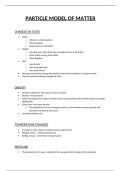
PARTICLE MODEL OF MATTER
CHANGES IN STATE
SOLID
o Vibrate in a fixed position
o Closely packed
o Strong forces of attraction
LIQUID
o Can slide over each other due to weaker forces of attraction
o More kinetic energy than solids
o Close together
GAS
o Low density
o Can be compressed
o Very weak forces
Heating increases the energy the particles have and can produce a change of state
Mass in conserved during a change of state
DENSITY
Density is defined as the mass per unit of volume
Density = mass/volume
Solids and liquids have similar densities as the space between the particles does not change
significantly
Gases have a far lower density
o The particles have lots of energy to move, so the volume increases greatly and
therefore the density decreases
Less dense objects rise
TEMPERATURE CHANGES
A change in state requires energy known as latent heat
Melting: mLfus – latent heat of fusion
Boiling: mLvap – latent heat of vaporisation
PRESSURE
The temperature of a gas is related to the average kinetic energy of the molecules
CHANGES IN STATE
SOLID
o Vibrate in a fixed position
o Closely packed
o Strong forces of attraction
LIQUID
o Can slide over each other due to weaker forces of attraction
o More kinetic energy than solids
o Close together
GAS
o Low density
o Can be compressed
o Very weak forces
Heating increases the energy the particles have and can produce a change of state
Mass in conserved during a change of state
DENSITY
Density is defined as the mass per unit of volume
Density = mass/volume
Solids and liquids have similar densities as the space between the particles does not change
significantly
Gases have a far lower density
o The particles have lots of energy to move, so the volume increases greatly and
therefore the density decreases
Less dense objects rise
TEMPERATURE CHANGES
A change in state requires energy known as latent heat
Melting: mLfus – latent heat of fusion
Boiling: mLvap – latent heat of vaporisation
PRESSURE
The temperature of a gas is related to the average kinetic energy of the molecules