
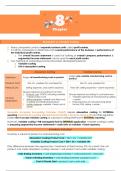
Absorption vs Variable Costing
Many companies consist of separate business units called profit centres.
It’s NB for companies to determine both overall performance of the business + performance of
the individual profit centres.
o The overall income statement is useful for looking at overall company performance &
segmented income statement can be used for each profit centre.
Two methods of computing income have been developed based on:
o Variable costing
o Full or absorption costing.
Absorption Costing Variable Costing
Assigns only variable manufacturing costs to
Definition: Assigns all manufacturing costs to product
product
Product Cost: DM, DL, variable OH, and fixed OH DM, DL, and variable OH
Period Cost: Selling expenses, and admin expenses Fixed OH, selling expenses + admin expenses
Groups expenses according to function
Product cost: GOGS, including variable Groups expense according to cost behaviour
+ fixed product cost Variable expenses of manufacturing, selling
Income
Selling expense: variable and fixed cost + admin
Statement: of selling and distributing product I Fixed expenses of manufacturing (fixed
Admin expense: variable + fixed cost of factory OH), selling + admin.
admin
Generally Accepted Accounting Principles (GAAP) require absorption costing for EXTERNAL
reporting. Financial Accounting Standards Board (FASB), + Revenue Service (IRS) & other regulatory
bodies don’t accept variable costing as a product-costing method for EXTERNAL reporting.
However, variable costing = NB managerial tool for INTERNAL application. Variable costing is useful
in preparing segmented income statements = useful info on variable + fixed expenses.
Inventory Valuation
Inventory is valued at product or manufacturing cost.
Absorption Costing Product Cost = DM + DL + Variable OH
Variable Costing Product Cost = DM + DL + variable OH
Only difference between the approaches = treatment of fixed factory OH. As a result, the unit
product cost under absorption costing’s always > unit product cost under variable costing.
Units Ending Inventory = units beginning inventory + units produced – units sold
Value of Ending Inventory = units ending inventory x product cost
Cost of Goods Sold = product cost x units sold
, Example:
During the most recent year, HannaH Inc had the following data associated with their product:
Units in beginning inventory -
Units produced 10 000
Units sold (R300 per unit) 8 000
Variable cost per unit:
Direct materials 50
Direct labour 100
Variable overhead 50
Fixed costs:
Fixed overhead per unit produced 25
Fixed selling and admin 100 000
1. How many units are in ending inventory?
Units Ending Inventory = units beginning inventory + units produced – units sold
= 0 + 10 000 – 8 000 = 2 000 units
2. Using absorption costing, calculate the per-unit product cost.
Absorption Costing Product Cost = DM + DL + variable OH + fixed OH = 50 + 100 + 50 + 25 = R225
3. What is the value of ending inventory according to absorption costing?
Value of Ending Inventory = units ending inventory x product cost = 2 000 x 225 = R450 000
4. Calculate the cost of goods sold under adsorption costing.
Cost of Goods Sold = product cost x units sold = 225 x 8 000 = R1 800 000
5. Prepare an Income Statement using absorption costing.
HannaH Inc
Absorption Costing Income Statement
Sales (300 x 8 000) 2 400 000
,=
-
Cost of Goods Sold (1 800 000)
Gross Margin 600 000
Selling & Admin expense (100 000)
Operating Income - 500 000
6. Using variable costing, calculate the per-unit product cost.
Variable Costing Product Cost = direct materials + direct labour + variable overhead
= 50 + 100 + 50 = R200
7. What is the value of ending inventory according to variable costing?
Value of Ending Inventory = units ending inventory x product cost = 2 000 x 200 = R400 000
8. Calculate the cost of goods sold under variable costing.
Cost of Goods Sold = product cost x units sold Cost of = 200 x 8 000 = R1 600 000
9. Prepare an Income Statement using variable costing.
HannaH Inc
Absorption Costing Income Statement
Sales (300 x 8 000)
Cost of Goods Sold
-(12600
400 000
000)
Contribution Margin 800 000
Fixed expenses:
Fixed OH (25 x 10 000)
Fixed selling & admin
I--
(250 000)
(100 000)
Operating Income 450 000
Many companies consist of separate business units called profit centres.
It’s NB for companies to determine both overall performance of the business + performance of
the individual profit centres.
o The overall income statement is useful for looking at overall company performance &
segmented income statement can be used for each profit centre.
Two methods of computing income have been developed based on:
o Variable costing
o Full or absorption costing.
Absorption Costing Variable Costing
Assigns only variable manufacturing costs to
Definition: Assigns all manufacturing costs to product
product
Product Cost: DM, DL, variable OH, and fixed OH DM, DL, and variable OH
Period Cost: Selling expenses, and admin expenses Fixed OH, selling expenses + admin expenses
Groups expenses according to function
Product cost: GOGS, including variable Groups expense according to cost behaviour
+ fixed product cost Variable expenses of manufacturing, selling
Income
Selling expense: variable and fixed cost + admin
Statement: of selling and distributing product I Fixed expenses of manufacturing (fixed
Admin expense: variable + fixed cost of factory OH), selling + admin.
admin
Generally Accepted Accounting Principles (GAAP) require absorption costing for EXTERNAL
reporting. Financial Accounting Standards Board (FASB), + Revenue Service (IRS) & other regulatory
bodies don’t accept variable costing as a product-costing method for EXTERNAL reporting.
However, variable costing = NB managerial tool for INTERNAL application. Variable costing is useful
in preparing segmented income statements = useful info on variable + fixed expenses.
Inventory Valuation
Inventory is valued at product or manufacturing cost.
Absorption Costing Product Cost = DM + DL + Variable OH
Variable Costing Product Cost = DM + DL + variable OH
Only difference between the approaches = treatment of fixed factory OH. As a result, the unit
product cost under absorption costing’s always > unit product cost under variable costing.
Units Ending Inventory = units beginning inventory + units produced – units sold
Value of Ending Inventory = units ending inventory x product cost
Cost of Goods Sold = product cost x units sold
, Example:
During the most recent year, HannaH Inc had the following data associated with their product:
Units in beginning inventory -
Units produced 10 000
Units sold (R300 per unit) 8 000
Variable cost per unit:
Direct materials 50
Direct labour 100
Variable overhead 50
Fixed costs:
Fixed overhead per unit produced 25
Fixed selling and admin 100 000
1. How many units are in ending inventory?
Units Ending Inventory = units beginning inventory + units produced – units sold
= 0 + 10 000 – 8 000 = 2 000 units
2. Using absorption costing, calculate the per-unit product cost.
Absorption Costing Product Cost = DM + DL + variable OH + fixed OH = 50 + 100 + 50 + 25 = R225
3. What is the value of ending inventory according to absorption costing?
Value of Ending Inventory = units ending inventory x product cost = 2 000 x 225 = R450 000
4. Calculate the cost of goods sold under adsorption costing.
Cost of Goods Sold = product cost x units sold = 225 x 8 000 = R1 800 000
5. Prepare an Income Statement using absorption costing.
HannaH Inc
Absorption Costing Income Statement
Sales (300 x 8 000) 2 400 000
,=
-
Cost of Goods Sold (1 800 000)
Gross Margin 600 000
Selling & Admin expense (100 000)
Operating Income - 500 000
6. Using variable costing, calculate the per-unit product cost.
Variable Costing Product Cost = direct materials + direct labour + variable overhead
= 50 + 100 + 50 = R200
7. What is the value of ending inventory according to variable costing?
Value of Ending Inventory = units ending inventory x product cost = 2 000 x 200 = R400 000
8. Calculate the cost of goods sold under variable costing.
Cost of Goods Sold = product cost x units sold Cost of = 200 x 8 000 = R1 600 000
9. Prepare an Income Statement using variable costing.
HannaH Inc
Absorption Costing Income Statement
Sales (300 x 8 000)
Cost of Goods Sold
-(12600
400 000
000)
Contribution Margin 800 000
Fixed expenses:
Fixed OH (25 x 10 000)
Fixed selling & admin
I--
(250 000)
(100 000)
Operating Income 450 000


