MKTG 351 EXAM 3 CSUF| 174 QUESTIONS AND ANSWERS|GUARANTEED SUCCESS
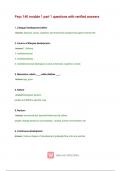
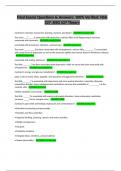
simulated (laboratory) market testing the presentation of advertising and other promotional materials for several products, including a test product, to members of the products target market commercialization the decision to market a product innovation a product perceived as new by a potential adopter simultaneous product development a team-oriented approach to new-product development development the stage in the product development process in which a prototype is developed and a marketing strategy is outlined new product a product new to the world, the market, the producer, the seller, or some combination of these new-product strategy a plan that links the new-product development process with the objectives of the marketing department, the business unit, and the corporation brainstorming the process of getting a group to think of unlimited ways to vary a product or solve a problem introductory stage the full-scale launch of a new product into the marketplace business analysis the second stage of the screening process where preliminary figures for demand, cost, sales, and profitability are calculated maturity stage a period during which sales increase at a decreasing rate Test marketing the limited introduction of a product and a marketing program to determine the reactions of potential customers in a market situation concept test a test to evaluate a new-product idea, usually before any prototype has been created decline stage simulated (laboratory) market testing commercialization the decision to market a product Diffusion the process by which the adoption of an innovation spreads Product development a marketing strategy that entails the creation of marketable new products; the process of converting applications for new technologies into marketable products product life cycle (PLC) a concept that provides a way to trace the stages of a products acceptance, from its introduction (birth) to its decline (death) product category all brands that satisfy a particular type of need screening the first filter in the product development process, which eliminates ideas that are inconsistent with the organizations new-product strategy or are obviously inappropriate for some other reason growth stage the second stage of the product life cycle when sales typically grow at an increasing rate, many competitors enter the market, large companies may start to acquire small pioneering firms, and profits are healthy inseparability the inability of the production and consumption of a service to be separated; consumers must be present during the production heterogeneity the variability of the inputs and outputs of services, which causes services to tend to be less standardized and uniform than goods Reliability the ability to perform a service dependably, accurately, and consistently credence quality a characteristic that consumers may have difficulty assessing even after purchase because they do not have the necessary knowledge or experience core service the most basic benefit the consumer is buying intangibility the inability of services to be touched, seen, tasted, heard, or felt in the same manner that goods can be sensed service the result of applying human or mechanical efforts to people or objects Responsiveness the ability to provide prompt service supplementary service a service that supports or enhances the core service Empathy caring, individualized attention to customers Assurance the knowledge and courtesy of employees and their ability to convey trust Tangibles the physical evidence of a service, including the physical facilities, tools, and equipment used to provide the service internal marketing treating employees as customers and developing systems and benefits that satisfy their needs Nonprofit organization marketing the effort by nonprofit organizations to bring about mutually satisfying exchanges with target markets public service advertisement (PSA) an announcement that promotes a program of a federal, state, or local government or of a nonprofit organization search quality a characteristic that can be easily assessed before purchase Perishability the inability of services to be stored, warehoused, or inventoried experience quality a characteristic that can be assessed only after use gap model a model identifying five gaps that can cause problems in service delivery and influence customer evaluations of service quality mass customization a strategy that uses technology to deliver customized services on a mass basis nonprofit organization an organization that exists to achieve some goal other than the usual business goals of profit, market share, or return on investment supplier relationship management process supports manufacturing flow by identifying and maintaining relationships with highly valued suppliers supply chain integration when multiple firms or business functions in a supply chain coordinate their activities and processes so that they are seamlessly linked to one another in an effort to satisfy the customer order processing system a system whereby orders are entered into the supply chain and filled supply chain resiliency the ability of a supply chain to return to its ideal operational state after being disrupted buffer stocks extra inventory held in addition to cycle stock as insurance against unexpected demand increases supply chain the connected chain of all of the business entities, both internal and external to the company, that perform or support the logistics function order fulfillment process a highly integrated process, often requiring persons from multiple companies and multiple functions to come together and coordinate to create customer satisfaction at a given place and time Cycle stocks inventory held temporarily for the purpose of fulfilling predicted demand in a period third-party logistics company (3PL) a firm that provides functional logistics services to others Smart RFID (radio-frequency identification) an inventory handling and tracking system that employs radio-frequency electromagnetic fields to transfer and read product data via an electronic tag mass customization a production method whereby products are not made until an order is placed by the customer; products are made according to customer specifications demand management process seeks to align supply and demand throughout the supply chain by anticipating customer requirements at each level and creating demand-related plans of action prior to actual customer purchasing behavior supply chain team an entire group of individuals who orchestrate the movement of goods, services, and information from the source to the consumer supply chain management a management system that coordinates and integrates all of the activities performed by supply chain members into a seamless process, from the source to the point of consumption, resulting in enhanced customer and economic value customer service management process presents a multi-company, unified response system to the customer whenever complaints, concerns, questions, or comments are voiced build-to-stock a production method whereby products are made in advance of demand based on forecasts and are stored until customer orders arrive manufacturing flow management process concerned with ensuring that firms in the supply chain have the needed resources to manufacture with flexibility and to move products through a multi-stage production process seasonal inventory an extra inventory buffer that is held in response to predictable demand increases that occur annually supply chain risk any potential disruption that threatens the supply chains efficient and effective operations Nearshoring the transfer of an offshored activity from a distant to a nearby country supply chain agility an operational strategy focused on inducing inventory velocity and operational flexibility simultaneously in the supply chain Work-in-process inventory materials inventory that is currently in the process of being converted into finished goods logistics information system the link that connects all the logistics functions of the supply chain in-transit inventory inventory that is currently moving within a transportation network to or from the companys facilities (plant, warehouse, or sales location) fourth-party logistics companies (4PLs) a consulting-based organization that assesses anothers entire logistical service needs and provides integrated solutions, often drawing on multiple 3PLs for actual service offshoring the outsourcing of a business process from one country to another for the purpose of gaining economic advantage build-to-order a production method whereby products are not made until an order is placed by the customer; products are made according to customer specifications three-dimensional printing (3DP) the creation of three-dimensional objects via an additive manufacturing (printing) technology that layers raw material into desired shapes inventory control system a method of developing and maintaining an adequate assortment of materials or products to meet a manufacturers or a customers demand supply chain security efforts made by companies to protect their in-transit inventory or value-transforming assets from external or internal threats Business processes bundles of interconnected activities that stretch across firms in the supply chain materials-handling system a method of moving inventory into, within, and out of a warehouse customer relationship management (CRM) process allows companies to prioritize their marketing focus on different customer groups according to each groups long-term value to the company or supply chain
Written for
- Institution
-
Allied Business School
- Course
-
Business 351
Document information
- Uploaded on
- October 17, 2023
- Number of pages
- 18
- Written in
- 2023/2024
- Type
- Exam (elaborations)
- Contains
- Questions & answers
Subjects

Also available in package deal