ENG1514 EXAM 2023-10-17
ENG1514
Applied English Language For Foundation Phase First Additional Language
100 marks Duration: 48 hours
WHATSAPP 0766247307
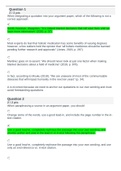
Question 1 - Paragraph 1:
1. "When you show consideration for others, you display good manners."
2. Noun Phrase: The Collins dictionary
Constituent parts: The Collins (noun) + dictionary (noun)
, SECTION A: Integrated Content and Text-Based Questions
Read Text A and answer the questions set. TEXT A
MANNERS MATTER
PARA.1 The Collins Dictionary defines 'Etiquette'* as: 'The customs or rules governing behaviour
regarded as correct or acceptable in social or official life'. This is related to how people behave in a
particular group or in a specific setting. When you show consideration for others, you display good
manners. For example, speaking to other people sitting at the dinner table at a party is good
manners. Writing a message or e-mail to the hosts of the dinner party the next day, expressing
your gratitude for being invited, is polite. This would most likely lead to you being invited to their
next dinner party.
PARA.2 Good manners have their origins in ancient history. For instance, it may be seen as hygienic
to cover your mouth when yawning. However, centuries ago the act of yawning was believed to be
the soul leaving one's body, allowing evil spirits to enter. The belief was that covering the mouth
kept the soul inside the body. The habit of saying 'Bless you' when someone sneezes dates back to
the time of Pope Gregory the First. He commanded that anyone who sneezed should be blessed in
case they had contracted the plague, which was a deadly disease at that time.
PARA.3 Manners are often used as a means to judge people. For example, in Western culture, one
is judged by the way one uses one's cutlery at the dinner table. However, there are some cultures
that use their hands to eat their food. In most African cultures, a child is expected to address adults
with a certain level of formality, regardless of their relationship with them. Not using a title when
addressing adults is considered to be highly insulting, yet in some cultures it is acceptable to
address an adult by his or her first name. It is also a sign of respect not to look an elder in the eye
but this may not necessarily be so in other cultures. In Kenya and Nigeria, when greeting a person,
it is the norm to ask about their general well-being. Skipping this part is considered very
ENG1514
Applied English Language For Foundation Phase First Additional Language
100 marks Duration: 48 hours
WHATSAPP 0766247307
Question 1 - Paragraph 1:
1. "When you show consideration for others, you display good manners."
2. Noun Phrase: The Collins dictionary
Constituent parts: The Collins (noun) + dictionary (noun)
, SECTION A: Integrated Content and Text-Based Questions
Read Text A and answer the questions set. TEXT A
MANNERS MATTER
PARA.1 The Collins Dictionary defines 'Etiquette'* as: 'The customs or rules governing behaviour
regarded as correct or acceptable in social or official life'. This is related to how people behave in a
particular group or in a specific setting. When you show consideration for others, you display good
manners. For example, speaking to other people sitting at the dinner table at a party is good
manners. Writing a message or e-mail to the hosts of the dinner party the next day, expressing
your gratitude for being invited, is polite. This would most likely lead to you being invited to their
next dinner party.
PARA.2 Good manners have their origins in ancient history. For instance, it may be seen as hygienic
to cover your mouth when yawning. However, centuries ago the act of yawning was believed to be
the soul leaving one's body, allowing evil spirits to enter. The belief was that covering the mouth
kept the soul inside the body. The habit of saying 'Bless you' when someone sneezes dates back to
the time of Pope Gregory the First. He commanded that anyone who sneezed should be blessed in
case they had contracted the plague, which was a deadly disease at that time.
PARA.3 Manners are often used as a means to judge people. For example, in Western culture, one
is judged by the way one uses one's cutlery at the dinner table. However, there are some cultures
that use their hands to eat their food. In most African cultures, a child is expected to address adults
with a certain level of formality, regardless of their relationship with them. Not using a title when
addressing adults is considered to be highly insulting, yet in some cultures it is acceptable to
address an adult by his or her first name. It is also a sign of respect not to look an elder in the eye
but this may not necessarily be so in other cultures. In Kenya and Nigeria, when greeting a person,
it is the norm to ask about their general well-being. Skipping this part is considered very