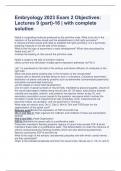
Embryology 2023 Exam 2 Objectives: Lectures 9 (part)-16 | with complete solution
Embryology 2023 Exam 2 Objectives: Lectures 9 (part)-16 | with complete solution Nodal is a signaling molecule produced by the primitive node. What is its role in the induction of the primitive streak and the establishment of left-right symmetry? It induces primitive streak and helps to establish left-right symmetry. It is a symmetry breaking molecule in the left side of the embryo. What is the first sign of asymmetry in early development? What roles are played by Nodal and Left-1? Involves the beating of cilia around the primitive node. Nodal is swept to left side of primitive node by ciliary current and stimulates multiple gene expression pathways via Pitx-2 Left-1 is expressed on left side of the embryo and blocks diffusion of molecules to the right side. What role does planar polarity play in the formation of the neural plate? Causes cells to become oriented along an axis in a flat plane. Caused by asymmetric distribution of planar cell polarity proteins such as disheveled (concentrated posteriorly) and pickle (concentrated anteriorly). List the stages in neural tube development. Due to fusion of apical surfaces of neural folds, mediated by glycoconjugates, closure of the neural tube begins midway along neural tube (21-22 days), tube closure extends cranially and caudally, anterior, and posterior neuropores remain at day 23, and secondary neurulation occurs caudal to the posterior neuropore which involves the formation of solid rod of mesenchymal cells (medullary cord), mesenchymal rod becomes hollow via cavitation, and not prominent in humans. What roles do retinoic acid, Otx-2, Gbx-2, Wnt-8, Shh and FGF8 plan inn the segmentation of the spinal cord? Retinoic acid:Blocks the expression of FGF-8 and Wnt-3a Otx-2 and Gbx-2: Help organize the midbrain and hindbrain (These are transcription factors) Wnt-8 and Shh: Head Organization FGF-8: Maintains the stems cells in a proliferative state Presomitic mesoderm flanking posterior regions of neural tube secrete FGF-8 which maintains these cells in a proliferative state. This differentiation is under the influence of retinoic acid produced by flanking somites (which are also advancing posteriorly). Retinoic acid blocks FGF-8 and Wnt-3a What is the origin of the sensory (ectodermal) placodes and with which cranial nerves are they associated? Origin is the ectodermal placode and from the neural crest. Nerves are V, VII, IX, and X. Characterize the location of and fate of each of the three areas of mesoderm in the early embryo. Paraxial (segment plate) mesoderm: thick column closest to and parallel with the notochord becomes segmented into somites Intermediate mesoderm: narrow column of mesoderm, lateral to the paraxial mesoderm, and gives rise to urogenital system. Lateral plate mesoderm: thin plate of mesoderm lateral to intermediate mesoderm and splits to form lining of body cavities and mesoderm of most internal organs as well as limbs. In relation to the somitomeres, at what position does the first pair of somites form? The first pair of somites forms behind (caudal to) the 7th pair of somitomeres at the expense of the eight pair of somitomeres. In the segmentation clock of somitogenesis describe the role of ephrins in maintaining the intersomitic spaces. Cells at the anterior border of a somite express Eph A (receptor) and cells of the posterior border of the anterior somite will express Eph B (ligand), resulting in a fissure between the two adjacent somites. Describe the formation of the dermomyotome and the factors and pathways involved. Wnt genes in dorsal neural tube → transformation of dorsal half of somite into dermomyotome. Dermomyotome → expression of Pax3, Pax7, paraxis → separation of dermomyotome into dorsal dermotome and ventral myotome. List the derivatives from the final subdivisions of the somites. Sclerotome (cartilage), Syndotome (tendons), Myotome (skeletal muscle), Dermatome (dermis), Endothelial cells List the factors involved in the formation of the intermediate mesoderm and list the derivatives. Factors: BMP and Activin Derivatives: Pronephros and Mesonephros Distinguish between somatic and splanchnic mesoderm. Somatic Mesoderm: the dorsal layer that is closely associated with the ectoderm Splanchnic Mesoderm: the ventral layer that is closely associated with the with the endoderm and is specified by the transcription factor Describe the formation of the lateral plate mesoderm and distinguish between the somatopleure and the splanchnopleure. Lateral plate mesoderm: The lateral plate mesoderm divides into two layers (as a result of the formation of the body cavities). The dorsal layer= somatic mesoderm. The ventral layer= splanchnic mesoderm Somatopleure: A fold of tissue, in the embryo of a vertebrate, from which the walls of the body and the amnion develop. -[From the Book] Somatopleure: The combination of the somatic mesoderm and the ectoderm Splanchnopleure: A layer of embryonic cells formed from the mesoderm and endoderm that develops into the wall of the viscera -[From the Book] Splanchnopleure: The combination of the splanchnic mesoderm and the endoderm Differentiate between the intraembryonic coelom and the extraembryonic coelom. Intraembryonic coelom: The cavity between the somatopleure and splanchnopleure. This space will give rise to the thoracic and abdominal cavities. Extraembryonic coelom: The fluid-filled spaces formed within the mass of the extraembryonic mesoderm. The two are continuous with each other. Describe the cardiac crescent and distinguish from the cardiogenic mesoderm; list the factors that induce the formation of the cardiac crescent. The cardiac crescent is formed by the cranially bilateral heart fields fusion at the midline before somite and heart tube formation which populate both endocardial and myocardial progenitors Factors: The Cells migrating through the primitive streak, Cells migrating through the anterior primitive streak, Cells migrating through the middle of the primitive streak, Cells entering the streak most posteriorly What is the secondary heart field? The secondary heart field, a population of cardiac precursor cells, is derived from a region of the splanchnic mesoderm, medial to and distinct from the primary heart field that makes up the cardiac crescent. It constitutes a source of cells that gives rise to both the most distal outflow tract myocardium and the most proximal smooth muscle that forms the tunica media of the arterial trunks. Which signaling factor is necessary for the formation of endoderm? Depends on nodal expression during gastrulation Describe the role of Cdx-2 in the formation of the hindgut and foregut. Posterior gut expresses Cdx-2 which promoters hindgut development and suppressed the formation of anterior gut structures. Study Figure 6.22D and also 6.23 for the overall development of the digestive system and embryo by the end of the fourth week. Early Development of the Digestive System - Diagram Study Figure 6.22D and also 6.23 for the overall development of the digestive system and embryo by the end of the fourth week. Gross development of human embryos during the period of early organogenesis. List major features of the fourth week embryo. - Length of embryo = 4 mm - Rudiments for most of the major organ systems are present (except limbs and kidneys). - Prominent pharyngeal arches - Wolffian ridge List each of the three major circulatory arcs in the 4-week human embryo and the components and function of each. 1. Vitelline Arc --Comp
Written for
- Institution
- Embryology
- Course
- Embryology
Document information
- Uploaded on
- October 17, 2023
- Number of pages
- 17
- Written in
- 2023/2024
- Type
- Exam (elaborations)
- Contains
- Questions & answers
Subjects
-
embryology 2023 exam 2 objectives lectures 9 par

Also available in package deal