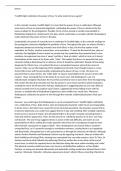
Week Article Keywords
1 Organizational interventions: A research-based framework for Effect & process
the evaluation of both process and effects (Nielsen et al., 2012). evaluation, evaluation
framework,
1 Relational responsibilities in responsive evaluation (Visse et al., Responsive
2012) evaluation, mutual &
shared understanding,
morality
2 The science of training and development in organizations: what Before, during & after
matters in practice (Salas et al., 2012) training, informal
learning, training
evaluation
2 Transfer of training: a meta-analytic review (Blume et al., 2010) Transfer,
near/far/vertical/
horizontal transfer
2 Work factors influencing the transfer stages of soft skills Soft skills, transfer
training: a literature review (Botke et al., 2018) stages, (impact of)
work factors
4 Optimizing the learning in action learning: reflective questions, Action learning,
levels of learning and coaching (Sofo et al., 2010) reflective inquiry,
reflective practice,
action learning
coaching, levels of
learning
4 Competing paradigms in Qualitative Research (Guba & Lincoln, Paradigms, post-
1994) positivism,
positivism, critical
theory &
constructivism,
methodology,
ontology,
epistemology
4 Verdonschot, S. (2018, November). Exploring the learning Generative moments,
potential of evaluation research by a review of 17 impact studies impact map
5 Handley et al. (2007). Researching situated learning: Situated learning,
Participation, Idenitty and Practices in Client-Consultant identity, participation,
Relationships practice, consultancy
skills framework
5 Imants, J., Wubbels, T., & Vermunt, J. (2013). Teachers' Teacher workplace
enactments of workplace conditions and their beliefs and learning, enactment of
attitudes towards reform. reform, workplace
conditions, teacher
learning
6 Akkerman, S., & Bruining, T. (2016). Multilevel boundary Professional
crossing in a professional development school Partnership. Development School,
4 learning
mechanisms,
Boundary crossing
6 Cox, A. (2012). What are communities of practice? A 4 influential
comparative review of four seminal works. communities of
practice
6 Mørk, B. E., Aanestad, M., Hanseth, O., & Grisot, M. (2008). Communities of
, Conflicting epistemic cultures and obstacles for practice, Integrated
learning across communities of practice. Virtual Campus,
Systemic work
cultures
7 Koopmans, L., Bernaards., C. M., Hildebrandt, V. H., Schaufeli, Frameworks of
W. B., de Vet, H. C. W., & Van der Beek, A. J. (2011). individual work
Conceptual frameworks of individual work performance. A performance, task
systematic review. performance,
contextual
performance,
counterproductive
work behavior,
adaptive performance
7 Pelgrim, E., Hissink, E., Bus, L., Van der Schaaf, M., Adaptive expertise,
Nieuwenhuis, L., Van Tartwijk, J., & Kuijer-Siebelink, W. adaptive performance
(2022). Professionals’ adaptive expertise and adaptive
performance in educational and workplace settings: an overview
of reviews.
7 Van Dijk, E. E., Van Tartwijk, J., Van der Schaaf, M. F., & Teacher expertise, six
Kluijtmans, M. (2020). What makes an expert university teachers core tasks,
teacher? A systematic review and synthesis of frameworks for expertise frameworks
teacher expertise in higher education.
1. Title:
organizational interventions: A research-based framework for the evaluation of both process and
effects (Nielsen et al., 2012).
Research question:
To present an evaluation framework based on recent intervention research and process-oriented
organization theory
Main findings or conclusions:
, 1. Mechanisms (process) can explain outcomes
2. Employees as targets of change, management is crucial
3. Phases from initiation to implementation should be considered linear change phases
4. Pre and post-measurement of expected outcomes are important
Key concepts described in article:
Effective evaluation: movement from one fixed state to another fixed state (outcome of the
intervention)
- Change is a given and always occuring
- Effect/outcome evaluation cannot solely account for continuous changes that occur
Proces evaluation: Looks at how certain interventions are interpreted and acted upon by people
in the organisation, with conditions that can hamper or strenghten them.
(process of the intervention, whats happening during the change)
- Evaluation at every stage, not just in the end
- Process and outcomes are intertwined, one cannot be understood without the other
Omnibus context: how the intervention fits with the culture and conditions of the group
Discrete contexts: what specific events may have influenced effects of the intervention?
Organizational actors: employees, management, senior management and middle managers
Mental models: are about sense-making, why do you do the things you do. This influences
actors behaviour and thus intervention outcomes. These are also individual,
but may become shared over time.
Evaluation framework: consists of:
- Organizational actors (first category)
- Mental models of those actors (second category)
- Contextual factors (third category)
- Design and processes (fourth category), consisting of five phases:
o Initiation
o Screening
o Action planing
o Implementation
o Effect evaluation
How do the key concepts relate to eachother?
Together they summises which elements to include when evaluating organizational interventions.
1. Title
Relational responsibilities in responsive evaluation (Visse et al., 2012)
Research question
To introduce an interpretive framework for understanding the moral aspects of evaluation practice
Main findings or conclusions
, - Evaluators need to develop moral competence in to maneuver within this socio-political field
- The evaluator can explore responsibilities by articulating three narratives; identity, relation
and value. Reflecting on these narratives can be beneficial in order to decide what "must be
done"
- Processes of reflecting on your own work are fostered in interaction with others
Key concepts described in article
Responsive evaluation: to create a mutual understanding of the social practice at hand (not
necessarily shared!). It is a reflective practice which requires
openness from the evaluator him/herself
Mutual understanding: People involved know each others perspective and it is ok to have
different perspectives.
Shared understanding: people have or create the same perspective
Morality: taking care for people involved in evaluation and the cause
- Shaped in interaction with stakeholders in daily practice
- Evaluator cares for someone and something, takes responsibility for that (unknowingly)
Being an evaluator depends on:
1. Identity: how is the evaluator seen by themselves and others?
2. Relation: on which relationships does the evaluator (not) focus and why?
3. Values: what values matter in responsive evaluation and evaluation practice?
How do the key concepts relate to eachother?
The key concepts relate to eachother in that they share a common goal, to make the evaluator
understand the moral aspects of evaluation practice. Being an evaluator requires one to realize that
identity, relation and values are fluid and constantly shifting. In order to maintain a clear
understanding of the socio-political environment evaluators need to develop or have moral
competence.
2. Title
The science of training and development in organizations: what matters in practice (Salas et al., 2012)
Research question
1 Organizational interventions: A research-based framework for Effect & process
the evaluation of both process and effects (Nielsen et al., 2012). evaluation, evaluation
framework,
1 Relational responsibilities in responsive evaluation (Visse et al., Responsive
2012) evaluation, mutual &
shared understanding,
morality
2 The science of training and development in organizations: what Before, during & after
matters in practice (Salas et al., 2012) training, informal
learning, training
evaluation
2 Transfer of training: a meta-analytic review (Blume et al., 2010) Transfer,
near/far/vertical/
horizontal transfer
2 Work factors influencing the transfer stages of soft skills Soft skills, transfer
training: a literature review (Botke et al., 2018) stages, (impact of)
work factors
4 Optimizing the learning in action learning: reflective questions, Action learning,
levels of learning and coaching (Sofo et al., 2010) reflective inquiry,
reflective practice,
action learning
coaching, levels of
learning
4 Competing paradigms in Qualitative Research (Guba & Lincoln, Paradigms, post-
1994) positivism,
positivism, critical
theory &
constructivism,
methodology,
ontology,
epistemology
4 Verdonschot, S. (2018, November). Exploring the learning Generative moments,
potential of evaluation research by a review of 17 impact studies impact map
5 Handley et al. (2007). Researching situated learning: Situated learning,
Participation, Idenitty and Practices in Client-Consultant identity, participation,
Relationships practice, consultancy
skills framework
5 Imants, J., Wubbels, T., & Vermunt, J. (2013). Teachers' Teacher workplace
enactments of workplace conditions and their beliefs and learning, enactment of
attitudes towards reform. reform, workplace
conditions, teacher
learning
6 Akkerman, S., & Bruining, T. (2016). Multilevel boundary Professional
crossing in a professional development school Partnership. Development School,
4 learning
mechanisms,
Boundary crossing
6 Cox, A. (2012). What are communities of practice? A 4 influential
comparative review of four seminal works. communities of
practice
6 Mørk, B. E., Aanestad, M., Hanseth, O., & Grisot, M. (2008). Communities of
, Conflicting epistemic cultures and obstacles for practice, Integrated
learning across communities of practice. Virtual Campus,
Systemic work
cultures
7 Koopmans, L., Bernaards., C. M., Hildebrandt, V. H., Schaufeli, Frameworks of
W. B., de Vet, H. C. W., & Van der Beek, A. J. (2011). individual work
Conceptual frameworks of individual work performance. A performance, task
systematic review. performance,
contextual
performance,
counterproductive
work behavior,
adaptive performance
7 Pelgrim, E., Hissink, E., Bus, L., Van der Schaaf, M., Adaptive expertise,
Nieuwenhuis, L., Van Tartwijk, J., & Kuijer-Siebelink, W. adaptive performance
(2022). Professionals’ adaptive expertise and adaptive
performance in educational and workplace settings: an overview
of reviews.
7 Van Dijk, E. E., Van Tartwijk, J., Van der Schaaf, M. F., & Teacher expertise, six
Kluijtmans, M. (2020). What makes an expert university teachers core tasks,
teacher? A systematic review and synthesis of frameworks for expertise frameworks
teacher expertise in higher education.
1. Title:
organizational interventions: A research-based framework for the evaluation of both process and
effects (Nielsen et al., 2012).
Research question:
To present an evaluation framework based on recent intervention research and process-oriented
organization theory
Main findings or conclusions:
, 1. Mechanisms (process) can explain outcomes
2. Employees as targets of change, management is crucial
3. Phases from initiation to implementation should be considered linear change phases
4. Pre and post-measurement of expected outcomes are important
Key concepts described in article:
Effective evaluation: movement from one fixed state to another fixed state (outcome of the
intervention)
- Change is a given and always occuring
- Effect/outcome evaluation cannot solely account for continuous changes that occur
Proces evaluation: Looks at how certain interventions are interpreted and acted upon by people
in the organisation, with conditions that can hamper or strenghten them.
(process of the intervention, whats happening during the change)
- Evaluation at every stage, not just in the end
- Process and outcomes are intertwined, one cannot be understood without the other
Omnibus context: how the intervention fits with the culture and conditions of the group
Discrete contexts: what specific events may have influenced effects of the intervention?
Organizational actors: employees, management, senior management and middle managers
Mental models: are about sense-making, why do you do the things you do. This influences
actors behaviour and thus intervention outcomes. These are also individual,
but may become shared over time.
Evaluation framework: consists of:
- Organizational actors (first category)
- Mental models of those actors (second category)
- Contextual factors (third category)
- Design and processes (fourth category), consisting of five phases:
o Initiation
o Screening
o Action planing
o Implementation
o Effect evaluation
How do the key concepts relate to eachother?
Together they summises which elements to include when evaluating organizational interventions.
1. Title
Relational responsibilities in responsive evaluation (Visse et al., 2012)
Research question
To introduce an interpretive framework for understanding the moral aspects of evaluation practice
Main findings or conclusions
, - Evaluators need to develop moral competence in to maneuver within this socio-political field
- The evaluator can explore responsibilities by articulating three narratives; identity, relation
and value. Reflecting on these narratives can be beneficial in order to decide what "must be
done"
- Processes of reflecting on your own work are fostered in interaction with others
Key concepts described in article
Responsive evaluation: to create a mutual understanding of the social practice at hand (not
necessarily shared!). It is a reflective practice which requires
openness from the evaluator him/herself
Mutual understanding: People involved know each others perspective and it is ok to have
different perspectives.
Shared understanding: people have or create the same perspective
Morality: taking care for people involved in evaluation and the cause
- Shaped in interaction with stakeholders in daily practice
- Evaluator cares for someone and something, takes responsibility for that (unknowingly)
Being an evaluator depends on:
1. Identity: how is the evaluator seen by themselves and others?
2. Relation: on which relationships does the evaluator (not) focus and why?
3. Values: what values matter in responsive evaluation and evaluation practice?
How do the key concepts relate to eachother?
The key concepts relate to eachother in that they share a common goal, to make the evaluator
understand the moral aspects of evaluation practice. Being an evaluator requires one to realize that
identity, relation and values are fluid and constantly shifting. In order to maintain a clear
understanding of the socio-political environment evaluators need to develop or have moral
competence.
2. Title
The science of training and development in organizations: what matters in practice (Salas et al., 2012)
Research question