

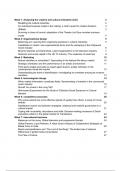
Week 1: Analysing the creative and cultural industries (CCI) 2
Modelling the cultural industries 2
An individual business model in the making: a chef’s quest for creative freedom 3
(ElBulli) 3
Surviving in times of turmoil: adaptation of the Theatre Les Deux mondes business
model 4
Week 2: Organisational design 5
Balancing act: Learning from organising practices in cultural industries 5
Capabilities in motion: new organisational forms and the reshaping of the Hollywood
movie industry 6
Beyond networks and hierarchies: Latent organisations in UK television industry 7
Networks and social capital in the UK TV industry: The weakness of weak ties 9
Week 3: Marketing 10
Robust identities or nonentities? Typecasting in the feature film labour market 10
Strategic orientation and firm performance in an artistic environment 11
Third-party singlas and sales to expert-agent buyers: quality indicators in the
contemporary visual arts market 12
Understanding the bond of identification: investigating its correlates among art museum
members 13
Week 5: technological change 15
When market information constitutes fields: Sensemaking of markets in the commercial
music industry. 15
Should You Invest in the Long Tail? 17
Web-based Experiments for the Study of Collective Social Dynamics in Cultural
Markets 19
Week 6: competitive processes 20
Why some awards are more effective signals of quality than others: A study of movie
awards 20
Gatekeeper search and selection strategies: relational and network governance in a
cultural market 21
Coping with uncertainty, abundance and strife: Decision-making processes of Dutch
acquisition editors in the global market for Translations 22
Week 7: international business 24
Makeover on the move: Global television and programme formats 24
Global Parents, Local Partners: A Value Chain Analysis of Collaborative Strategies of
Media Firms in India 26
Banal cosmopolitanism and “The Lord of the Rings” The limited role of national
differences in global media consumption 27
The Fate of Culture 27
,Week 1: Analysing the creative and cultural industries (CCI)
Article 1
Modelling the cultural industries
Summary
The article discusses the definition of cultural industries, the boundaries of cultural industries,
and examines six tools for economic analysis that can be applied to cultural industries
Cultural vs creative industries
- Cultural industries: those industries that combine the creation, production, and
commercialisation of the contents which are intangible or cultural in nature
- require input of human creativity
- Original ideas and novel ways of interpreting the world,
expressed in text, sound, and image
- Vehicles for symbolic messages to those who consume them
- Cultural goods and services are more than simply utilitarian
and serve larger communicative purpose
- Contain potentially intellectual property
- Creative industries: those industries which have their origin in individual creativity,
skill, and talent, and which have a potential for wealth and job creation though the
generation and exploitation of intellectual property
- Used for more commercial activities
- Creative is a subset of cultural because it involves creativity, it has symbolic
meaning, but it also have a commercial underlying value
6 economic approaches to analysing the cultural industries
1. Industrial organisation theory
- Market concentration
- Barriers to entry and exit
- Degree of competition
- Relevance → primarily to those models oriented towards the commercial
production of cultural goods and services
2. Value chain analysis
- Production chain with value adding stages from initial idea, production,
marketing, distribution, and consumption
- Relevance → Used by firms to analyse performance in different stages of the
production cycle
3. Inter industry analysis
- Input-output analysis
- Output from one industrial sector as input to another sector (spillovers)
- Social accounting matrices
- Similar tool requiring less data for analysing the impact of industries
- Relevance → Used to evaluate the economic impact of cultural policy
4. Location analysis
, - Network and agglomeration externalities in cultural production lead to
clustering of firms that benefit from being located close to other firms in the
same or similar industries
- Relevance → used by governments to attract firms and develop cultural
industry clusters
5. Contract theory and property rights
- Identifying property rights as a basis for contractual arrangements that can be
explained by the uniqueness of cultural industries
- Nobody knows → uncertainty of demand
- Art for art’s sake → irrational labour market
- Infinite variety → all products are more or less differentiated
- Durability → ability to yield rents over a long period
- Relevance → peculiarities of the industry used by firms to develop optimal
contracts with value chain partners
6. Trade and development
- Theory of comparative advantage to explain specialisation of production in
different countries
- Relevance → used to explain specialisation of countries and to eliminate trade
barriers
Article 2
An individual business model in the making: a chef’s quest for creative freedom
(ElBulli)
Summary
The article demonstrates that business models are not only organisational devices that
reveal a company’s logic for creating and capturing value, but also are useful in identifying
triggers and mechanisms associated with changes
Business model
- Business model: the content, structure, and governance of the transactions designs
so as to creature value through the exploitation of business opportunities
- Organisational device
- Reveals logic for creating and capturing value
- Reveals organisation’s approach to renewal
- Enhances understanding, labelling, and classification of an organisation’s operations
ElBulli business model
→ Increase creative freedom with each phase
Period 1: Employee
- Pre-stage of business model
- Ferran Adria worked in the restaurant
Period 2: Owner-manager
- Restaurant as main entity
- Creativity and business → temporary activity
- Why: quest for authenticity
Modelling the cultural industries 2
An individual business model in the making: a chef’s quest for creative freedom 3
(ElBulli) 3
Surviving in times of turmoil: adaptation of the Theatre Les Deux mondes business
model 4
Week 2: Organisational design 5
Balancing act: Learning from organising practices in cultural industries 5
Capabilities in motion: new organisational forms and the reshaping of the Hollywood
movie industry 6
Beyond networks and hierarchies: Latent organisations in UK television industry 7
Networks and social capital in the UK TV industry: The weakness of weak ties 9
Week 3: Marketing 10
Robust identities or nonentities? Typecasting in the feature film labour market 10
Strategic orientation and firm performance in an artistic environment 11
Third-party singlas and sales to expert-agent buyers: quality indicators in the
contemporary visual arts market 12
Understanding the bond of identification: investigating its correlates among art museum
members 13
Week 5: technological change 15
When market information constitutes fields: Sensemaking of markets in the commercial
music industry. 15
Should You Invest in the Long Tail? 17
Web-based Experiments for the Study of Collective Social Dynamics in Cultural
Markets 19
Week 6: competitive processes 20
Why some awards are more effective signals of quality than others: A study of movie
awards 20
Gatekeeper search and selection strategies: relational and network governance in a
cultural market 21
Coping with uncertainty, abundance and strife: Decision-making processes of Dutch
acquisition editors in the global market for Translations 22
Week 7: international business 24
Makeover on the move: Global television and programme formats 24
Global Parents, Local Partners: A Value Chain Analysis of Collaborative Strategies of
Media Firms in India 26
Banal cosmopolitanism and “The Lord of the Rings” The limited role of national
differences in global media consumption 27
The Fate of Culture 27
,Week 1: Analysing the creative and cultural industries (CCI)
Article 1
Modelling the cultural industries
Summary
The article discusses the definition of cultural industries, the boundaries of cultural industries,
and examines six tools for economic analysis that can be applied to cultural industries
Cultural vs creative industries
- Cultural industries: those industries that combine the creation, production, and
commercialisation of the contents which are intangible or cultural in nature
- require input of human creativity
- Original ideas and novel ways of interpreting the world,
expressed in text, sound, and image
- Vehicles for symbolic messages to those who consume them
- Cultural goods and services are more than simply utilitarian
and serve larger communicative purpose
- Contain potentially intellectual property
- Creative industries: those industries which have their origin in individual creativity,
skill, and talent, and which have a potential for wealth and job creation though the
generation and exploitation of intellectual property
- Used for more commercial activities
- Creative is a subset of cultural because it involves creativity, it has symbolic
meaning, but it also have a commercial underlying value
6 economic approaches to analysing the cultural industries
1. Industrial organisation theory
- Market concentration
- Barriers to entry and exit
- Degree of competition
- Relevance → primarily to those models oriented towards the commercial
production of cultural goods and services
2. Value chain analysis
- Production chain with value adding stages from initial idea, production,
marketing, distribution, and consumption
- Relevance → Used by firms to analyse performance in different stages of the
production cycle
3. Inter industry analysis
- Input-output analysis
- Output from one industrial sector as input to another sector (spillovers)
- Social accounting matrices
- Similar tool requiring less data for analysing the impact of industries
- Relevance → Used to evaluate the economic impact of cultural policy
4. Location analysis
, - Network and agglomeration externalities in cultural production lead to
clustering of firms that benefit from being located close to other firms in the
same or similar industries
- Relevance → used by governments to attract firms and develop cultural
industry clusters
5. Contract theory and property rights
- Identifying property rights as a basis for contractual arrangements that can be
explained by the uniqueness of cultural industries
- Nobody knows → uncertainty of demand
- Art for art’s sake → irrational labour market
- Infinite variety → all products are more or less differentiated
- Durability → ability to yield rents over a long period
- Relevance → peculiarities of the industry used by firms to develop optimal
contracts with value chain partners
6. Trade and development
- Theory of comparative advantage to explain specialisation of production in
different countries
- Relevance → used to explain specialisation of countries and to eliminate trade
barriers
Article 2
An individual business model in the making: a chef’s quest for creative freedom
(ElBulli)
Summary
The article demonstrates that business models are not only organisational devices that
reveal a company’s logic for creating and capturing value, but also are useful in identifying
triggers and mechanisms associated with changes
Business model
- Business model: the content, structure, and governance of the transactions designs
so as to creature value through the exploitation of business opportunities
- Organisational device
- Reveals logic for creating and capturing value
- Reveals organisation’s approach to renewal
- Enhances understanding, labelling, and classification of an organisation’s operations
ElBulli business model
→ Increase creative freedom with each phase
Period 1: Employee
- Pre-stage of business model
- Ferran Adria worked in the restaurant
Period 2: Owner-manager
- Restaurant as main entity
- Creativity and business → temporary activity
- Why: quest for authenticity


