MANAGEMENT 1.1
CHAPTER 2
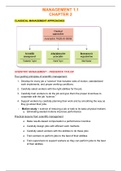
CLASSICAL MANAGEMENT APPROACHES
SCIENTIFIC MANAGEMENT – FREDERICK TAYLOR
Four guiding principles of scientific management:
1. Develop for every job a “science” that includes rules of motion, standardized
work implements, and proper working conditions.
2. Carefully select workers with the right abilities for the job.
3. Carefully train workers to do the job and give them the proper incentives to
cooperate with the job “science.”
4. Support workers by carefully planning their work and by smoothing the way as
they go about their jobs.
- Motion study = science of reducing a job or task to its basic physical motions
o Eliminating wasted motions improves performance
Practical lessons from scientific management
o Make results-based compensation a performance incentive
o Carefully design jobs with efficient work methods
o Carefully select workers with the abilities to do these jobs
o Train workers to perform jobs to the best of their abilities
o Train supervisors to support workers so they can perform jobs to the best
of their abilities
, MANAGEMENT 1.1
CHAPTER 2
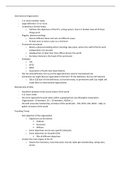
ADMINISTRATIVE PRINCIPLES – HENRI FAYOL
Rules/duties of management:
to fit diverse
to make sure
to lead, select, Coordinatio
efforts
Foresight Organization
to provide and Command
and evaluate together and Control
things happen
to complete a mobilize
workers to get
n
ensure
according to
plan of action resources to plan and to
the best work information is
for the future implement the take necessary
toward the shared and
plan corrective
plan problems
action
solved
• Administrative principles (Henri Fayol)
– Scalar chain
• there should be a clear and unbroken line of communication from
the top to the bottom of the organization
– Unity of command
• each person should receive orders from only one boss
– Unity of direction
• one person should be in charge of all activities with the same
performance objective
BUREAUCRATIC ORGANIZATION – MAX WEBER
Bureaucracy = an ideal, intentionally
rational, and very efficient form of
organization, based on principles of logic,
order, and legitimate authority
CHAPTER 2
CLASSICAL MANAGEMENT APPROACHES
SCIENTIFIC MANAGEMENT – FREDERICK TAYLOR
Four guiding principles of scientific management:
1. Develop for every job a “science” that includes rules of motion, standardized
work implements, and proper working conditions.
2. Carefully select workers with the right abilities for the job.
3. Carefully train workers to do the job and give them the proper incentives to
cooperate with the job “science.”
4. Support workers by carefully planning their work and by smoothing the way as
they go about their jobs.
- Motion study = science of reducing a job or task to its basic physical motions
o Eliminating wasted motions improves performance
Practical lessons from scientific management
o Make results-based compensation a performance incentive
o Carefully design jobs with efficient work methods
o Carefully select workers with the abilities to do these jobs
o Train workers to perform jobs to the best of their abilities
o Train supervisors to support workers so they can perform jobs to the best
of their abilities
, MANAGEMENT 1.1
CHAPTER 2
ADMINISTRATIVE PRINCIPLES – HENRI FAYOL
Rules/duties of management:
to fit diverse
to make sure
to lead, select, Coordinatio
efforts
Foresight Organization
to provide and Command
and evaluate together and Control
things happen
to complete a mobilize
workers to get
n
ensure
according to
plan of action resources to plan and to
the best work information is
for the future implement the take necessary
toward the shared and
plan corrective
plan problems
action
solved
• Administrative principles (Henri Fayol)
– Scalar chain
• there should be a clear and unbroken line of communication from
the top to the bottom of the organization
– Unity of command
• each person should receive orders from only one boss
– Unity of direction
• one person should be in charge of all activities with the same
performance objective
BUREAUCRATIC ORGANIZATION – MAX WEBER
Bureaucracy = an ideal, intentionally
rational, and very efficient form of
organization, based on principles of logic,
order, and legitimate authority