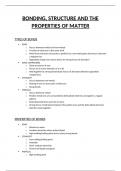
BONDING, STRUCTURE AND THE
PROPERTIES OF MATTER
TYPES OF BONDS
IONIC
o Occurs between metals and non-metals
o Transfer of electrons in the outer shell
o Metal loses electrons to become a positive ion, non-metal gains electrons to become
a negative ion
o Oppositely charge ions means there are strong forces of attraction
IONIC COMPOUNDS
o Giant structures of ions
o Forces act in every direction as it is 3D
o Held together by strong electrostatic forces of attraction between oppositely
charged ions
COVALENT
o Occurs between non-metals
o Sharing of one or more pairs of electrons
o Stong bonds
METALLIC
o Occurs between metals
o Positive metal ions are surrounded by delocalised electrons arranged in a regular
pattern
o Delocalised electrons are free to move
o Strong forces of attraction between the positive ions and the delocalised electrons
hold the metal together
PROPERTIES OF BONDS
IONIC
o Dissolve in water
o Conduct electricity when molten/liquid
o High melting/boiling point due to many strong bonds
COVALENT
o Low melting/boiling point
o Insoluble
o Don't conduct electricity
o Tend to be liquids and gases
METALLIC
o High melting point
PROPERTIES OF MATTER
TYPES OF BONDS
IONIC
o Occurs between metals and non-metals
o Transfer of electrons in the outer shell
o Metal loses electrons to become a positive ion, non-metal gains electrons to become
a negative ion
o Oppositely charge ions means there are strong forces of attraction
IONIC COMPOUNDS
o Giant structures of ions
o Forces act in every direction as it is 3D
o Held together by strong electrostatic forces of attraction between oppositely
charged ions
COVALENT
o Occurs between non-metals
o Sharing of one or more pairs of electrons
o Stong bonds
METALLIC
o Occurs between metals
o Positive metal ions are surrounded by delocalised electrons arranged in a regular
pattern
o Delocalised electrons are free to move
o Strong forces of attraction between the positive ions and the delocalised electrons
hold the metal together
PROPERTIES OF BONDS
IONIC
o Dissolve in water
o Conduct electricity when molten/liquid
o High melting/boiling point due to many strong bonds
COVALENT
o Low melting/boiling point
o Insoluble
o Don't conduct electricity
o Tend to be liquids and gases
METALLIC
o High melting point