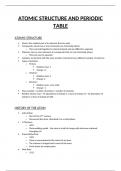
ATOMIC STRUCTURE AND PERIODIC
TABLE
ATOMIC STRUCTURE
Atoms: the smallest part of an element that can exist
Compounds: when two or more elements are chemically joined
o They are held together by chemical bonds and are difficult to separate
Mixtures: two or more elements or compounds that are not chemically joined
o They are easy to separate
Isotopes: an element with the same number of protons but a different number of neutrons
Types of particles
o Proton:
Relative mass: 1
Charge: +1
o Neutron:
Relative mass: 1
Charge: 0
o Electron:
Relative mass: very small
Charge: -1
Mass number = number of protons + number of neutrons
Relative atomic mass = (% abundance of isotope 1 x mass of isotope 1) + (% abundance of
isotope 2 x mass of isotope 2)/100
HISTORY OF THE ATOM
John Dalton
o Start of the 19th century
o Discovered the atom, described it as a solid sphere
JJ Thomson
o 1897
o Plum pudding model – the atom is a ball of charge with electrons scattered
throughout it
Ernest Rutherford
o 1909
o Mass is concentrated at the centre of an atom
o The nucleus is charged and is most of the mass
o Most atoms are empty space
Niels Bohr
o 1911
TABLE
ATOMIC STRUCTURE
Atoms: the smallest part of an element that can exist
Compounds: when two or more elements are chemically joined
o They are held together by chemical bonds and are difficult to separate
Mixtures: two or more elements or compounds that are not chemically joined
o They are easy to separate
Isotopes: an element with the same number of protons but a different number of neutrons
Types of particles
o Proton:
Relative mass: 1
Charge: +1
o Neutron:
Relative mass: 1
Charge: 0
o Electron:
Relative mass: very small
Charge: -1
Mass number = number of protons + number of neutrons
Relative atomic mass = (% abundance of isotope 1 x mass of isotope 1) + (% abundance of
isotope 2 x mass of isotope 2)/100
HISTORY OF THE ATOM
John Dalton
o Start of the 19th century
o Discovered the atom, described it as a solid sphere
JJ Thomson
o 1897
o Plum pudding model – the atom is a ball of charge with electrons scattered
throughout it
Ernest Rutherford
o 1909
o Mass is concentrated at the centre of an atom
o The nucleus is charged and is most of the mass
o Most atoms are empty space
Niels Bohr
o 1911