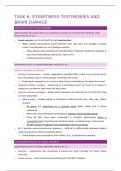
TASK 6: EYEWITNESS TESTIMONIES AND
BRAIN DAMAGE
HOW CAN YOU ELICIT FALSE MEMORIES
QUESTIONABLE RECOLLECTIONS OF A SHOOTING INCIDENT IN A VICTIM WITH FRONTAL LOBE
INJURY (JELICIC ET AL.)
Pseudo-memories can be elicited through misinformation
Study: healthy participants asked whether they had seen live footage of plane
crash in Amsterdam (no such footage existed)
o Many people were sensitive to misinformation implicitly implied by question &
said they remembered seeing the crash on TV
o Created pseudo-memory
NEUROPSYCHOLOGY & PSEUDE-MEMORIES (PETERS ET AL.)
MEMORY RESEARCH IN THE PAST
(Post-hoc) misinformation – subtle suggestions provided after event has occurred (post-
hoc) may distort way in which people remember the event
Participants exposed to an event & later receive misleading info about this event
Imagination-inflation paradigm – imagining an improbable event can lead to increase in
subjective confidence that event did take place
Semantic relatedness paradigms – participants exposed cues referring to a critical item that
is never presented
DRM paradigm – people asked to remember related words (e.g., bed, nap, pillow,
snooze)
o All words are associated to a common word (here: sleep) that is never
presented
o After each list presentation participants asked to recall studied words
o Once all lists have been presented & recalled, participants given a
recognition test comprising the studied words, unrelated lures, critical lures
o 65-80% falsely recognised non-presented critical lure words
All 3 provide source-monitoring problems – difficult to differentiate between details
really perceived & details fantasised about
Some people more susceptive than others (e.g., schizophrenic patients)
THE NEUROPSYCHOLOGY OF (FALSE) MEMORIES
NEUROPSYCHOLOGY & PSEUDE-MEMORIES (PETERS ET AL.)
Distortion – eyewitness may remember a yellow taxi, when actually the taxi’s colour
was blue
Pseudo-memory – when someone remembers sth that didn’t happen
, Memory is reconstructive – events are encoded in incomplete & fragmentised way
Retrieval – different fragments have to be combined to form an entity
Source monitoring – mechanism that serves as a screening & controlling device for
memory at retrieval
Cognitive process involved in determining source of memory information
Prefrontal cortex important
Limitations: executive function & pseudo-memory only have broad definitions
CASE BH
Background Two policemen find a confused man in red light district of Amsterdam
Man is unable to respond to questions & comments
Man is disoriented in time, place, person, finds himself in a state of
mutism
Initial CT scan – no neuroanatomical abnormalities detected
neurological Neurological examination shows no abnormalities BUT impairment on
evidence several neuropsychological test suggests brain damage
Main complaint – cannot remember anything from before incident
(anterograde amnesia)
Later Normal IQ & long-term verbal memory
neurological Poor performance on WM task, shows frontal dysfunctions, low scores
evidence for memory for famous events before incident, tendency to confabulate
when not knowing responses
Memory for new facts intact
SYMPTOMS INDICATE RIGHT PFC & RIGHT DLPFC DAMAGE
The end After suggestive interviews & hypnosis – BH believed he was Canadian
& worked as a CIA agent
BUT reality: he was born in Paris & has never been to Canada / USA
MEMORY RESEARCH IN THE PRESENT
Medial Switchboard, linking up different brain regions that are simultaneously
temporal activated during encoding of a specific event
lobe Want to recollect / retrieve specific event, certain structures in MTL
mobilise different regions in sensory & association cortex
PFC Involved in search strategies & evaluation of their results
Evaluates & monitors relevant information & inhibits irrelevant info (retrieval)
Decreased inhibitory control increased spreading activation in semantic
network increased probability to falsely remember non-presented
critical lure word
BRAIN DAMAGE
HOW CAN YOU ELICIT FALSE MEMORIES
QUESTIONABLE RECOLLECTIONS OF A SHOOTING INCIDENT IN A VICTIM WITH FRONTAL LOBE
INJURY (JELICIC ET AL.)
Pseudo-memories can be elicited through misinformation
Study: healthy participants asked whether they had seen live footage of plane
crash in Amsterdam (no such footage existed)
o Many people were sensitive to misinformation implicitly implied by question &
said they remembered seeing the crash on TV
o Created pseudo-memory
NEUROPSYCHOLOGY & PSEUDE-MEMORIES (PETERS ET AL.)
MEMORY RESEARCH IN THE PAST
(Post-hoc) misinformation – subtle suggestions provided after event has occurred (post-
hoc) may distort way in which people remember the event
Participants exposed to an event & later receive misleading info about this event
Imagination-inflation paradigm – imagining an improbable event can lead to increase in
subjective confidence that event did take place
Semantic relatedness paradigms – participants exposed cues referring to a critical item that
is never presented
DRM paradigm – people asked to remember related words (e.g., bed, nap, pillow,
snooze)
o All words are associated to a common word (here: sleep) that is never
presented
o After each list presentation participants asked to recall studied words
o Once all lists have been presented & recalled, participants given a
recognition test comprising the studied words, unrelated lures, critical lures
o 65-80% falsely recognised non-presented critical lure words
All 3 provide source-monitoring problems – difficult to differentiate between details
really perceived & details fantasised about
Some people more susceptive than others (e.g., schizophrenic patients)
THE NEUROPSYCHOLOGY OF (FALSE) MEMORIES
NEUROPSYCHOLOGY & PSEUDE-MEMORIES (PETERS ET AL.)
Distortion – eyewitness may remember a yellow taxi, when actually the taxi’s colour
was blue
Pseudo-memory – when someone remembers sth that didn’t happen
, Memory is reconstructive – events are encoded in incomplete & fragmentised way
Retrieval – different fragments have to be combined to form an entity
Source monitoring – mechanism that serves as a screening & controlling device for
memory at retrieval
Cognitive process involved in determining source of memory information
Prefrontal cortex important
Limitations: executive function & pseudo-memory only have broad definitions
CASE BH
Background Two policemen find a confused man in red light district of Amsterdam
Man is unable to respond to questions & comments
Man is disoriented in time, place, person, finds himself in a state of
mutism
Initial CT scan – no neuroanatomical abnormalities detected
neurological Neurological examination shows no abnormalities BUT impairment on
evidence several neuropsychological test suggests brain damage
Main complaint – cannot remember anything from before incident
(anterograde amnesia)
Later Normal IQ & long-term verbal memory
neurological Poor performance on WM task, shows frontal dysfunctions, low scores
evidence for memory for famous events before incident, tendency to confabulate
when not knowing responses
Memory for new facts intact
SYMPTOMS INDICATE RIGHT PFC & RIGHT DLPFC DAMAGE
The end After suggestive interviews & hypnosis – BH believed he was Canadian
& worked as a CIA agent
BUT reality: he was born in Paris & has never been to Canada / USA
MEMORY RESEARCH IN THE PRESENT
Medial Switchboard, linking up different brain regions that are simultaneously
temporal activated during encoding of a specific event
lobe Want to recollect / retrieve specific event, certain structures in MTL
mobilise different regions in sensory & association cortex
PFC Involved in search strategies & evaluation of their results
Evaluates & monitors relevant information & inhibits irrelevant info (retrieval)
Decreased inhibitory control increased spreading activation in semantic
network increased probability to falsely remember non-presented
critical lure word