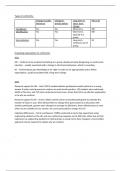
Types of conformity:
Change in public Change in Long-term or NSI or ISI
behaviour private beliefs short- term
change
Compliance Yes No Short-term NSI
Identification Yes Yes Short-term, NSI
typically in a
group
Internalisation Yes Yes Long-term, ISI
continues out of
group
Evaluating explanations for conformity:
AO1:
NSI – Conform to be accepted and belong to a group, despite privately disagreeing, to avoid social
rejection – usually associated with a change in short-term behaviour, which is rewarding
ISI – Conforming to gain knowledge or be ‘right’ in order to act appropriately and to follow
expectations, usually associated with a long-term change
AO3:
Research support for NSI – Asch (1951) studied whether participants would conform to a wrong
answer if under social pressure to conform to avoid social rejection, 123 students who conformed
36.8% of the time, and 75% who conformed at least once, shows than NSI is an effective explanation
as to why we conform
Research support for ISI – Jennes (1932) used 811 beans and asked participants to estimate the
number of beans in a jar, then allowed them to change their guess based on a discussion with
another participant, guesses were changed on average by 286 beans, shows effectiveness as even
when we are confident in our answer, we can be persuaded to change it by ISI
Individual differences – Perrin and Spencer (1980) conducted an Asch-style experiment using
engineering students in the UK, only one conforming response out of 400 trials, either due to their
experience as engineering students or historical bias as social norms have changed, a more holistic
approach may be required to explain why we conform
.
, Evaluating Asch as an explanation for conformity:
AO1:
- 123 male participants from the USA
- Line judgement task with one real participant in a room with six to eight participants
- Measured the amount of times a participant conformed in giving the obvious wrong answer – in
an unambiguous task – conformity was 36.8%, with 75% conforming at least once
- Interviewed afterwards and said they conformed to fit in (NSI)
AO3:
- Biased sample of only men from the US (ethnocentric towards individualistic culture,
collectivists may be more likely to conform), lacks population validity and beta bias
- Lacks ecological validity and therefore generalisability
- Research contradictions - Perrin and Spencer (1980) conducted an Asch-style experiment using
engineering students in the UK, only one conforming response out of 400 trials, either due to
their experience as engineering students or historical bias as social norms have changed, a more
holistic approach may be required to explain why we conform
Variations of Asch:
Conformity dropped to 5%-9%
Change in public Change in Long-term or NSI or ISI
behaviour private beliefs short- term
change
Compliance Yes No Short-term NSI
Identification Yes Yes Short-term, NSI
typically in a
group
Internalisation Yes Yes Long-term, ISI
continues out of
group
Evaluating explanations for conformity:
AO1:
NSI – Conform to be accepted and belong to a group, despite privately disagreeing, to avoid social
rejection – usually associated with a change in short-term behaviour, which is rewarding
ISI – Conforming to gain knowledge or be ‘right’ in order to act appropriately and to follow
expectations, usually associated with a long-term change
AO3:
Research support for NSI – Asch (1951) studied whether participants would conform to a wrong
answer if under social pressure to conform to avoid social rejection, 123 students who conformed
36.8% of the time, and 75% who conformed at least once, shows than NSI is an effective explanation
as to why we conform
Research support for ISI – Jennes (1932) used 811 beans and asked participants to estimate the
number of beans in a jar, then allowed them to change their guess based on a discussion with
another participant, guesses were changed on average by 286 beans, shows effectiveness as even
when we are confident in our answer, we can be persuaded to change it by ISI
Individual differences – Perrin and Spencer (1980) conducted an Asch-style experiment using
engineering students in the UK, only one conforming response out of 400 trials, either due to their
experience as engineering students or historical bias as social norms have changed, a more holistic
approach may be required to explain why we conform
.
, Evaluating Asch as an explanation for conformity:
AO1:
- 123 male participants from the USA
- Line judgement task with one real participant in a room with six to eight participants
- Measured the amount of times a participant conformed in giving the obvious wrong answer – in
an unambiguous task – conformity was 36.8%, with 75% conforming at least once
- Interviewed afterwards and said they conformed to fit in (NSI)
AO3:
- Biased sample of only men from the US (ethnocentric towards individualistic culture,
collectivists may be more likely to conform), lacks population validity and beta bias
- Lacks ecological validity and therefore generalisability
- Research contradictions - Perrin and Spencer (1980) conducted an Asch-style experiment using
engineering students in the UK, only one conforming response out of 400 trials, either due to
their experience as engineering students or historical bias as social norms have changed, a more
holistic approach may be required to explain why we conform
Variations of Asch:
Conformity dropped to 5%-9%