EMPIRICAL METHODS
IN FINANCE:
SUMMARY
@ECOsummaries
→ 20% discount
1
,Table of contents
Lecture 1________________________________________________page 3
Lecture 2________________________________________________page 4-6
Lecture 3________________________________________________page 7-11
Lecture 4________________________________________________page 12-13
Lecture 5________________________________________________page 14-17
Lecture 6________________________________________________page 18-20
Lecture 7________________________________________________page 21-23
Lecture 8________________________________________________page 24-25
2
, Lecture 1 – Introduction
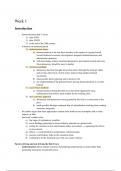
Financial econometrics:
Financial econometrics: application of statistical techniques to problems in finance
→ Testing theories, forecasting future values, determining relationship between financial
variables.
Steps for financial econometrics:
1. Have a clear question of interest.
2. Construct a model.
→ Mathematical equation that describes relation between x and y.
3. Find data for the variables necessary.
4. Turn model into an econometric model (specifying form of function)
→ y = α + βx + µ
Types of data:
1. Cross-sectional data:
- Data collected at a single point in time.
- Example: different CEO’s salary measured at one point in time, e.g., 2010.
2. Time series data:
- Data collected at many points in time.
- Example: weekly %-return of SP500 between 2000 and 2005
3. Panel data:
- Time series of a cross-sectional dataset (=multiple fixed points in time over time)
- Example: housing prices of different towns and their population respectively in US in
1980 and 1990.
Main difference time series and panel data:
- In time series data there is only one ‘i’ so for example only Mexico or only Germany.
- In panel data there are many ‘i’, so for example Mexico, Germany and Belgium.
3
IN FINANCE:
SUMMARY
@ECOsummaries
→ 20% discount
1
,Table of contents
Lecture 1________________________________________________page 3
Lecture 2________________________________________________page 4-6
Lecture 3________________________________________________page 7-11
Lecture 4________________________________________________page 12-13
Lecture 5________________________________________________page 14-17
Lecture 6________________________________________________page 18-20
Lecture 7________________________________________________page 21-23
Lecture 8________________________________________________page 24-25
2
, Lecture 1 – Introduction
Financial econometrics:
Financial econometrics: application of statistical techniques to problems in finance
→ Testing theories, forecasting future values, determining relationship between financial
variables.
Steps for financial econometrics:
1. Have a clear question of interest.
2. Construct a model.
→ Mathematical equation that describes relation between x and y.
3. Find data for the variables necessary.
4. Turn model into an econometric model (specifying form of function)
→ y = α + βx + µ
Types of data:
1. Cross-sectional data:
- Data collected at a single point in time.
- Example: different CEO’s salary measured at one point in time, e.g., 2010.
2. Time series data:
- Data collected at many points in time.
- Example: weekly %-return of SP500 between 2000 and 2005
3. Panel data:
- Time series of a cross-sectional dataset (=multiple fixed points in time over time)
- Example: housing prices of different towns and their population respectively in US in
1980 and 1990.
Main difference time series and panel data:
- In time series data there is only one ‘i’ so for example only Mexico or only Germany.
- In panel data there are many ‘i’, so for example Mexico, Germany and Belgium.
3