Samenvatting Digization & Big Data Analystics
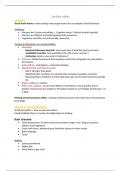
Lecture 1:
§The Foundations: computer and the internet
-Technological revolution has been around the development of four basic components:
1 Hardware: This is the physical device through which interaction occurs.
2 Communication: This is network used by the device.
3 Service: The softwares used to run the device and provide value to consumers.
4 Content: The transaction of data and information.
§The Foundations: Devices
-All computers work on the same principle as that of the analytical engine designed by
Charles Babbage in 1834
-The invention of transistors which shrank the size of compute
-Real breakthroughs came with the invention of the microprocessor in
1971 which was roughly the size of a stamp.
-This microprocessor has 2300 transistors and carried out 60,000 operations per second.
-A year later, 3,500 transistors that performed 300,000 operations per second.
-Moore’s law as a norm based on observation and stated ”the number of transistors in a
dense integrated circuit (IC) double about every two years”
§The Foundations: connection:
-Connecting multiple computers and sharing data started with the ARPANET: An inter-
university connection between UCLA and University of Utah.
-Other countries were working on their own networks such as:
• British: National Physics Lab (NPL)
• Hawaii: ALOHAnet
• Michigan: Merit network.
• France: CYCALDES, Tymnet and Telenet.
• Each of these networks used different network protocols.
-standardised data transmission system was developed called Transmission Control
Protocol/Internet Protocol (TCP/IP).
-2G network rolled out in 1991 and offered digital, encrypted signal and enabled sending
text messages SMS.
• 3G rolled out in 1998 enabled data transmission and access to the internet.
• 4G enabled faster speeds and access to the internet.
• 5G is expected to be a decisive step forward and offers 10X data transmission speeds, less
battery consumption by 90%.
-Computers became a staple at home after the development of the internet and the World
Wide Web (WWW).
-in 1989, Tim Berners-Lee invented a protocol that made publishing, searching and using
information easier.
§The Foundations: Content
,-Smartphones became the digital product marking the birth of the fourth technologies
revolution.
-Each smartphone could deploy multiple applications which created efficiencies and value.
-The operating system on each smartphone created a symbiotic relationship between users
and developer.
-Users provided their data and developer gained from access to data.
-The OS provider also benefited from the inflow of data which used for system optimization
and sold to advertisers.
§The inflexion point: Smartphones and sensors
-intelligent sensors are devices that have further aided the ushering of the technological
revolution.
-Intelligent sensors are a combination of sensor and a microprocessor.
It not only gathers information but uses its own computations to analyses and transmit data
when detecting specific changes.
-Sensors allow real time monitoring and help predict failures and improve optimization
The advent of 5G and rise in network capacity has spawned the development of Internet of
Things (IoT).
-IoT is a network of connections between physical objects equipped with sensors, which
allow data to flow between them. Objects
belonging to the network can digitally identify and communicate with other devices.
-It allows for the development of track-and-trace systems in logistics; in manufacturing, it
gives rise to smart factories.
§The breakthrough: data and algorithms
-All these technologies have created troves of data which are
increasing exponentially.
-Data volumes are doubling every three years.
-This has led to the coining of the term BIG DATA.
-The innate dimensions of big data are:
• Volume: Quantity of collected and stored data. Data size is in TB.
• Velocity: The transfer rate of data between source and destination.
• Variety: Different type of data like pictures, videos and audio arrives at the receiving
end.
• Veracity: Accurate analysis of captured data is virtually worthless if it’s not accurate.
• Value: It represents the business value to be derived from big data
§The breakthrough: Intelligent algorithms
-Volume of data is not enough, to derive value, one needs to do powerful analytics.
-This can be done through Intelligent Algorithms.
-Clever statistical models are employed to gain insights from data.
This is also called Machine learning.
-Machine Learning is of different types:
,• Supervised:
• Unsupervised:
• Reinforced:
-Supervised: Cleaned data is fed into the system and it learns.
-Unsupervised: Unclassified or dirty data is fed into the system and the program finds
patterns and learns.
-Reinforced: The algorithm tests various solutions according to a goal. This is also called
Artificial Intelligence.
-Fun fact: AlphaGo Zero is an AI that independently tested various solutions and beat all
humans by learning in 3 days.
Artificial Intelligence, the holy grail of computing, is expected to roll out in 4 waves (Kai Fu
(2018)).
• Internet AI:
• Business AI:
• Perceptive AI:
• Autonomous AI:
-Artificial Intelligence, the holy grail of computing, is expected to roll out in 4 waves (Kai Fu
(2018):
• Internet AI: . It consists of user-profiling recommendation algorithms that learn from the
masses of data about what a particular person does on the web.
• Business AI: . This AI brings together threads in historical data and discover hidden
correlations between data and events. This allows organisations to better optimise expenses
and enhance profitability. Commonly used in the banking and insurance sectors.
• Perceptive AI: This AI tries to merge the virtual world with the real world. Ubiquitous
sensors of the IoT will allow AI to gain senses, accelerating AI’s evolution. This kind of AI will
pave the way for smart factories, homes, and shops, as well as intelligent consumption.
• Autonomous AI: This AI be able to feel and respond to the real and virtual worlds
surrounding it, move and act productively, and optimize its own actions. For instance, drones
will be able to recognise and destroy weeds growing amongst crops. Alternatively, heat-
resistant drones will extinguish fires on their own.
§Digital transformations:
-Digital Transformation is defined as the comprehensive change in the functioning of
organisations (companies and public institutions), enabled by digital technologies and built
upon data and networks.
, Ruimte voor aantekeningen
Lecture 1:
§The Foundations: computer and the internet
-Technological revolution has been around the development of four basic components:
1 Hardware: This is the physical device through which interaction occurs.
2 Communication: This is network used by the device.
3 Service: The softwares used to run the device and provide value to consumers.
4 Content: The transaction of data and information.
§The Foundations: Devices
-All computers work on the same principle as that of the analytical engine designed by
Charles Babbage in 1834
-The invention of transistors which shrank the size of compute
-Real breakthroughs came with the invention of the microprocessor in
1971 which was roughly the size of a stamp.
-This microprocessor has 2300 transistors and carried out 60,000 operations per second.
-A year later, 3,500 transistors that performed 300,000 operations per second.
-Moore’s law as a norm based on observation and stated ”the number of transistors in a
dense integrated circuit (IC) double about every two years”
§The Foundations: connection:
-Connecting multiple computers and sharing data started with the ARPANET: An inter-
university connection between UCLA and University of Utah.
-Other countries were working on their own networks such as:
• British: National Physics Lab (NPL)
• Hawaii: ALOHAnet
• Michigan: Merit network.
• France: CYCALDES, Tymnet and Telenet.
• Each of these networks used different network protocols.
-standardised data transmission system was developed called Transmission Control
Protocol/Internet Protocol (TCP/IP).
-2G network rolled out in 1991 and offered digital, encrypted signal and enabled sending
text messages SMS.
• 3G rolled out in 1998 enabled data transmission and access to the internet.
• 4G enabled faster speeds and access to the internet.
• 5G is expected to be a decisive step forward and offers 10X data transmission speeds, less
battery consumption by 90%.
-Computers became a staple at home after the development of the internet and the World
Wide Web (WWW).
-in 1989, Tim Berners-Lee invented a protocol that made publishing, searching and using
information easier.
§The Foundations: Content
,-Smartphones became the digital product marking the birth of the fourth technologies
revolution.
-Each smartphone could deploy multiple applications which created efficiencies and value.
-The operating system on each smartphone created a symbiotic relationship between users
and developer.
-Users provided their data and developer gained from access to data.
-The OS provider also benefited from the inflow of data which used for system optimization
and sold to advertisers.
§The inflexion point: Smartphones and sensors
-intelligent sensors are devices that have further aided the ushering of the technological
revolution.
-Intelligent sensors are a combination of sensor and a microprocessor.
It not only gathers information but uses its own computations to analyses and transmit data
when detecting specific changes.
-Sensors allow real time monitoring and help predict failures and improve optimization
The advent of 5G and rise in network capacity has spawned the development of Internet of
Things (IoT).
-IoT is a network of connections between physical objects equipped with sensors, which
allow data to flow between them. Objects
belonging to the network can digitally identify and communicate with other devices.
-It allows for the development of track-and-trace systems in logistics; in manufacturing, it
gives rise to smart factories.
§The breakthrough: data and algorithms
-All these technologies have created troves of data which are
increasing exponentially.
-Data volumes are doubling every three years.
-This has led to the coining of the term BIG DATA.
-The innate dimensions of big data are:
• Volume: Quantity of collected and stored data. Data size is in TB.
• Velocity: The transfer rate of data between source and destination.
• Variety: Different type of data like pictures, videos and audio arrives at the receiving
end.
• Veracity: Accurate analysis of captured data is virtually worthless if it’s not accurate.
• Value: It represents the business value to be derived from big data
§The breakthrough: Intelligent algorithms
-Volume of data is not enough, to derive value, one needs to do powerful analytics.
-This can be done through Intelligent Algorithms.
-Clever statistical models are employed to gain insights from data.
This is also called Machine learning.
-Machine Learning is of different types:
,• Supervised:
• Unsupervised:
• Reinforced:
-Supervised: Cleaned data is fed into the system and it learns.
-Unsupervised: Unclassified or dirty data is fed into the system and the program finds
patterns and learns.
-Reinforced: The algorithm tests various solutions according to a goal. This is also called
Artificial Intelligence.
-Fun fact: AlphaGo Zero is an AI that independently tested various solutions and beat all
humans by learning in 3 days.
Artificial Intelligence, the holy grail of computing, is expected to roll out in 4 waves (Kai Fu
(2018)).
• Internet AI:
• Business AI:
• Perceptive AI:
• Autonomous AI:
-Artificial Intelligence, the holy grail of computing, is expected to roll out in 4 waves (Kai Fu
(2018):
• Internet AI: . It consists of user-profiling recommendation algorithms that learn from the
masses of data about what a particular person does on the web.
• Business AI: . This AI brings together threads in historical data and discover hidden
correlations between data and events. This allows organisations to better optimise expenses
and enhance profitability. Commonly used in the banking and insurance sectors.
• Perceptive AI: This AI tries to merge the virtual world with the real world. Ubiquitous
sensors of the IoT will allow AI to gain senses, accelerating AI’s evolution. This kind of AI will
pave the way for smart factories, homes, and shops, as well as intelligent consumption.
• Autonomous AI: This AI be able to feel and respond to the real and virtual worlds
surrounding it, move and act productively, and optimize its own actions. For instance, drones
will be able to recognise and destroy weeds growing amongst crops. Alternatively, heat-
resistant drones will extinguish fires on their own.
§Digital transformations:
-Digital Transformation is defined as the comprehensive change in the functioning of
organisations (companies and public institutions), enabled by digital technologies and built
upon data and networks.
, Ruimte voor aantekeningen