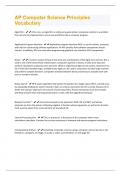
AP Computer Science Principles Vocabulary Exam | 182 Questions And Answers!!
Algorithm - At its core, an algorithm is really just a generalized, conceptual solution to a problem that can later be implemented in some real-world form like a computer program. Application Program Interface - Application program interface (API) is a set of routines, protocols, and tools for constructing software applications. An API specifies how software components should interact. In addition, APIs are used when programming graphical user interface (GUI) components. Binary - A numeric system of base 2 that only uses combinations of the digits zero and one; this is used in one of the lowest levels of abstraction. Computers operate in binary, as they store data and perform calculations using only zeros and ones. While a single binary digit can be used to represent True (1) or False (0) in boolean logic, multiple binary digits can be used in conjunction to store large numbers and perform complex functions. Computers translate between binary and what you actually work with such as numbers and text. Binary Search - A search algorithm that locates the position of a target value within a sorted array by repeatedly dividing the search interval in half; can only be used when the list is sorted. Because of its divide-and-conquer approach, the amount of work required to find an item grows much more slowly with Binary Search than with Sequential Search. In fact, with this logarithmic behavior Boolean Function* - Any function based on the operations AND, OR, and NOT, and whose elements are from the domain of Boolean algebra. A function whose arguments, as well as the function itself, assume values from a two-element set (usually {0,1}) Central Processing Unit - CPU, or processor, is the brains of the computer where most calculations take place. Contains the circuitry necessary to interpret and execute program instructions. Computational Artifact - Something created by a human using a computer and can be, but is not limited to, a program, an image, an audio, a video, a presentation, or web page fileCryptography - The science of coding and decoding messages in order to keep them secure. Coding takes place using a key that ideally is known only by the sender and intended recipient of the message. Floating Point Numbers - As the name implies, floating point numbers are numbers that contain floating decimal points. Examples include, the numbers 5.5, 0.001, and -2,345.6789. Numbers without decimal places are called integers. Computers recognize real numbers that contain fractions as floating point numbers. Hexadecimal - Hexadecimal describes a base-16 number system. That is, it describes a numbering system containing 16 sequential numbers as base units (including 0) before adding a new position for the next number. The hexadecimal numbers are 0-9 and then use the letters A-F. Used to represent digital data because it utilizes fewer digits than binary
Written for
- Institution
- AP Computer Science Principles Vocabulary
- Course
- AP Computer Science Principles Vocabulary
Document information
- Uploaded on
- October 14, 2023
- Number of pages
- 21
- Written in
- 2023/2024
- Type
- Exam (elaborations)
- Contains
- Questions & answers
Subjects
-
ap computer science principles vocabulary

Also available in package deal