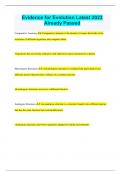
Evolution Questions and Answers (Complete and Certified)
Evolution Questions and Answers (Complete and Certified) Evolution(Macroevolution) Gradual change of organisms over very long periods of time. Types of Evolution- Coevolution, Convergent, and Divergent(Adaptive Radiation) Coevolution- change of 2 different species in close association to each other.(Predator/Prey) Convergent- 2 different organism have similar phenotypes because of the environment.(ex. Dolphin and Shark) Divergent(Adaptive Radiation)- 2 or more of the same species become dissimilar because of environment.(Darwins finches)(artificial selection in dogs) Station 1 (Types of Evolution) 1. A group of mice becomes separated by the formation of a river. Over time, the northern mice became smaller and whiter, while the southern mice became larger and browner. This is an example of: a. divergence b. analogous structures c. gigantification d. industrial melanism A. Divergence 2. Put these terms/examples into the correct area in the table below: (select and drag) same ancestory, different ancestory, different resources available in environment, similar environment, artificial selection, dolphin and shark, darwins finches, adaptive radiation, butterfly and bat, mustard seed plant evolving into broccoli- colliflower- or kale, predator changes in response to prey changing, flower tube becomes deeper and the beak of humming bird becomes longer. 1. Coevolution- Predator changes in response to prey changing, Flower tube becomes deeper and the beak of humming bird becomes longer. 2. Convergent- Different Ancestory, Dolphin and Shark, Butterfly and Bat, Similar Environment 3. Divergence- Similar Ancestory, Artificial Selection, Darwins Finches, Adaptive Radiation, Different Resources available in Environment, Mustard Seed plant evolving into broccoli- colliflower- or kale. Evidence to Support Evolution *Plate Tectonics( Pangea- splitting of the supercontinent) *Fossils *Comparative Anatomy *Comparative Embryology *Comparative Biochemistry *Dating of Fossils - By Superposition- where it is found in the soil- the deeper it is the older it is. - By Radioactive Decay- all living things contain C-14(half life of 5730 years)- can determine the age of a fossil by determining the half-life. *Comparative Anatomy - Homologous Structures(Divergent)- similar characteristics from common ancestors(may be used for different function) Ex. Bat Wing, Mouse Forelimb, Human Arm - Analogous Structures(Convergent)- similar in purpose, but inherited from separate ancestors. Ex. Bat Wing, Butterfly Wing, Bird Wing. - Vestigial Structures- inherited, but not used by organism. Ex. Whales, Snakes *Comparative Embryology - development of the embryo - zygote-> blastrula-> blastopore->digestive system - some type of gill slits-> lungs *Comparative Biochemistry(molecular) - changes in DNA - similarity of proteins in various organisms * the more similar the proteins are in different species, the more closely related the species are thought to be. * Hemoglobin in humans and in gorillas differs by only one amino acid. Station 2 (Evidence to Support Evolution) 1. A Neanderthal campsite is found with only 1/16 of the original amount of Carbon 14 present in the charcoal. The half-life for C-14 is 5,700 years. a) How old is the campsite? b) When was the fire last lit? 2. If the half life of the element thorium-230 is 75,000 years, how old is a fossil that contains only 1/32 of its original thorium-230? 3. If there was originally 100 g of thorium-230, how much
Written for
- Institution
- Evolution
- Course
- Evolution
Document information
- Uploaded on
- October 13, 2023
- Number of pages
- 20
- Written in
- 2023/2024
- Type
- Exam (elaborations)
- Contains
- Questions & answers
Subjects
-
evolution questions and answers complete and cert

Also available in package deal