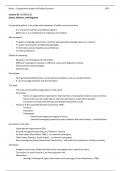
Notes – Comparative Analysis of Political Systems 2023
Lecture 01: 06/09/2023
States, Nations, and Regimes
Comparative politics is the study and comparison of politics across countries.
- It is a research method, according to Lijphart.
- Right now, it is a combination of substance and method.
Why compare?
- To gather knowledge about other countries (and gaining knowledge about our country).
- To create classifications and develop typologies.
- To formulate and test hypotheses and theories.
- To make predictions.
Pitfalls of comparing
- Requires a lot of background information.
- Different meanings of concepts in different cultural and linguistic contexts.
- Ethnocentrism and stereotypes.
- Selection bias.
Stereotypes
- Over-generalised belief about a certain group of people; used as a mental shortcut.
- It can encourage prejudice and discrimination.
The state
- The main unit of political organisation in the world.
- Distinction:
- States are legal political organisations that maintain a monopoly of violence over a territory.
- Governments are the leadership or elite that administers a state (time-specific).
- Countries encompass the territory and people living within a state.
- Features of the state (Montevideo Convention 1933):
- Territory
- Population
- Sovereignty
- Internal sovereignty (monopoly of force).
- External sovereignty (capacity to enter relations with other states) – United Nations.
Anomalies to the state
- Supranational organisations (EU)
- Partially recognised states (Kosovo, Palestine, Taiwan)
- De facto states (Somaliland, TRNC) – no external sovereignty
- Failed states (Somalia, South Sudan) – no internal sovereignty
- Non-sovereign territories (Greenland, Puerto Rico) – still under the constitution of other countries
The Nation
- Imagined community (Anderson) that claims sovereignty over a specific territory.
- The nation is a social construct, an intersubjective fact.
- Nationalism
- Ideology, claiming the right of the nation to be sovereign (French Revolution, 1789).
, Notes – Comparative Analysis of Political Systems 2023
- Goals: Eradicate internal (ethnic) differences to homogenise the nation and differentiate the
nation from others.
- Nation-state: the notion that each nation has (or should have) its state and vice versa.
- Nationhood is not the same as citizenship.
- Citizenship is legal, but not everyone in the Netherlands is part of the Dutch nation.
Nationalism and Ethnicity
- Ethnicity is also mostly a social construct, drawing on common descent and heritage.
- Various ethnicities can exist within states and across states.
- Does not necessarily translate into a quest for political sovereignty.
- Ethnicity can overlap with the nation or conflict with it.
- Nationalism often has an ethnic foundation – old ethnic identities are resilient and have not disappeared.
- Political leaders can invoke both ethnicity and nationalism to generate mobilisation and legitimacy.
- Yugoslavia showed that nationhood can change and even disappear.
Did the state create the nation, or was the nation the state?
- Depends on the case.
- Depends also on the foundation of the nation:
- Ethnicity
- Language
- Religion
- Ideals/ ideology
- This determines the extent to which nations are open: can you become a nation member?
- Nation-building: transforming a state into a nation-state.
Regimes
- Democratic regime
- Term with a strong positive connotation.
- One of the most contested concepts in political science.
- ‘Rule by the people’ (demos + kratein) – Strong element of political equality.
- Direct vs. representative democracy.
- Representative: Enables democracy on a large scale; people elect representatives on their
behalf – a distinction between rulers (elite) and the ruled (mass).
- Majoritarian vs. liberal democracy.
- Majoritarian: the majority of the people decide.
- Liberal: as many people as possible decide – freedom, rule of law, and protection of
minorities are more important than majority preference. Idea of Trias Politica. However,
liberal dem. is less democratic as majority preference is not decisive.
- Authoritarian regime/ Dictatorship
- Term with a negative connotation.
- Highly diverse residual category (non-democracy).
- Defining characteristics: no competition for power and limited freedoms.
- Military junta, dictatorship, monarchy, one-party state, theocracy
- Hybrid/ Illiberal regime
- In-between cases (mostly emerged after the Third Wave of democratisation).
- Totalitarian regime
- Attempt to transform society on an ideological basis – socialisation of citizens.
- Participation is encouraged or enforced mass mobilisation.
- The state controls all aspects of public and private life through a system of terror.
- Single mass party, often led by a charismatic dictator.
Lecture 01: 06/09/2023
States, Nations, and Regimes
Comparative politics is the study and comparison of politics across countries.
- It is a research method, according to Lijphart.
- Right now, it is a combination of substance and method.
Why compare?
- To gather knowledge about other countries (and gaining knowledge about our country).
- To create classifications and develop typologies.
- To formulate and test hypotheses and theories.
- To make predictions.
Pitfalls of comparing
- Requires a lot of background information.
- Different meanings of concepts in different cultural and linguistic contexts.
- Ethnocentrism and stereotypes.
- Selection bias.
Stereotypes
- Over-generalised belief about a certain group of people; used as a mental shortcut.
- It can encourage prejudice and discrimination.
The state
- The main unit of political organisation in the world.
- Distinction:
- States are legal political organisations that maintain a monopoly of violence over a territory.
- Governments are the leadership or elite that administers a state (time-specific).
- Countries encompass the territory and people living within a state.
- Features of the state (Montevideo Convention 1933):
- Territory
- Population
- Sovereignty
- Internal sovereignty (monopoly of force).
- External sovereignty (capacity to enter relations with other states) – United Nations.
Anomalies to the state
- Supranational organisations (EU)
- Partially recognised states (Kosovo, Palestine, Taiwan)
- De facto states (Somaliland, TRNC) – no external sovereignty
- Failed states (Somalia, South Sudan) – no internal sovereignty
- Non-sovereign territories (Greenland, Puerto Rico) – still under the constitution of other countries
The Nation
- Imagined community (Anderson) that claims sovereignty over a specific territory.
- The nation is a social construct, an intersubjective fact.
- Nationalism
- Ideology, claiming the right of the nation to be sovereign (French Revolution, 1789).
, Notes – Comparative Analysis of Political Systems 2023
- Goals: Eradicate internal (ethnic) differences to homogenise the nation and differentiate the
nation from others.
- Nation-state: the notion that each nation has (or should have) its state and vice versa.
- Nationhood is not the same as citizenship.
- Citizenship is legal, but not everyone in the Netherlands is part of the Dutch nation.
Nationalism and Ethnicity
- Ethnicity is also mostly a social construct, drawing on common descent and heritage.
- Various ethnicities can exist within states and across states.
- Does not necessarily translate into a quest for political sovereignty.
- Ethnicity can overlap with the nation or conflict with it.
- Nationalism often has an ethnic foundation – old ethnic identities are resilient and have not disappeared.
- Political leaders can invoke both ethnicity and nationalism to generate mobilisation and legitimacy.
- Yugoslavia showed that nationhood can change and even disappear.
Did the state create the nation, or was the nation the state?
- Depends on the case.
- Depends also on the foundation of the nation:
- Ethnicity
- Language
- Religion
- Ideals/ ideology
- This determines the extent to which nations are open: can you become a nation member?
- Nation-building: transforming a state into a nation-state.
Regimes
- Democratic regime
- Term with a strong positive connotation.
- One of the most contested concepts in political science.
- ‘Rule by the people’ (demos + kratein) – Strong element of political equality.
- Direct vs. representative democracy.
- Representative: Enables democracy on a large scale; people elect representatives on their
behalf – a distinction between rulers (elite) and the ruled (mass).
- Majoritarian vs. liberal democracy.
- Majoritarian: the majority of the people decide.
- Liberal: as many people as possible decide – freedom, rule of law, and protection of
minorities are more important than majority preference. Idea of Trias Politica. However,
liberal dem. is less democratic as majority preference is not decisive.
- Authoritarian regime/ Dictatorship
- Term with a negative connotation.
- Highly diverse residual category (non-democracy).
- Defining characteristics: no competition for power and limited freedoms.
- Military junta, dictatorship, monarchy, one-party state, theocracy
- Hybrid/ Illiberal regime
- In-between cases (mostly emerged after the Third Wave of democratisation).
- Totalitarian regime
- Attempt to transform society on an ideological basis – socialisation of citizens.
- Participation is encouraged or enforced mass mobilisation.
- The state controls all aspects of public and private life through a system of terror.
- Single mass party, often led by a charismatic dictator.