VATI - Fundamentals - Safety & Infection control
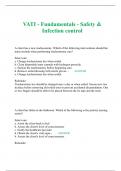
VATI - Fundamentals - Safety & Infection control A client has a new tracheostomy. Which of the following interventions should the nurse include when performing tracheostomy care? Select one: a. Change tracheostomy ties when soiled. b. Clean disposable inner cannula with hydrogen peroxide. c. Suction the tracheostomy before beginning care. d. Remove soiled dressing with sterile gloves. - ANSWER a. Change tracheostomy ties when soiled. Raitonale: Tracheostomy ties should be changed once a day or when soiled. Secure new ties in place before removing old soiled ones to prevent accidental decannulation. One or two fingers should be able to be placed between the tie tape and the neck. A client has fallen in the bathroom. Which of the following is the priority nursing action? Select one: a. Assist the client back to bed b. Assess the client's level of consciousness c. Notify the healthcare provider d. Obtain the client's vital signs - ANSWER b. Assess the client's level of consciousness Rationale: Safety first. Before proceeding with the assessment or taking vital signs assess the level of consciousness. Complaints of pain, any joint or bone deformity may provide evidence of fractures or dislocations. Inspection of the skin will determine lacerations, contusions, or hematomas that may need to be treated. After a report to the provider, additional x-rays or exams may be ordered. A nurse is providing discharge education for a female client diagnosed with Chlamydia. Which statement made by the client would indicate the need for further instruction? Select one: a. "I will return to the clinic in one month for re-screening." b. "Symptoms of reinfection may include yellow vaginal discharge." c. "Possible complications to monitor for include pelvic inflammatory disease." d. "I will refrain from sexual intercourse until completion of antibiotics." - ANSWER a. "I will return to the clinic in one month for re-screening." Rationale: No test for cure is required, but all women should be rescreened for re-infections 3 to 12 months after treatment because of high risk for pelvic inflammatory disease (PID). There is less evidence of the need for re-screening of treated men, but it should be considered. A nurse is caring for a client with a diagnosis of sepsis with a temperature of 40.8 C (105.5 F). The provider has ordered a cooling blanket. Which intervention is appropriate to delegate to an Unlicensed Assistive Personnel (UAP)? Select one: a. Bathe the client to keep the skin damp b. Obtain a fan for the client's use c. Assess the client's skin for any reddened d. Report shivering by the client - ANSWER d. Report shivering by the client Rationale: The unlicensed assistive personnel should be taught to observe for and report shivering during any form of external cooling. Shivering may indicate that the client is being cooled too quickly.
Written for
- Institution
- VATI - Fundamentals - Safety & Infection control
- Course
- VATI - Fundamentals - Safety & Infection control
Document information
- Uploaded on
- October 13, 2023
- Number of pages
- 17
- Written in
- 2023/2024
- Type
- Exam (elaborations)
- Contains
- Questions & answers
Subjects
-
vati fundamentals safety infection control
-
vati fundamentals safety infection contro
-
ati vati fundamentals safety infection contr

Also available in package deal