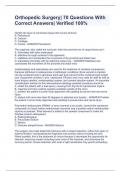
Orthopedic Surgery| 70 Questions With Correct Answers| Verified 100%
Identify the layer of connective tissue that covers all bone: A. Periosteum B. Calcium C. Cartilage D. Fascia - ANSWER Periosteum The scaphoid, also called the navicular, links the proximal row of carpal bones as it: A. Articulates with each metacarpal B. attaches its rough surfaces to the ligaments C. stabilizes and coordinates the movement of the proximal and distal rows. D. articulates proximally with its matching carpel row. - ANSWER Stabilizes and coordinates the movement of the proximal and distal rows. Vertebroplasty and kyphoplasty are used for the treatment of vertebral compression fractures attributes to osteoporosis or pathologic conditions. Bone cement is injected into the vertebral body to decrease back pain and prevent further vertebral body height loss. Equipment includes C-arm, radiolucent OR bed, and x-ray vests for staff as well as bone biopsy needles, vertebroplasty system, and cement injection system. An important consideration relevant to this interventional radiology-assisted procedure would be: A. shield the patient with a lead apron, covering from thyroid to reproductive organs. B. organize and have casting supplies available outside of the room. C. position the patient in prone body alignment with padding to prevent skin and nerve injury. D. abduct both arms less than 90 degrees on attached arm boards. - ANSWER Position the patient in prone body alignment with padding to prevent skin and nerve injury. Polymethyl methacrylate (PMMA, or bone cement) is an acrylic, cement-like substance composed of a liquid methyl methacrylate monomer and a powder methyl methacrylate-styrene co-polymer. What element is added to the powder component to make the finished product radiopaque? A. Radiografinpaque B. Polucrylate Sodium C. Barium D. Granular allograft bone - ANSWER Barium The surgeon may treat distal limb fractures with a closed reduction, rather than open or external fixation, manipulating the fragments into position without incising the skin. When possible, this is the treatment of choice because it decreases the opportunity for infection, improves results (including bone union of the fracture), and minimizes the recovery period. Closed reduction with local or light anesthesia may permit ambulatory surgery. Select a situation where closed reduction would be performed in addition to open reduction and fixation surgery to a distal limb. A. Significant bone comminution B. Where periosteal damage is evident C. Before an open procedure to reduce the fracture site. D. When soft tissue entrapment is suspected. - ANSWER When soft tissue entrapment is suspected Osteomalacia is a metabolic bone disease characterized by inadequate mineralization of bone, which leads to reduced absorption of calcium and phosphorus. This malabsorption condition is due to a deficiency of _____ that can be treated by _______. A. calcium; nutritional diet and supplements. B. vitamin D; dietary supplements and exposure to sunlight C. phosphorus; nutraceuticals and exposure to therapeutic radiation D. soy protein; weight-bearing exercise and sunlight - ANSWER Vitamin D; dietary supplements and exposure to sunlight Open reduction and internal fixation (ORIF) is a method of providing exposure of the fracture site and using pins, wire screws, a plate and screw combination, rods, or nails to correct the fracture. Surgeons use open reduction and internal fixation when they are unable to reduce a fracture by closed methods and skeletal traction is not indicated. What would be an advantage for an open rather than closed fracture reduction technique? A. Direct observation and verification of fracture alignment B. Decreased opportunity for surgical site infection C. Improved bone union outcomes D. Ability to rule out comminuted or compound fractures without imaging. - ANSWER Direct observation and verification of fracture alignment Paget's disease is a disorder affecting older adults. The bones are weak and poorly constructed. It is characterized by the proliferation of osteoclasts and compensatory increased osteoblastic activity. This degenerative process results in: A. weak and non-supported bone matrix. B. replacement of cancellous bone with cortical bone. C. rapid, disorganized bone remodeling. D. immature bone cells with air spaces. - ANSWER Rapid, disorganized bone remodeling Osteoporosis is one of the most common and serious bone diseases and is responsible for more than 2 million fractures a year. Osteoporosis -related fractures most commonly occur in the hip, spine, and wrist, but any bone can be affected. The excessive reduction of total bone mass in osteoporosis is due to the loss of: A. calcified matrix and collagenous fibers. B. exercise and weight-bearing physical activity. C. estrogen and testosterone D. calcium and Vitamin D. - ANSWER Calcified matrix and collagenous fibers The vertebral bodies are connected by several cartilaginous joints. What purpose does this connection enable? A. Communication between the spinous process and vertebral bodies B. Vertebral flexion, rotation, and extension C. Vertebral flexion and torsion D. Sustains integrity and spinal support. - ANSWER Vertebral flexion and torsion Colles' (wrist) fracture is a dorsally angulated fracture of the distal end of the radius. Most of these fractures can be managed successfully with closed reduction and immobilization, but external fixation is especially useful in the case of comminuted intra-articular fracture. Internal fixation with Kirschner wires (K wires) is indicated when the distal end of the radius is severely comminuted and displaced. Select the correct statement for a patient with Colles' fracture fixation. A. Position in modified semi-fowler with the hand table and tourniquet at the operative side. B. Provide soft tissue instruments in OR and casting supplies available outside OR. C. Place and tourniquet cuff at mid forearm level and set to systolic blood pressure level. D. Position affected wrist and take an AP lateral film before surgeon's arrival. - ANSWER Provide soft tissue instruments in OR and casting supplies available outside OR. While not as prevalent as arthroplasty of the shoulder, knee, or hip, total elbow replacement is indicated for patients with traumatic lesions or excessive bone loss from rheumatic or degenerative arthritis, resulting in elbow instability and pain or bilateral elbow ankylosis. The prosthesis may be used with or without PMMA, depending on the quality of the diseased bone and the design of the implant. If PMMA is not used, what replacement product, element, or substance is used? A. Synthetic bone putty B. Autologous bone graft C. Hemostatic gel sponge with thrombin D. Sid Orthopedic Surgery| 70 Questions With Correct Answers| Verified 100%
Written for
- Institution
- Orthopedic Surgery|
- Course
- Orthopedic Surgery|
Document information
- Uploaded on
- October 13, 2023
- Number of pages
- 10
- Written in
- 2023/2024
- Type
- Exam (elaborations)
- Contains
- Questions & answers
Subjects
-
orthopedic surgery 70 questions
-
orthopedic surgery questions stuvia
-
identify the layer of connective tissue that cover
-
the scaphoid also called the navicular links the

Also available in package deal