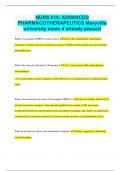
NURS 615: ADVANCED PHARMACOTHERAPEUTICS Maryville university exam 4 already passed
NURS 615: ADVANCED PHARMACOTHERAPEUTICS Maryville university exam 4 already passed What is Tiotropium (SPIRIVA) used to treat? Used in the management/ maintenance treatment of chronic obstructive pulmonary disease (COPD) which includes chronic bronchitis and emphysema. What is the drug classification of Tiotropium? >It is a long-acting, 24H anticholinergic-bronchodilator. >It is a muscurinic receptor antagonist, often referred to as an antimuscurinic or anticholinergic agent. What is the mechanism of action of Tiotropium (SPIRIVA) It does not display selectivity for specific muscarinic receptors, when topically applied it acts mainly on M3 muscarinic receptors[8] located on smooth muscle cells and submucosal glands. This leads to a reduction in smooth muscle contraction and mucus secretion and thus produces a bronchodilatory effect. What are the adverse effects with montelukast (Singular) Anxiety, aggression, depression, suicidal thoughts, What patient teaching should accompany the prescription of montelukast (Singulair)? Teach pt regarding adverse effect about aggression , depression suicidal thoughts that could occur What patient teaching should be provided when prescribing inhaled corticosteroids? They should be taken 2x a day every day for the use of prevention of asthma. Rinse mouth after use to prevent oral thrush. What ethnic background should not be prescribed long-acting beta agonists? African Americans, increased incidence of death in this population What medication would you prescribe for bronchospasm for a patient taking propranolol? Ipratropium What is the mechanism of action of albuterol? Activation of beta adrenergic receptors lead to relaxation of the muscle of the lung and opening and dilation of the airway Beta adrenergic receptor are coupled with stimulatory g-protein of the the d-anelyl cyclase> This enzyme produces the second messennger cyclic AMP (in the lungs it cAMP decreases calcium concentration w/in cells and and activates protein kinase A. Both of these inactivates myosin activase kinase and myosin like phosphatase They open large conductants of hyperpolarize airway smooth muscle cells What is the mechanism of action of inhaled corticosteroids? Extremely potent vasoconstrictive and anti-inflammatory activity. When is it appropriate to use a short acting beta agonist? the drug of choice for acute treatment of asthma symptoms and exacerbations. Relief of acute asthma attack. LABA not used for acute rather used for long term treatment and prevention of asthma True What is the mechanism of action of inhaled muscarinic receptor antagonists? Atropine (the prototype of muscarinic receptor antagonists) prevents the effects of ACh by competitively blocking its binding to muscarinic receptors in the CNS, peripheral ganglia, and at neuroeffector sites on smooth muscle, cardiac muscle, and secretory glands. What are side effects of atropine in patients with airway disease. Atropine inhibits secretions of the nose, mouth, pharynx, and bronchi and thus causes dryness of the mucous membranes of the respiratory tract. This action is especially marked if secretion is excessive and is the basis for the use of atropine and scopolamine in preanesthetic medication. It causes depression of mucous secretion and the inhibition of mucociliary clearance. What are the adverse effects associated with inhaled corticosteroids? Cough, Thrush, dysphonia, cough and bronchospasm, thin skin, bone loss, smell of burning plastic, HA, visual changes What special populations should not be prescribed pseudoephedrine? Not to be used in children under four years of age, elderly, and patients with HTN. What drug should be prescribed for a patient with nasal congestion with hypertension? Coricidin HBP, chlorpheneramine What are the adverse effects of antihistamines? Dry mouth, changes in vision, increased heart rate Urinary retention, constipation, increased HR, pupil dilation, hallucination delirium Motor impairment (ataxia) flushed skin, cyclopesia, sedation diff. conc. Visual disturbances What conditions should cause a patient to avoid the use of antihistamines Patients over 60 or under 6 years of age; elderly, Men with BPH Patients over 60 or under 6 year old that could not be given antihistamines should be treated with what kind of antihistamines They should be treated with second generation antihistamines like: fexophenydine, loratidine, What is the mechanism of action of codeine in the suppression of cough? Works on the cough center of the brain in the medulla oblongata. Which medications are considered antitussives? Dextromethorphan; Codeine; Benzonatate; ( examples include: Scot-Tussen DM; Hold DM; Robitussion; Vicks; Delsym; and generic) 7. How are upper respiratory infections treated? URIs are mostly treated for relief of symptoms. Some people benefit from the use of cough suppressants, expectorants, vitamin C, and zinc to reduce symptoms or shorten the duration. What patient education should be provided to the patient taking antacids? May cause constipation or diarrhea. What is the action of loperamide? Opiod receptor agonist Slows gastric motility and diminishes the loss of fluid and electrolytes. What are the adverse effects of bismuth subsalicylate? It can cause rebound constipation; gray/black stools and black tongue What special population should not be administered bismuth subsalicylate? Children and adolescents should not be administered this during or after recovery from chickenpox or flu-like illness. Also, not for anyone with aspirin hypersensitivity. Cats When should bismuth subsalicylate be administered? It is indicated in the use of Traveler's Diarrhea due to its antibacterial and antisecretory properties. Used for H-pylori treatment to reduce risk of duodenal ulcer occurence. Before each meal and at bedtime for up to 4 times a day for up to 3 weeks. It should be administered after each loose stool up to the maximum daily dose. What lab values should be monitored with long-term administration of proton pump inhibitors? LFTs; H&H; Vit B12; Ca++; bone-density monitoring for pts with osteoporosis. Assess for B12 deficiency and calcium deficiency. What happens when there is Low levels of Magnesium in the body? Dec. absorption of Calcium causing hip fractures. What is the patient at risk for when taking long term proton pump inhibitors The patient is at risk for developing megablastic anemia. The patient is also at risk for developing hip fractures and osteoporosis. Why is osteoporosis a risk when taking omeprazole? Inhibiting stomach acid, PPIs speed up bone mineral loss. Bone fractures due to lose of calcium. What is the most rapid acting laxative and why? Stimulants (disacodyl) pr due to the direct action on intestinal mucosa by stimulating the mesenteric plexus. Facilitate the release of prostaglandins and increase cAMP concentration, thus increase electrolyte concentration and stimulates peristalsis. (pg. 534) Rectal admin of Bisacodyl laxative is the most rapid action. How does metoclopramide improve GERD? It increases tone and amplitude of gastric contractions & relaxes the pyloric sphincter & duodenal bulb, & increases peristalsis of the duodenum and jejunum resulting in accelerated gastric emptying and increase speed of gastric transit. Works on the dopamine receptors. What is the Step Down Approach with GERD? Start with lifestyle modifications and PPI for 8 weeks. If symptom free for 4 weeks, step down to H2RA. If symptoms not relieved, increase PPI to BID for 4-8 weeks. If symptom free for 4 weeks, step down to daily PPI and reassess in 6-12 mos. If symptoms not relieved refer patient out for an endoscopy. Goal: stepdown to lowest PPI to transition to an H2 blocker What is the Step Up Approach with GERD? antacids, lifestyle & OTC antacids H2 RAs and -PPI (if no erosive disease present) 4-8 weeks if better- back to H2, if worse continue if not better- refer out What is the first line therapy for peptic ulcer disease with a positive H. pylorus PPI 2x daily, amoxicillin 1g 2x daily, and clarithromycin 500mg 2x daily for 7 to 14 days. Triple line therapy and continue PPI for 8 to 12 weeks until healing is completed. What is the Second line therapy for those you fail initial treatment of peptic ulcer disease with H. Pylori PPI 2x daily, metronidazole, tetracycline, and bismuth salicylate for 14 days. Quadruple therapy. How will you treat nausea and vomiting? First-line therapy is vitamin B6 and Unisom, especially in pregnant women. Ginger is helpful. Zofran, especially in children How will you treat constipation in children? Miralax is first line treatment 15. What are the disadvantages of using stimulant laxatives for prolonged periods of time? Long-term use of stimulant laxatives can lead to dependence & loss of colon function (cathartic colon). What is the mechanism of action of the phenothiazine antiemetics? Chlorpomazine: Antagonize dopamine D2 receptor in various pathways in the central nervous system. The D2 dopamine blockade results in antipsychotic, antiemetic and other effects. Hypoprolactenemia as a sideffect of dopamine antagonist as blockade of D2 recepotor in the brain results increase plasma levels of prolactin due to increase secretion of lactotropes in the anterior pituitary. What are the side effects of docussate sodium? abdominal cramps, diarrhea. Long-term use can cause loss of bowel function. What is the mechanism of action of docusate sodium? Allows more water to be absorbed by the feces. They reduce the surface tension of the oil-water interface on the stool and facilitate admixture of fat and water into the stool, producing and emollient action. What is the mechanism of action of proton pump inhibitors? The PPI binds irreversibly to a hydrogen/potassium ATPase enzyme (proton pump) on gastric parietal cells and blocks the secretion of hydrogen ions, which combine with chloride ions in the stomach lumen to form gastric acid. They reduce gastric acid levels by more than 90% and frequently produce hypochlorydria. Serum gastrin levels increase parallel with inhibition of the acid secretion. The decrease in acid reduction lasts for up to 72 hours after each dose. What happens when there is reduced gastric acid levels by more than 90% on patients taking proton pump inhibitor? It frequently produces hypochlorydria. What is the mechanism of action of ondansetron? It is a 5-HT3 receptor antagonist and blocks serotonin both peripherally on vagal nerve terminals and centrally in the CTZ (chemoreceptor trigger zone). What are the contraindications to the use of misoprostol? Must be used cautiously in patients with renal compromise; Pregnancy Category X; most likely should not be given to nursing mothers; and no one under 18 years of age. How will you choose a diuretic in the treatment of hypertension? Check BUN and creatinine First check the level of kidney function, thiazide diuretics need GFR higher than mid-forties range. What is the mechanism of action of the Loop diuretic? It inhibits sodium reabsorption in the ascending loop of Henle. They are short-acting and cause a large natriuresis. Sodium stays with the water in the tubule and both are voided.Loop diuretics. Can cause potassium excretion. What is the mechanism of action of Thiazide-type-diuretics? It acts on the distal renal tubule to inhibit sodium reabsorption, their effect is usually longer lasting and with less brisk diuresis. They decrease preload thereby decreasing blood pressure. Can cause potassium excretion. What is the mechanism of action of Carbonic anhydrase inhibitors? It inhibit the enzyme carbonic anhydrase found in the proximal convoluted tubule. This results in several effects including bicarbonate accumulation in the urine and decreased sodium absorption. What is the mechanism of action of Potassium-sparing diuretics ? They are competitive antagonists that either compete with aldosterone for intracellular cytoplasmic receptor sites, or directly block sodium channels (specifically epithelial sodium channels (ENaC) by amiloride). [Epithelial sodium channel blockers: is a sodium channel blocker that is selective for the epithelial sodium channel.] The former prevents the production of proteins that are normally synthesized in reaction to aldosterone (example is Spironolactone). These mediator proteins are not produced, and so stimulation of sodium-potassium exchange sites in the collection tubule does not occur. This prevents sodium re-absorption and potassium and hydrogen ion secretion. What is the mechanism of action of Calcium sparing diuretic? It reduces the amount of calcium excreted into the urine and can increase the serum calcium levels, which may be beneficial in patients with hypocalcemia. Loop diuretics promote calcium excretion whereas thiazide diuretics do not. What is the mechanism of action of Osmotic diuretics? (mannitol and isosorbide) An osmotic diuretic is a type of diuretic that inhibits reabsorption of water and sodium (Na). They are pharmacologically inert substances that are given intravenously. They increase the osmolarity of blood and renal filtrate. In the nephron, osmotic diuretics act at the portions of the nephron that are water-permeable. Osmotic diuretics works by expanding extracellular fluid and plasma volume, therefore increasing blood flow to the kidney. This washes out the cortical medullary gradient in the kidney. This stops the loop of Henle from concentrating urine, which usually uses the high osmotic and solute gradient to transport solutes and water
Written for
- Institution
- NURS 615: ADVANCED PHARMACOTHERAPEUTICS Maryville
- Course
- NURS 615: ADVANCED PHARMACOTHERAPEUTICS Maryville
Document information
- Uploaded on
- October 12, 2023
- Number of pages
- 13
- Written in
- 2023/2024
- Type
- Exam (elaborations)
- Contains
- Questions & answers
Subjects
-
nurs 615 advanced pharmacotherapeutics maryville

Also available in package deal