100% satisfaction guarantee Immediately available after payment Both online and in PDF No strings attached 4.2 TrustPilot
logo-home
Exam (elaborations)

NSG 527 final exam |51 questions and answers

Rating
-
Sold
2
Pages
8
Grade
A+
Uploaded on
10-10-2023
Written in
2023/2024

Family Unit Success or failure of individuals in society is dependent upon stability of the: The two purposes of the family are: 1. Meeting the needs of society 2. Meeting the needs of the individuals in the family Healthy families exhibit the following characteristics: (Beaver and Hampton) Effective skills for negotiating problems Are clear, open and spontaneous in expressing emotions and decisions Respect the feelings of others Encourage others to be independent Hold others personally accountable for their actions Display warmth and closeness toward each other Stage 1 of Health/Illness and Family Interaction Family Efforts at Health Promotion-Many lifestyles that affect health are learned in the family. Tobacco use is an example of this. Health promotion, prevention, and risk reduction are impacted by families. Three causal relationships that can alter family health status include marriage parenthood social support systems Stage 2 of Health/Illness and Family Interaction Family Appraisal of Symptoms-This stage begins when a family member has symptoms Stage 3 of Health/Illness and Family Interaction Care Seeking-A decision is made to seek medical care. Family members are consulted as needed for advice and recommendations, which may include on home remedies and self-medication Stage 4 of Health/Illness and Family Interaction Referral and Obtaining Care-Contact with a health care provider is initiated. This can be based upon the severity of the patient's condition, family's culture, health beliefs, availability, and accessibility. Stage 5 of Health/Illness and Family Interaction Acute Response to Illness by Client and Family-The patient takes on the "sick role" and adaptation in this role begins with the patient and family. Stage 6 of Health/Illness and Family Interaction adaptation to Illness and Recovery- Support of the patient by the family unit begins for convalescing and rehabilitating. Coping and adaptation about the illness begins at this stage. Family as Context The patient is an individual with family members who are usually the primary resource for them. The individual is the primary receiver and the family is secondary for assessment and intervention of care. Family as Sum of its Members The family is a sum of all family members. Family healthcare is operational when all members of the family receive care. Family Subsystems as Client The subsystem of a family can be defined as a dyad or triad and be comprised of a married couple, parent-child, and sibling-sibling, for example. They are the recipients of care. Family as Client The entire family is in the foreground. Dynamics of the family, subsystems, and relationships with external sources are the focus. Family as a Component of Society The family is a subsystem of society. Families are considered an institution of society equating to religion and educational institutions for example. Primary Prevention Prevent the occurrence of disease. Health promotion and disease prevention Teach families to take responsibility for health and attain health goals by enjoying a healthy lifestyle Secondary Prevention After the disease occurrence Early detection, diagnosis, treatment of signs and symptoms Conduct screening assessments Health teaching Tertiary Prevention Recovery and rehabilitation Maximize the level of functioning Provide support to families in the rehabilitation process Nightingale's Environmental Model Did not present a theory of nursing or family nursing Emphasized the presence of environmental factors in health and wellness Nurses care for the whole family unit in the home environment King's Theory of Goal Attainment included family-as-context Collaboratively the nurse and family members identify complete assessment to determine goals and a plan of care The family unit provides socialization and establishes norms of behavior across the life cycle. Roy's Adaptation Model Family is a unit of analysis, in the same context as the individual The family unit is adaptive and interacts with the external environment and internal and external stimuli Neumann's Health System's Model The client is an open system where family is defined. Family is comprised of subsystems with relationships among the family members The ability to maintain wellness when exposed to stressors occurs through a series of exchanges in the open system of the model Appropriate model for community-based health care Orem's Self-Care Model The family unit needs to sustain self-care Nursing works with individuals to achieve self-care in the family unit; the family unit is not the direct receiver of the health care services. Self-care of the family can incorporate health beliefs of the family Rogers's Science of Unitary Human Beings A family has energy fields that respond to the environment similar to individuals. Families have stages of development and progress in one direction Permeability of boundaries determines the degree of responsiveness required from environmental input Newman's Expanding Consciousness Model Expansion of consciousness defines health Individuals move unidirectionally to expand consciousness and allow this inside and outside of the family unit; can incorporate the family with community energy fields As the individual of a family moves towards consciousness, he/she can explain the internal dynamics of the family. Structural-Functional Theory Family as a social system Identifies how the family interacts with other institutions of society Identifies how family members interact with each other in family relationships and support each other effectively to perform their functions discipline of Sociology Systems Theory The family as a set of interacting elements distinguishable from the environment it interacts. Views family in context of suprasystems and subsystems Grand theory Family Developmental Theory Explains the developmental changes of family members through the years Provides the ability to make predictions of family needs according the life cycle Emphasis is on the traditional nuclear family Family Interactional Theory Family members assign meaning to events in their world; this is impacted by the relevancy of the situation The focus on internal dynamics of families Family Stress Theory Illness causing stress that changes family dynamics Resources in the family for dealing with the stressor(s) Implications/reality of the event on families and how they will adapt Change Theory The effect of change on the family unit and health behavior Strong family support is predictive of success with new health behaviors Interactional/Communication Family Therapy Therapy consists of communication skills and the intent of messages sent and received; how communication effects behavior Attention is on patterns of communication in the family unit Structural Family Therapy Family interactions are altered by change in the structure of the family as facilitated by therapy Family Systems Therapy The self is differentiated; intellect and emotion are fostered in the individual unit of each family Can develop a family genogram from discussion on family tree with therapist Intellect leads over emotion Family Career or Life Cycle (Family development theory (2-Parent Nuclear) Transitional Stage: Between Families Stage I: Beginning Families Stage II: Childbearing Families Stage III: Families with Preschool Children Stage IV: Families with School Age Children Stage V: Families with Teenagers Stage VI: Families Launching Young Adults Stage VII: Middle-Age Parents Stage VIII: Family in Retirement and Old Age Other circumstances: divorced, stepparent, domestic The most stressful life events are: (FILE) family losses marital strains family legal violations illness and family caregiver strains intrafamily strains Phases of the Resiliency Model of Family Stress, Adjustment, and Adaptation 1. Adjustment 2.Adaptation The Resiliency Model of Family Stress, Adjustment, and Adaptation is based on 4 assumptions It is normal for families to face hardships and make changes to adapt. Families develop strengths to protect members from major disruptions. Families develop coping mechanisms and defense strategies with change. Families benefit and contribute to communities at times of stress and crisis. Interacting variables in Hill's Family Stress Theory A: Event and related hardships B: Crises in meeting the hardshipsC: How the family defines the eventX: The crises or noncrisis2.The adjustment phase post-crisisDisorganizations, recovery, reorganization Hill's Family Stress Theory (ABCX Model) Focus is on the precrisis stage Landmark family stress theory Developed by Hill and named the ABCX Model A, B, C, X are variables that interact and lead to family crisis or noncrisis Antistress Period Occurs prior to confronting the stressor; anticipation; if the stressor is identified early coping strategies can be identified to lessen the impact. Actual Stress Period Increased energy required by family members to cope with stressor(s); basic survival methods can be used at this time which may include intrafamilial and spiritual resources. Poststress Period Focus is on attaining homeostasis of the family unit; families are challenged at this time and can regress in dynamics; families need to focus intensely on affective function at this time. The three phases of stress include Antistress Period Actual Stress Period Poststress Period

Show more Read less


Whoops! We can’t load your doc right now. Try again or contact support.

Document information

Uploaded on
October 10, 2023
Number of pages
8
Written in
2023/2024
Type
Exam (elaborations)
Contains
Questions & answers

Content preview

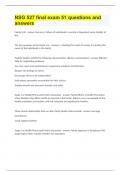
NSG 527 final exam 51 questions and answers
Family Unit - answer Success or failure of individuals in society is dependent upon stability of the:
The two purposes of the family are: - answer 1. Meeting the needs of society 2. Meeting the needs of the individuals in the family
Healthy families exhibit the following characteristics: (Beaver and Hampton) - answer Effective skills for negotiating problems
Are clear, open and spontaneous in expressing emotions and decisions
Respect the feelings of others
Encourage others to be independent
Hold others personally accountable for their actions
Display warmth and closeness toward each other
Stage 1 of Health/Illness and Family Interaction - answer Family Efforts at Health Promotion-
Many lifestyles that affect health are learned in the family. Tobacco use is an example of this. Health promotion, prevention, and risk reduction are impacted by families.
Three causal relationships that can alter family health status include - answer marriage
parenthood
social support systems
Stage 2 of Health/Illness and Family Interaction - answer Family Appraisal of Symptoms-This stage begins when a family member has symptoms Stage 3 of Health/Illness and Family Interaction - answer Care Seeking-A decision is made to seek medical care. Family members are consulted as needed for advice and recommendations, which may include on home remedies and self-medication
Stage 4 of Health/Illness and Family Interaction - answer Referral and Obtaining Care-Contact with a health care provider is initiated. This can be based upon the severity of the patient's condition, family's culture, health beliefs, availability, and accessibility.
Stage 5 of Health/Illness and Family Interaction - answer Acute Response to Illness by Client and
Family-The patient takes on the "sick role" and adaptation in this role begins with the patient and family.
Stage 6 of Health/Illness and Family Interaction - answer adaptation to Illness and Recovery- Support of the patient by the family unit begins for convalescing and rehabilitating. Coping and adaptation about the illness begins at this stage.
Family as Context - answer The patient is an individual with family members who are usually the
primary resource for them. The individual is the primary receiver and the family is secondary for
assessment and intervention of care.
Family as Sum of its Members - answer The family is a sum of all family members. Family healthcare is operational when all members of the family receive care.
Family Subsystems as Client - answer The subsystem of a family can be defined as a dyad or triad and be comprised of a married couple, parent-child, and sibling-sibling, for example. They are the recipients of care.
Family as Client - answer The entire family is in the foreground. Dynamics of the family, subsystems, and relationships with external sources are the focus.

Get to know the seller

Seller avatar
Reputation scores are based on the amount of documents a seller has sold for a fee and the reviews they have received for those documents. There are three levels: Bronze, Silver and Gold. The better the reputation, the more your can rely on the quality of the sellers work.
BRAINBOOSTERS Chamberlain College Of Nursing
View profile
Follow You need to be logged in order to follow users or courses
Sold
640
Member since
2 year
Number of followers
249
Documents
22507
Last sold
9 hours ago

In this page you will find all documents , flashcards and package deals offered by seller BRAINBOOSTERS

4.5

339 reviews

5
264
4
29
3
21
2
5
1
20

Recently viewed by you

Why students choose Stuvia

Created by fellow students, verified by reviews

Quality you can trust: written by students who passed their tests and reviewed by others who've used these notes.

Didn't get what you expected? Choose another document

No worries! You can instantly pick a different document that better fits what you're looking for.

Pay as you like, start learning right away

No subscription, no commitments. Pay the way you're used to via credit card and download your PDF document instantly.

Student with book image

“Bought, downloaded, and aced it. It really can be that simple.”

Alisha Student

Frequently asked questions