BIOS 242 FINAL EXAM STUDY GUIDE – MICRO MARCH LATEST UPDATE
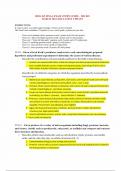
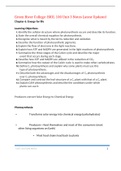
BIOS 242 FINAL EXAM STUDY GUIDE – MICRO MARCH LATEST UPDATE INSTRUCTIONS: It’s time to show your skills and knowledge of what you have learned! This Final Exam contributes 230 points to your overall grade, so please do your best. • There are 60 multiple choice questions worth 3 points each (180 total points). • There are 5 Fill in the blanks question worth 3 points each (15 total points). • There are 5 “Select all that apply” question worth 3 points each (15 total points). • There is 1 matching question worth 5 points (5 total points). • There is 1 essay question worth 5 points (5 total points). • There is 1 essay questions worth 10 points (10 total points). TCO 1: Given a list of Koch's postulates, analyze how early microbiologists proposed hypotheses and performed experiments to determine the causes of various diseases. Describe the contributions of Leeuwenhoek and Koch to the field of microbiology. • Antotoi van Leewenhoek Father of the microscope and discovered protozoa and bacteria • Koch studied diseases causes,simple staining techniques, estimating CFU/ml, Use of Petri dishes,transfer of bacteria, photomicrograph bacteria Describe the six different categories in which the organisms described by Leeuwenhoek were grouped. 1. Bacteria can cause disease, prokaryotes, lack nuclei,some lack cell walls some cell walls contain peptidoglycan, reproduce asexually (E. coli, L. spp, S. spp) 2. Archaea- Never causes disease, prokaryotes, lack nuclei, cell wall composed of polymers instead of peptidoglycan, reproduce asexually 3. Fungi- can cause disease (Eukaryotes, heterotrophs, have cell wall,reproduce asexually by budding. (ex. Beer S. cereviae , yeast infection C. albicans) 4. Protozoa- cause disease (Eukaryotes) single celled,similar to animals nutrients needs and cellular structure, live freely in water (ex. G. limblia, Plasmodium and malaria). (capable of movement: pseudopodia, cilia, flagella) 5. Algae-No disease (Eukaryotes) unicellular, photosynthetic,simple reproductive structures (ex. Alger plates Jello) 6. Small multicellular animals- worms, ticks, mosquitoes(Eukaryotes) can cause disease 7. Virus (could not observe)
Written for
- Institution
- BIOS 242
- Course
- BIOS 242
Document information
- Uploaded on
- October 10, 2023
- File latest updated on
- August 4, 2025
- Number of pages
- 17
- Written in
- 2023/2024
- Type
- Exam (elaborations)
- Contains
- Questions & answers
Subjects
-
bios 242 final exam study guide micro march 2023

Also available in package deal