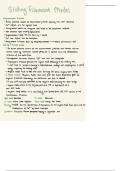
Neuromuscular Junction :
. Cast
Action
potential reaches the neuromuscular
junction Opening , the channels
.
2
Cat diffuses into the knob
synaptic
3 .
Acetylcholine leaves via
exocytosis and binds to the Sarcolemma receptors
4 Nat . Channels open causing depolarisation
S .
Depolaisation travels into the fibre by +-tubules
6 .
Caltions diffuse into the sarcoplasm
2 .
Acetylcholine is broken down by acetylcholinesterase
-
choline and ethanoic acid
sliding filament model :
1 An and travels into
.
action potential arrives at the neuromuscular junction the
muscle fiber transverse tubules which contact with the sarcoplasmic
by
are in
reticulum of the muscle fiber
2 .
Sarcoplasmic reticulum releases Cactions into the Sarcoplasm
3 .
Tropomyosin molecule
prevents the
myosin head attaching
to the
binding site ,
↳ cat bind to troponin conformational and pulled
causing tropomyosin
a is
change
away exposing ,
the
binding sites
heads bind to ADP and actin
forming actin-myosin cross bridge
4 the
.
Myosin
S Power Stroke heads and the activ filaments past the
Myosin coch
pull
:
.
in filament and ADP released
shortening the sarcomere is
myos ,
A ATP
myos in head breaking the cross-bridge
. .
new molecule attaches to the ,
7 .
Myosin heads return to the
original positions ,
ATP is
hydrolysed and a
new ADP binds .
heads attach further down and Calt returns
binding
8 to the
.
Myosin to a new site
Sarcoplasmic reticulum .
light band Narrows H-zone Narrows
: :
2 lines :
move closer
together Down band :
stays the same
Needed
Energy for the
powerstroke dissociation of the
myosin head from actin and the
:
,
reabsorption of Calt by active transport
Creatine Phosphate :
Reserve phosphate supply to regenerate ATP
. Cast
Action
potential reaches the neuromuscular
junction Opening , the channels
.
2
Cat diffuses into the knob
synaptic
3 .
Acetylcholine leaves via
exocytosis and binds to the Sarcolemma receptors
4 Nat . Channels open causing depolarisation
S .
Depolaisation travels into the fibre by +-tubules
6 .
Caltions diffuse into the sarcoplasm
2 .
Acetylcholine is broken down by acetylcholinesterase
-
choline and ethanoic acid
sliding filament model :
1 An and travels into
.
action potential arrives at the neuromuscular junction the
muscle fiber transverse tubules which contact with the sarcoplasmic
by
are in
reticulum of the muscle fiber
2 .
Sarcoplasmic reticulum releases Cactions into the Sarcoplasm
3 .
Tropomyosin molecule
prevents the
myosin head attaching
to the
binding site ,
↳ cat bind to troponin conformational and pulled
causing tropomyosin
a is
change
away exposing ,
the
binding sites
heads bind to ADP and actin
forming actin-myosin cross bridge
4 the
.
Myosin
S Power Stroke heads and the activ filaments past the
Myosin coch
pull
:
.
in filament and ADP released
shortening the sarcomere is
myos ,
A ATP
myos in head breaking the cross-bridge
. .
new molecule attaches to the ,
7 .
Myosin heads return to the
original positions ,
ATP is
hydrolysed and a
new ADP binds .
heads attach further down and Calt returns
binding
8 to the
.
Myosin to a new site
Sarcoplasmic reticulum .
light band Narrows H-zone Narrows
: :
2 lines :
move closer
together Down band :
stays the same
Needed
Energy for the
powerstroke dissociation of the
myosin head from actin and the
:
,
reabsorption of Calt by active transport
Creatine Phosphate :
Reserve phosphate supply to regenerate ATP