Health Assessment HESI Practice Questions and Answers 100% Correct
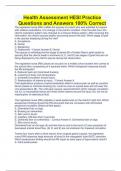
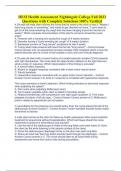
Health Assessment HESI Practice Questions and Answers 100% Correct The registered nurse (RN) notifies the spouse of a client who was admitted to hospice with shallow respirations, of a change in the client's condition. Over the past hour, the client's respiratory pattern has changed to a Cheyne Stokes pattern. After receiving this information, the client's spouse begins vacuuming around the bed. Which stage of grief is the spouse displaying during the visit? A. Acceptance B. Denial C. Bargaining D. Depression - Correct Answer B. Denial The spouse is exhibiting the first stage of denial (B) of Kubler-Ross's grief model by ignoring that the client's death is imminent (A, C, and D) are stages of grief that are not being displayed by the client's spouse during this observation. The registered nurse (RN) places an ice pack on a middle school student who comes to the school clinic complaining of a sprained ankle. Which therapeutic response should the RN anticipate? A. Reduced pain and minimized bruising. B. Lowering of body core temperature. C. Increased circulation around injury. D. Reabsorption of edema at injury. - Correct Answer A. Cold applications produce a topical anesthetic effect to reduce pain as well as constrict blood vessels to minimize bruising (A). Local ice over an injured area will not lower the core temperature (B). The cold pack causes vasoconstriction which reduces circulation, not (C), to traumatized tissue and limits further edema around the injury (D), but not by reabsorption of edematous fluid. The registered nurse (RN) palpates a weak pedal pulse on the client'rs right foot. Which assessment findings should the RN document that are consistent with diminished peripheral circulation (Select all that apply.) A. Diminished hair on legs. B. Bruising on extremities. C. Skin cool to touch. D. Capillary refill less than 3 seconds. E. Darkened skin on extremities. - Correct Answer A. Diminished hair on legs C. Skin cool to touch. Diminished hair on the legs (A) and skin that is cool to the touch (C) are symptoms of decreased arterial blood flow. (B, D, and E) are not indicators for impaired circulation. Twenty four hours after a client returns from surgical gastric bypass, the registered nurse (RN) observes large amounts of blood in the nasogastric tube (NGT) cannister. Which assessment finding should the RN report as early signs of hypovolemic shock? A. Faint pedal pulses
Written for
- Institution
- HESI Health Assessment
- Course
- HESI Health Assessment
Document information
- Uploaded on
- October 8, 2023
- Number of pages
- 24
- Written in
- 2023/2024
- Type
- Exam (elaborations)
- Contains
- Questions & answers
Subjects
- the
-
the registered nurse rn notifies the spouse of a
-
the registered nurse rn places an ice pack on a
-
the registered nurse rn palpates a weak pedal pu
-
twenty four hours after a client returns from surg

Also available in package deal