

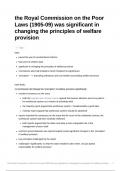
the Royal Commission on the Poor
Laws (1905-09) was significant in
changing the principles of welfare
provision
Tags
intro:
paved the way for pivotal liberal reforms
blue print of welfare state
significant in changing the principles of welfare provision
commission also had limitations which hindered its significance
“principles” —> prevailing orthodoxy and core beliefs surrounding welfare provision
main body:
1) commission did change the “principles” of welfare provision significantly
reached consensus on the issue
both the majority and minority reports agreed that serious attention and or be paid to
he workhouse system as a means of providing relief
the majority report argued that workhouse system = fundamentally a good idea
minority report argued that workhouse system should be abolished
reports reached the consensus on the issue that for much of the nineteenth century, the
workhouse system had been woefully inefficient
both reports argued that the state must take a more integrated role in the
management of poor relief
common ground between two reports helped create significant changes in the “principles”
of welfare provision
key principles challenged by the report
challenged “significantly” so that the state needed to take entire, not just partial
responsibility for welfare provision
the Royal Commission on the Poor Laws (1905-09) was significant in changing the principles of welfare provision 1
Laws (1905-09) was significant in
changing the principles of welfare
provision
Tags
intro:
paved the way for pivotal liberal reforms
blue print of welfare state
significant in changing the principles of welfare provision
commission also had limitations which hindered its significance
“principles” —> prevailing orthodoxy and core beliefs surrounding welfare provision
main body:
1) commission did change the “principles” of welfare provision significantly
reached consensus on the issue
both the majority and minority reports agreed that serious attention and or be paid to
he workhouse system as a means of providing relief
the majority report argued that workhouse system = fundamentally a good idea
minority report argued that workhouse system should be abolished
reports reached the consensus on the issue that for much of the nineteenth century, the
workhouse system had been woefully inefficient
both reports argued that the state must take a more integrated role in the
management of poor relief
common ground between two reports helped create significant changes in the “principles”
of welfare provision
key principles challenged by the report
challenged “significantly” so that the state needed to take entire, not just partial
responsibility for welfare provision
the Royal Commission on the Poor Laws (1905-09) was significant in changing the principles of welfare provision 1


