

100% satisfaction guarantee Immediately available after payment Both online and in PDF No strings attached 4.2 TrustPilot
logo-home
Exam (elaborations)

ACCCOB1 Accounting Principles questions fully solved 2023

Rating
-
Sold
-
Pages
2
Grade
A+
Uploaded on
07-10-2023
Written in
2023/2024

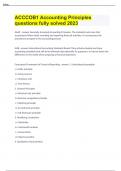
ACCCOB1 Accounting Principles questions fully solved 2023 GAAP Generally Accepted Accounting Principles. The standards and rules that accountants follow while recording and reporting financial activities. It encompasses the procedures accepted in the accounting process. IASB International Accounting Standards Board. They actively develop and issue accounting standards that will to be followed internationally. Its purpose is to narrow down the differences in the world when preparing a financial statement. Conceptual Framework of Financial Reporting 1. Underlying Assumption a. Entity principle b. Going concern c. Monetary Unit d. Time Period 2. General Principles a. Historical cost principle b. Revenue recognition principle c. Matching principle d. Accrual basis principle e. Full disclosure principle 3. Modifying Constraints a. Materiality b. Cost-benefit analysis c. Conservatism d. Industry practice 4. Qualitative Characteristics a. Usefulness b. Understandability c. Relevance d. Reliability e. Neutrality f. Comparability g. Consistency Underlying Assumptions 1. Entity concept 2. Going concern 3. Monetary Unit 4. Time Period General Principles 1. Historical cost principle 2. Revenue recognition principle 3. Matching principle 4. Accrual basis principle 5. Full disclosure principle Modifying Constraints 1. Materiality 2. Cost-benefit analysis 3. Conservatism 4. Industry practice Qualitative Characteristics 1. Usefulness 2. Understandability 3. Relevance 4. Reliability 5. Neutrality 6. Comparability 7. Consistency Entity Concept A business or an organization and its owners are treated as two separate parties. Establishes boundaries in what should be recorded in the financial statements of the business. Going Concern / Continuity Assumption States that businesses are assumed to continue to operate into the future unless there is an evidence that the business will not continue to operate. Going concern will then become liquidating concern. Monetary Unit Concept Only transactions and events that are capable of being measured in monetary terms are recognized in the financial statements. Time Period or Periodicity Concept States that recent accounting information is highly desirable since information that is presented is nearly accurate. It protects the users of accounting information from basing their decisions on outdated information. Interim Period - Accounting period that is shorter than 1 year Calendar Year - January 1 to December 31 Fiscal Year - !2 month duration that starts at any month other than January Natural Business Year - Length of the fiscal year is determined by the nature of business Historical Cost or Acquisition Cost The actual amount paid for merchandise or service at the time it was acquired. (No inflation) Revenue Recognition Principle Revenue is recognized whether the cash from the transaction has been received or not. (Receivable, prepaid income, accrued income) Matching Principle This requires that expenses incurred by an organization must be charged to the income statement in the accounting period in which the revenue is earned. Accrual Basis States that revenues are reported on the income statement when they are earned even before the cash is received from the customers. Expenses are reported on the income statement in the period when they occur or when they expire even before the payment is made. This provides better picture of a company's financial position at a moment or point in time. The reason is that all assets and all liabilities that were earned and incurred will be reported within that period. Full Disclosure Principle States that all information that would affect a reader's understanding of those statements should be disclosed especially if it will have a material impact on the entity's financial position or financial results. Materiality Concept If an omission or misstatement could influence the economic decisions of users then information is material. This emphasizes the significance of the transactions, balances and errors made in the financial statements. Cost-benefit Principle An individual (or a firm or a society) should take an action if, and only if, the extra benefits from taking the action are at least as great as the extra costs. Conservatism Concept It is exercising a degree of caution in the adoption of policies and significant estimates such that the assets, income, liability and expenses are not overstated or under stated. Industry Practice It allows some companies that have unusual tax and/or regulatory requirements to develop special accounting principles just for their industry. The public utility industry is one example of an industry with a unique set of special accounting principles. Usefulness Accounting information should be useful Understandability Informatio

Show more Read less
Institution
Accounting Principles
Course
Accounting Principles


Whoops! We can’t load your doc right now. Try again or contact support.

Written for

Institution
Accounting Principles
Course
Accounting Principles

Document information

Uploaded on
October 7, 2023
Number of pages
2
Written in
2023/2024
Type
Exam (elaborations)
Contains
Questions & answers

Subjects

Content preview

john


ACCCOB1 Accounting Principles
questions fully solved 2023
GAAP - answer Generally Accepted Accounting Principles. The standards and rules that
accountants follow while recording and reporting financial activities. It encompasses the
procedures accepted in the accounting process.


IASB - answer International Accounting Standards Board. They actively develop and issue
accounting standards that will to be followed internationally. Its purpose is to narrow down the
differences in the world when preparing a financial statement.


Conceptual Framework of Financial Reporting - answer 1. Underlying Assumption
a. Entity principle
b. Going concern
c. Monetary Unit
d. Time Period
2. General Principles
a. Historical cost principle
b. Revenue recognition principle
c. Matching principle
d. Accrual basis principle
e. Full disclosure principle
3. Modifying Constraints
a. Materiality
b. Cost-benefit analysis
c. Conservatism
d. Industry practice
4. Qualitative Characteristics

Get to know the seller

Seller avatar
Reputation scores are based on the amount of documents a seller has sold for a fee and the reviews they have received for those documents. There are three levels: Bronze, Silver and Gold. The better the reputation, the more your can rely on the quality of the sellers work.
johngatheca Teachme2-tutor
View profile
Follow You need to be logged in order to follow users or courses
Sold
21
Member since
2 year
Number of followers
25
Documents
512
Last sold
8 months ago
GeniusStuvia A+

Accounting, Finance, Statistics, Computer Science, Nursing, Chemistry, Biology & More — A+ Test Banks, Study Guides & Solutions With a wide-ranging selection covering subjects like Nursing, Accounting, and more, all meticulously curated for top-notch performance, our store is your one-stop destination for A+ materials.

2.5

2 reviews

5
0
4
1
3
0
2
0
1
1

Recently viewed by you

Why students choose Stuvia

Created by fellow students, verified by reviews

Quality you can trust: written by students who passed their tests and reviewed by others who've used these notes.

Didn't get what you expected? Choose another document

No worries! You can instantly pick a different document that better fits what you're looking for.

Pay as you like, start learning right away

No subscription, no commitments. Pay the way you're used to via credit card and download your PDF document instantly.

Student with book image

“Bought, downloaded, and aced it. It really can be that simple.”

Alisha Student

Frequently asked questions
