

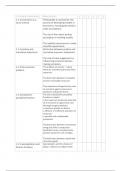
1.1 nature of economics Need to learn ✓ ✓ ✓ ✓ ✓ ✓
1.1.1 economics as a Thinking like an economist: the
social science process of developing models in
economics, including the need to
make assumptions
The use of the ceteris paribus
assumption in building models
The inability ineconomics to make
scientific experiments
1.1.2 positive and Distinction between positive and
normative statements normative economic statements
The role of value judgements in
influencing economic decision
making and policy
1.1.3 the economic The problem of scarcity – where
problem there are unlimited wants and finite
resources
The distinction between renewable
and non-renewable resources
Thei mportance of opportunity costs
to economic agents (consumers,
producers and government)
1.1.4 production The use of production possibility
possibility frontiers frontiers to depict:
o the maximum productive potential
of an economy o opportunity cost
(through marginal analysis)
o economic growth or decline
o efficient or inefficient allocation of
resources
o possible and unobtainable
production
The distinction between movements
along and shifts in production
possibility curves, considering the
possible causes for such changes
The distinction between capital and
consumer goods
1.1.5 specialistation and Specialisation and the division of
division of labour labour: reference to Adam Smith
, The advantages and disadvantages
of specialisation and the division of
labour in organising production
The advantages and disadvantages
of specialising in the production of
goods and services to trade
The functions of money (as a
medium of exchange, a measure of
value, a store of value, a method of
deferred payment)
1.1.6 free market The distinction between free market,
economies, mixed mixed and command economies:
economy, and command reference to Adam Smith, Friedrich
economies Hayek and Karl Marx
The advantages and disadvantages
of a free market economy and a
command economy
The role of the state in a mixed
economy
1.1.1 economics as a Thinking like an economist: the
social science process of developing models in
economics, including the need to
make assumptions
The use of the ceteris paribus
assumption in building models
The inability ineconomics to make
scientific experiments
1.1.2 positive and Distinction between positive and
normative statements normative economic statements
The role of value judgements in
influencing economic decision
making and policy
1.1.3 the economic The problem of scarcity – where
problem there are unlimited wants and finite
resources
The distinction between renewable
and non-renewable resources
Thei mportance of opportunity costs
to economic agents (consumers,
producers and government)
1.1.4 production The use of production possibility
possibility frontiers frontiers to depict:
o the maximum productive potential
of an economy o opportunity cost
(through marginal analysis)
o economic growth or decline
o efficient or inefficient allocation of
resources
o possible and unobtainable
production
The distinction between movements
along and shifts in production
possibility curves, considering the
possible causes for such changes
The distinction between capital and
consumer goods
1.1.5 specialistation and Specialisation and the division of
division of labour labour: reference to Adam Smith
, The advantages and disadvantages
of specialisation and the division of
labour in organising production
The advantages and disadvantages
of specialising in the production of
goods and services to trade
The functions of money (as a
medium of exchange, a measure of
value, a store of value, a method of
deferred payment)
1.1.6 free market The distinction between free market,
economies, mixed mixed and command economies:
economy, and command reference to Adam Smith, Friedrich
economies Hayek and Karl Marx
The advantages and disadvantages
of a free market economy and a
command economy
The role of the state in a mixed
economy


