

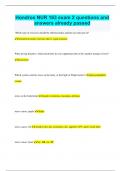
Hondros NUR 163 exam 2 questions and answers already passed
Hondros NUR 163 exam 2 questions and answers already passed Which type of exercises should the elderly/cardiac patients not take part in? Isometric/isotonic exercises due to vagal response When giving diuretics, which electrolyte do you supplement due to the smallest margin of error? potassium Which system controls stress on the body, or the Fight or Flight instinct? parasympathetic system stress on the body/mind negative emotions, insomnia, alertness stress causes: pupils dilate stress causes: GI mouth is dry, dec. peristalsis, dec. appetite, N/V, ulcers, heart burn stress causes: heart inc. HR, inc. BP stress causes: lungs inc. respirations, dilate bronchioles, hyperventilation - resp. alk. stress causes: blood glucose increased stress causes: insulin production decreased stress causes: sex drive dec. libido stress causes: urinary dec. output stress causes: musculoskeletal tension, headache, backache, sore muscles stress causes: immune system dec. WBC count - cancer stress causes: skin/hair acne, eczema, psoriasis, hair loss Relaxation Techniques for Stress Management exercise, art therapy, music, prayer, meditation, reiki, breathing exercises, massage What is a challenging stressor? Manageable, but requires mobilization of sources What is a neutral stressor? taxes existing resources What is a threatening stressor? Exceeds existing resources and personal capabilities Primary prevention Efforts to prevent an injury or illness from ever occurring; educating and vaccinations Secondary prevention screening and early detection Tertiary prevention actions taken to manage damage once a disease or disability has progressed beyond its early stages T/F Stress is a concept with psychological, physiological, and behavioral components True T/F Children with chronic stress may show s/s of failure to thrive True T/F Stress is experienced daily by people of all ages True T/F Stress that is severe, prolonged, and chronic is likely to result in disability and dysfunction True T/F A perceived stress event initiates a response in the peripheral nervous system False, CNS T/F Stress activates the limbic system True T/F Untreated stress is associated with chronic conditions such as coronary artery disease, tension headaches, insomnia, and depression True T/F Decreased respiratory rate is a result of the release of norepinephrine and epinephrine False; increased T/F Bronchoconstriction is a result of the release of norepinephrine and epinephrine False; bronchodilation T/F Increased blood glucose level is a result of the release of norepinephrine and epinephrine True T/F Decreased BP is a result of the release of norepinephrine and epinephrine False; increased T/F Increased HR, contraction, and cardiac output is a result of the release of norepinephrine and epinephrine True Which intervention would be most beneficial for a patient experiencing frequent headaches related to muscle tension? behavioral skills training, health education, biofeedback, or meditation? Biofeedback what are the defining characteristics of stress overload? Anger, impatience, inability to make decisions T/F If a person experiences a positive event, such as winning the lottery, the person experiences stress because he/she is encountering a significant life change True What is the fight or flight response? a predictable range of physiologic responses in the face of danger What life event is considered most stressful? The *sudden* death of a child Why would someone be experiencing constipation during a stressful event? decreased peristalsis T/F mild stress is bad False; mild stress causes increased alertness, which is good, in moderation T/F Depression can occur because of high levels of stress True Biofeedback is: making the pt aware of physiologic responses to stress in an attempt to gain control over those responses T/F Suppression is making generalizations to avoid disturbing thoughts False; emotion-focused strategy repression removal of anxiety-producing thoughts or experiences from conscious awareness denial refusing to acknowledge some painful painful aspect of external reality that is obvious to others rationalization creating an acceptable explanations for unacceptable thoughts or actions intellectualization making generalizations to avoid avoid disturbing thoughts or feelings displacement transferring emotions about one situation or person onto another suppression avoiding thinking about distressing situations projection Attributing one's own thoughts, feelings, or motives to another sublimation channeling negative energy into socially acceptable behaviors substitution keeping so busy with activities that there is no time to think about stressors Which systems does immobility affect? All body systems Immobility complications depression, f/e imbalance, a/b imbalance, dec. perfusion - DVT, dec. peristalsis, dec. C.O., skin breakdown - pressure ulcers, pneumonia - resp. acid., inc. risk for infection, edema, atrophy, bone demineralization - kidney stones and osteoporosis Immobility interventions ambulate, wt. bearing exercises, SCD's, ted hose, ankle pumps, turn Q 2 hrs, float heels, Ca++ Vit. D/Calcitonin, moon boots, hot/cold therapy, pre-med before exercise, referral to: social workers, PT, OT, DT What can you delegate to a UAP? anything that doesn't involve assessment, medications, or nursing treatments (examples include: ambulation, ROM, moon boots, float heels, hot/cold therapy (unless assessment is needed), wt. bearing exercises) What natural changes associated with aging affect activity in older adults? increased joint degeneration T/F By limiting physical mobility with restraint, the patient has a decreased risk for falls False; increased risk What can you do to help an older adult if pain is the common cause of decreased activity? pre-medicate within an hour before exercising T/F Risk factors for activity intolerance include exertional dyspnea True T/F Self-care deficits can negatively affect self-esteem True T/F When mobility decreases with age, older adults often display signs and symptoms of isolation True How would the nurse improve oxygenation for adequate exercise in a bedridden pt? clear secretions and teach effective couging What disorder would require a pt to use assistive devices such as padded eating utensils? Hemiplagia T/F Impaired physical mobility is a state in which a person has a limitation in physical mobility True deconditioned a loss of physical fitness; used for pts who experienced extended immobility such as prolonged bedrest Why are older adults at increased risk for bone fractures? bone density decreases and bones become more brittle T/F Immobility results in dec. cardiac output True T/F Immobility results in secondary hypertension False T/F Immobility contributes to the formation of DVT True T/F Immobility causes inc. calcium resorption into skeletal bones False; aides in demineralization T/F Immobility contributes to the development of pressure ulcers True T/F immobility has been linked to increased verbal and decreased nonverbal communication in individuals False T/F Psychological effects associated with immobility are more concerning for older adults than any other age group False; children are more concerning T/F Immobilization in children can interfere with intellectual and psychomotor functioning True T/F Immobility can hamper physical growth and development in children True T/F For adults, being unable to work or perform ADL's due to immobility often causes a loss of self-worth True What kind of diagnostic test would be used for a pt with significant pain in the lower right leg after falling off a ladder? x-ray T/F The best reason bed exercises should be encouraged for pts on bedrest is to minimize atrophy ad maintain joint movement True T/F Muscle relaxants *aren't* classified as analgesics True An otherwise strong, healthy pt with a lower leg cast is learning to ambulate with crutches. Which gait would he/she use? 3-point gait Where do the patients feet stop when performing the swing-through crutch gait? past the crutch tips The nurse is teaching a pt who has crutches how to sit down in a chair. Which hand should the patient hold both crutches? The hand on the injured side Forearm crutches are generally used by pts with which types of conditions? general weakness or paraplegia A pt requiring minimal assistance with ambulation would use which type of device? a cane When preparing to safely transfer a pt from a bed to a wheel chair using a transfer belt, what would a nurse do first? Assess the patient's physiological capacity to transfer. T/F When assisting a pt who is able to help transfer themselves from the bed to a wheel chair using a transfer belt, you would have the pt push down on the mattress with both hands and rock to stand on the count of 3. True. What would be the first action to perform just before moving a pt to the side of the bed? Raise the head of the bed 30 degrees. The nurse is preparing to transfer a pt with left sided weakness from the bed to a wheel chair using a transfer belt. Which position would the nurse instruct the pt to assume? Place your stronger leg forward and your weaker leg back. Why does the nurse cup one hand around the pt's elbow and support the forearm and wrist during the ROM exercises? To ensure stability while exercising the joint. The nurse notes that the pt's left elbow is resistant to extension and flexion while performing ROM exercises. What is the appropriate nursing action? Omit all of the ROM exercises until the healthcare provider is notified. Why would the nurse ask the physical therapist to perform passive ROM exercises on a pt with lower extremity injuries sustained in a car crash? The pt has orthopedic trauma When caring for a pt with Alzheimer's, why would the nurse would cover the catheter? to reduce pt access How many people are needed to transfer a pt from a bed to a stretcher? 3 What would the nurse do first before transferring from bed to stretcher? lock the brakes T/F Crutches should be placed 6 inches in front, and 6 inches to the side of the feet True Four-point gait used when both legs can bear some weight; right crutch, left foot, left crutch, right foot Three-point gait used when only one leg can bear weight (ex: broken leg or sprained ankle) Two-point gait matches the crutch to the opposite foot, moving them together like walking, where the crutches move with the natural swing of the arms swing to gait both crutches are advanced together and then both legs are lifted and placed down again on a spot behind the crutches. swing through gait both crutches are advanced then the legs swing past the crutches Walker used by pts who are able to bear partial weight cane used for people who need minimal assistance; place cane on strong side - move cane and strong foot forward at the same time, landing the strong leg past the cane - move weak leg to meet strong leg and repeat
Document information
- Uploaded on
- October 7, 2023
- Number of pages
- 15
- Written in
- 2023/2024
- Type
- Exam (elaborations)
- Contains
- Questions & answers


