Infection Prevention and Control Fundamentals Exam I Questions With Verified Answers
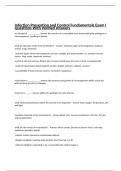
an infection is __________ - Answer the invasion of a susceptible host (human being) by pathogens or microorganisms, resulting in disease what are the parts of the chain of infection? - Answer -infectious agent (microorganisms: bacteria, viruses, fungi, protozoa) -reservoir (place where microorganisms survive, multiply, and await transfer; ex. animals, humans, insects, food, water, inanimate surfaces) -portal of exit and entrance (blood, skin, mucous membranes, GU tract, GI tract, transplacental) -mode of transmission (direct/indirect contact, droplet, airborne, vehicles, vectors) -susceptibility of host (immune system, risk factors, organisms) colonization is __________ - Answer the presence and growth of microorganisms within a host but without tissue invasion or damage virulence is _____ - Answer ability of a pathogen to cause disease what environmental factors affect the survival of an organism? - Answer food, oxygen, temperature, pH, and light examples of portals of exit and entrance - Answer blood, skin, mucous membranes, GU tract, GI tract, and transplacental what are the modes of transmission? - Answer -direct contact (person to person--fecal, oral route, healthcare providers hands) -indirect contact (person to contaminated object) -droplet (coughing, sneezing large particles that travel up to 6 ft) -airborne (droplets suspended in air or aerosolized by medical equip.) -vehicles (contaminated items, water, blood, solutions, food) -vector (flies, mosquito, flea, tick) what are the steps of the infectious process? - Answer -incubation period (time between exposure to first symptoms; ex. chickenpox is 14-16 days, common cold 1-2 days, influenza 1-4 days, ebola 2-21 days, COVID 2-14 days) -prodromal stage (interval from start of nonspecific symptoms to progression of more specific symptoms; ex. herpes simplex starts with itching and tingling before lesion appears) -illness stage (interval when pt has specific signs and symptoms of disease; ex. strep throat manifested by sore throat, pain, swelling) -convalescence (interval when acute symptoms of infection disappear; length depends on severity of infection and host resistance) localized infection s/s vs. systemic infection s/s - Answer localized: wound infection causes pain, tenderness, warmth, redness systemic: fever, elevated WBC, N/V, lymphadenopathy, organ failure what is the purpose of inflammation? - Answer cellular response of the body to injury/infection causing blood, fluid, and nutrient to the site of injury HAI - Answer health care associated infection (also called iatrogenic infection) examples of sites and causes for HAI - Answer -urinary: foley catheter, specimen collection, poor perineal hygiene -wounds: skin prep for surgery, dressing changes, contaminated solutions -respiratory: suctioning, equipment -blood: IV tubing, PIV, drug additives, accessing IV port, hemodialysis catheters, CVL HAI are exogenous or endogenous. What does this mean? - Answer -exogenous: from outside the person (salmonella, clostridium, Aspergillus) -endogenous: overgrowth of patient's normal flora (staph, yeast, strep, enterococci)
Written for
- Institution
- Infection control
- Course
- Infection control
Document information
- Uploaded on
- October 6, 2023
- Number of pages
- 6
- Written in
- 2023/2024
- Type
- Exam (elaborations)
- Contains
- Questions & answers
Subjects
-
infection prevention and control
-
infection prevention and control fundamentals exam
-
an infection is the invasion of a susce
-
what are the parts of the chain of infection inf

Also available in package deal