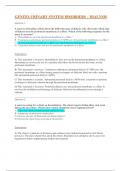
GENITO-URINARY SYSTEM DISORDERS – DIALYSIS
GENITO-URINARY SYSTEM DISORDERS – DIALYSIS This is an exam with answers on dialysis. it made my revision easier and I passed well. I recommend it. check some of the questions captured: Question 1: A nurse is educating a client about the different types of dialysis. The client asks which type of dialysis uses the peritoneal membrane as a filter. Which of the following responses by the nurse is accurate? A. "Hemodialysis uses the peritoneal membrane as a filter." B. "Continuous ambulatory peritoneal dialysis (CAPD) uses the peritoneal membrane as a filter." C. "Automated peritoneal dialysis (APD) uses the peritoneal membrane as a filter." D. "Peritoneal dialysis does not use the peritoneal membrane as a filter." Explanation A) This statement is incorrect. Hemodialysis does not use the peritoneal membrane as a filter. Hemodialysis involves the use of a machine that filters the blood outside the body, not the peritoneal membrane. B) This statement is incorrect. Continuous ambulatory peritoneal dialysis (CAPD) uses the peritoneal membrane as a filter during manual exchanges of dialysate fluid, not with a machine like automated peritoneal dialysis (APD). C) This statement is accurate. Automated peritoneal dialysis (APD) uses a machine to perform exchanges of dialysate solution through the peritoneal membrane. D) This statement is incorrect. Peritoneal dialysis uses the peritoneal membrane as a filter. It involves the instillation and drainage of dialysate fluid into the abdominal cavity through a catheter. ________________________________________ Question 2: A nurse is caring for a client on hemodialysis. The client reports feeling dizzy and weak during the procedure. Which intervention should the nurse implement first? A. Check the client's blood pressure and pulse rate. B. Administer an antiemetic medication. C. Increase the rate of fluid removal during dialysis. D. Elevate the client's legs to promote blood flow.
Written for
- Institution
- GENITO-URINARY SYSTEM DISORDERS – DIALYSIS
- Course
- GENITO-URINARY SYSTEM DISORDERS – DIALYSIS
Document information
- Uploaded on
- October 5, 2023
- Number of pages
- 27
- Written in
- 2023/2024
- Type
- Exam (elaborations)
- Contains
- Questions & answers
Subjects
- dialysis
-
genito urinary system disorders dialysis
-
genito urinary system disorders

Also available in package deal