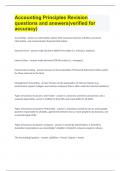
Accounting Principles Revision questions and answers(verified for accuracy)
Accounting an information system that measures business activities, processes information, and communicates financial information. External Users make decisions ABOUT the entity (i.e. investors, bankers). Internal Users make decisions FOR the entity (i.e. managers). Financial Accounting focuses on the preparation of Financial Statements (often useful for those external to the firm) Management Accounting focuses on the preparation of internal reports (e.g. performance reports, budgets and variance analyses) (this is often useful for internal members). Types of business structures: Sole Trader is a business owned by one person, not a separate legal entity, owner is entitled to all profits and responsible for all debts. Types of business structures: Partnership is a business owned by two or more people, partners responsible for all debts, agreement between two or more people to do business, not a separate legal entity. Types of business structures: Company is owned by shareholders, is formed by Australian Corporations Law, shareholder's liability is limited to amount unpaid on shares. The Accounting Equation Liabilities + Owner's Equity = Assets. Assets are resources that are owned (usually purchased) and/or controlled by the entity. examples: cash, accounts receivable, inventory, vehicles, machinery, land and buildings. Liabilities can be viewed as the opposite of assets, reflect the financial obligations of the entity. examples: wages and salaries payable, accounts payable and bank loans. Owner's/Shareholder's Equity reflect the financial investment of the owner(s) in the organisation, it includes investment plus all profits not paid out to the owner(s) (aka retained profits). Entity a thing with a distinct and independent existence. Things that increase owner's equity owner investments in the business, revenues etc. Things that decrease owner's equity owner withdrawals from the business, expenses etc. Revenues amounts received (or to be received) from customers for sales of products/services. examples: sales, service fees, rent received, interest received etc. Expenses amounts that have been paid (or will be paid later). examples: cost of goods sold, salaries and wages expense, advertising expense etc. Financial statements tell how the firm is performing and where it stands. The reliability (objectivity) principle information must be reasonably accurate, information must be free from bias, information must report what actually happened. The matching principle relates the inputs and outputs of goods and services to one another The profit recognition principle recognise revenue when it is "earned". Conservatism anticipating no profits, but anticipating all losses. Account detailed record of all the changes that have occurred in a particular asset, liability or owner's equity during any given period. Journal chronological order of transactions Ledger record that holds all accounts (accounts include individual asset accounts, liability accounts and owner's equity accounts) Trial balance A list of all the ledger accounts and their balances Examples of asset accounts cash, accounts receivable, bill receivable, prepaid expenses, land, building, machinery, equipment Examples of liability accounts accounts payable, bill payable, expenses incurred but not paid, mortgage payable. Examples of owner's equity accounts capital, drawings, revenues, expenses, profit. Double-entry accounting to record the dual effects of each business transaction Accrual-basis transactions are recorded when revenues are earned or expenses are incurred Cash-basis transactions are recorded when cash is paid or cash is received Accrual accounting profit is calculated by the excess of revenues earned less expenses incurred Cash accounting profit is calculated by the excess of cash inflows from revenues less cash outflows from expenses The revenue principle recognition of revenue and cash receipts do not necessarily occur at the same time Prepaids or Deferrals (adjusting entry) expenses paid but not yet incurred OR cash received but revenue not yet earned Accruals (adjusting entry) expenses incurred but not yet paid for OR revenue earned but cash not collected yet. Five categories of adjusting entries 1. Prepaid expenses (rent or insurance prepaid) 2. Accrued expenses (wages or electricity payable) 3. Unearned revenues (payment received for services not complete) 4. Accrued revenues (payment not received for completed services) 5. Depreciation (non-current asset purchased and expense recognised over time Depreciation the process of allocating the cost of a non-current asset (i.e. an asset with a useful life of greater than a year) across years in which the owner will benefit from ownership. Accruals the recognition of an expense or revenue that has arisen but has not yet been recorded. Deferred revenue amounts received before the service is performed (need to convert to revenue as revenue is earned) Financial Statements parts Part 1: name of entity, title of statement, date or period covered Part 2: body of statement Two basic categories of adjusting entries Prepayments and Accruals Five types of adjusting entries - Prepaid Expenses - Depreciation of non-current assets - Accrued Expenses - Accrued Revenue - Unearned Revenues The Accounting Cycle 1. transaction occurs 2. prepare source documents (i.e. a cheque, invoice etc) 3. make journal entry 4. post to ledger accounts 5. prepare trial balance 6. journalise and post adjusting entries and prepare adjusted trial balance 7. prepare financial statements 8. journalise and post closing entries 9. prepare post-closing trial balance The accounting work sheet a multi-columned document used by accountants to help move data from the trial balance to the financial statements. it provides an overview of adjusting entries and preparation of Income Statement and Balance Sheet, it assembles all information needed to adjust the accounts and prepare financial statements, and it contains info needed to close off revenue and expense accounts for the period. Steps in producing an accounting worksheet Step 1: enter ledger account titles and balances in their specified columns Step 2: enter the adjustments in the adjustments columns Step 3: prepare an adjusted trial balance by adding or subtracting along each row Step 4: extend adjusted balances to the financial statement columns Step 5: total the income statement columns and the balance sheet columns. Closing the accounts end of the period process that prepares the accounts for recording transactions during the next period. refers to "closing" the revenue, expense and drawings accounts. Four steps in the closing accounts process Step 1: revenue accounts are closed to Income Summary account Step 2: expense accounts are closed to Income accounts Step 3: income summary account is closed to Capital account Step 4: drawings account is closed to Capital account. Liquidity the measure of how quickly an item can be converted into cash
Written for
- Institution
-
Minnesota School Of Business
- Course
-
Accounting Principles
Document information
- Uploaded on
- October 5, 2023
- Number of pages
- 15
- Written in
- 2023/2024
- Type
- Exam (elaborations)
- Contains
- Questions & answers
Subjects
-
accounting principles revision

Also available in package deal