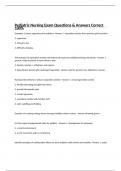
Pediatric Nursing Exam Questions & Answers Correct 100%
Examples of stress experienced by toddlers - Answer 1. separation anxiety from parents, grief reactions 2. regression 3. refusal to eat 4. difficulty sleeping Three phases of separation anxiety and behavioral responses exhibited during each phase - Answer 1. protest; clings to parent to force them to stay 2. despair, inactive + withdrawn and regress 3. detachment, denial, after prolonged separation , denies need for parents lvoe, affection to nurses Nursing interventions to reduce separation anxiety - Answer 1. encourage family contact 2. familiar belonging brought from home 3. provide therapeutic play 4. accept regression 5. consistent routine with familiar staff 6. extra cuddling and holding Example of a coping strategy found amongst toddlers when in stress - Answer throwing games List the major developmental tasks for toddlers - Answer 1. development of autonomy 2.. control environment 3. act of movement with no restraining Identify examples of collaborative efforts to assist toddlers with control and mobility - Answer 1. assist child with ambulation within their control 2. throwing games, vent frustrations 3. child life specialist, modified toys 4. physical therapist, promote strength and flexibility List nursing interventions used to prepare a toddle for a procedure - Answer 1. brief explanations, 5-10 mins, emphasize what the child will see, hear, taste, or feel 2. see age appropriate videos with parents 3. comfort by use of bandages to stop bleeding, avoid deception to gain compliance Identify the initial step to effective pain management and special considerations made for a toddler - Answer 1. assessment, meaning of hurt, what word is used for pain 2. prior pain experience 3. what does your child do when she/he is hurting 4. anything special that need to know about the child in pain List behavioral cues demonstrated by a a toddler when experiencing pain - Answer 1. frowning 2. crying 2. restlessness List physiological cues demonstrated by a toddler when experiencing pain. - Answer 1. rapid pulse 2. rapid respiration 3. perspiration Identify nursing interventions used for pain management with a toddler - Answer 1. form of relaxation, deep breaths 2. form of distraction 3. transport to treatment room for treatments 4. medical personnel restrains, not parents 5. the parents presence 6. explain in a a few simple words 7. administration of pain meds Provide examples of fostering autonomy and independence when planning for discharge - Answer 1. select favoring snacks 2. help with dressing change 3. allow playing if on bed rest ( can play near bed) 4. continue to perform toileting and hygiene skills 5. toys for psychosocial development 6. give independence and allow exploration within safe guidelines List seven reliable devices for accurately measuring and administering oral meds - Answer *measuring spoon *plastic syringes *calibrated nipple *plastic medicine cup *calibrated dropper *hollow handles medicine spoon *medicine bottle used to delivery oral meds via syringe Six methods of med administration that encourage child's acceptance - Answer 1. flavored ice pop/small ice cube to suck to numb tongue 2. mix drop with a small about (1tsp) of sweet tasting substance NO honey until age 1 year 3. give a chase of water, juice, soft drink 4. if n/v is a problem, give a carbonated beverage poured over finely crushed ice before or after 5. when unpleasant tastes pinch the nose and drink med thru a straw 6. have pharmacist prepare drug in a flavored chewable lozenge 7. infants will suck forma needless syringe What two types of meds should never be crushed and why? - Answer *enteric or protected coating; could irritate the stomach; this type of tables is absorbed by small intestine *Slow release- could be absorbed more rapidly If med must be crushed what type of food should never be used? - Answer Honey in infants due to botulism 2 methods of restraining for infant or toddler receiving IM injection in vastus lateralis - Answer 1. body of larger infant can be securely held between the nurses arm and body 2. swaddle baby leaving the part of the extremity out that is receiving the injection List six meds that should be reviewed by 2 profession nurses before administration to infant/child - Answer *digoxin *chemotherapeutic agents *insulin *epinephrine *opoids *sedatives According to Ericksons theory of development why would a toddler view hospitalization as a punishment? - Answer Ritualism the need to maintain sameness and reliability provides sense of comfort. without ritu8als little opportunity to exert autonomy. consequently regression and dependency occurs Hearing test for newborn - Answer OAE- Otoacoustive Emission measures intensity sound from the cochlear hair cells in response to clicks from a probe placed in the ear canal does not detect neural damage Detects inner hearing loss does not detect damage to cranial nerve Parallel play - Answer two toddlers playing side by side, no interaction or sharing What to you give to a child who has taken too much tylenol - Answer mico Parenting Styles - Answer Authoritarian authoritative permissive indifferent Authoritarian - Answer High control, low warmth Highly controlling/expect to be obeyed/little communication permits little independence Child outcome: no negotiation skills, no ability to direct and initiate own activities, frustrated in efforts to achieve autonomy, girls passive, boys aggressive authoritative - Answer Moderately high control, high warmth sets reasonable limits on behavior accepts and encourages growing autonomy open communication flexible rules Child outcome: willingly excepts restriction, more self reliant, self controlled, socially competent, better school performance permissive - Answer Low control, Low warmth no limit setting lacks affection for child ; focused on stress in own life may show hostility toward or neglect of the child Child outcome: may become rebellious, aggressive, socially inept, impulsive, may be creative, active, outgoing Guidelines for acceptable behavior in children - Answer *set realistic expectations based on child's age consistently enforce the expected directions and behaviors *focus on promoting appropriate and desirable behavior in child model behavior review expected behavior for special situations help distinguish between inside and outside voice Praise or reward child *Tell child of inappropriate behavior as soon as it begins *when reprimanding, focus on behavior rather that the child *be alert for when situations arise that may led to misbehaving (tired, hungry) *friendly reminders to help child gain self control Cephalocaudal development - Answer development that proceeds from the head toward the feet Proximodistal developemtn - Answer development that proceed from the center of the body outward extremities Developmental Age groups - Answer Infancy- birth to 12 months high level of care in daily activities Toddlerhood- 1-3 years. increased motor ability and independent behavior Preschool- 3-6 years. the preschooler refinees gross and fine motor ability and language skills and often participates in a preschool learning program School age- 6-12 years. begins with entry to school sys. growing intellectual skills, physical ability, and independence Adolescence- 12-18 years. begins with entry into the teen years. Mature cognitive thought, formation of identity, and influence of peers import characteristic of adolescence. Freud Stages - Answer Oral- birth to 1 year pleasure from the mouth, sucking and eating primary Anal- 1-3 years childs pleasure centered in anal area Phallic- 3-6 years sexual energy center / child works out relationships with parents of same/opposite sexes Latency- 6-12 years sexual energy is at rest in passage between earlier stages and adolescence Genital - 12- adulthood mature sexuality is achieved physical growth is completed/relationships with other occure Common defense Mechanisms used by children - Answer Regression- return to early behavior Repression- involuntary forgetting of uncomfortable situations rationalization- attempt to make unacceptable feelings acceptable fantasy- creation of the mind to help deal with unacceptable fear Erickson Theory (psychosocial) - Answer Trust vs Mistrust (birth to 1 year) Autonomy vs Shame (1 to 3 years) Initiative vs guilt (3 to 6 years) Industry vs inferiority (6 to 12 years) Identity vs Role confusion (12 to 18 Years) Trust vs Mistrust - Answer birth to 1 yr Task of first year of life is to establish trust, fostered by provision of food, clean clothing, touch , and comfort
Document information
- Uploaded on
- October 5, 2023
- Number of pages
- 28
- Written in
- 2023/2024
- Type
- Exam (elaborations)
- Contains
- Questions & answers