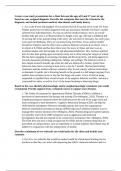
Operations and Supply Chain Management - C720 (WGU) exam |245 questions and answers.
Operations The process used to acquire inputs, such as people, capital, and material, and transform them into outputs, such as products and services. Operations Manager They allocate resources. Capital Facilities and equipment Competitive Advantage Developing capabilities that customers value, can be sustained over the long-term, and competitors find difficult to replicate. Inseparability The process of separating production from consumption; cannot be done for services because they are produced and consumed simultaneously. Technology The application of knowledge, tools, processes, and procedures to solve problems. Product Design The characteristics, features, and performance of the product; how the product functions; does not fundamentally change the product. Example: changing Coca-Cola's beverage containers from glass to aluminum. Product Technology The application of knowledge to improve the product. Process How to accomplish a task. Process Design How a product is made; can fundamentally alter the nature of the product. Example: changing the taste of Coca-Cola. Process Technology The application of knowledge to improve a process. Cross-Functionality When individuals with different expertise work towards a common goal; this is an essential business process. Concurrent Engineering Completing product design and process design simultaneously. Functional Areas Subsystems within an organization, such as marketing, finance, and accounting, that are linked together by a common organizational goal. Strategy Consists of the organizational goals and the methods of implementing the goals; every element of the SWOT analysis should be considered when developing strategies. Key Policies Main goals of an organization. Organizational Structure The formal relationships among different functional areas that aids in communication. Relative Advantage Where one entity has an advantage over another; will often trade their specialized products for those that they do not produce; companies with a relative advantage are able to produce products at a lower cost than their competitors. North American Free Trade Agreement (NAFTA) A free trade agreement between the United State, Mexico, and Canada to reduce tariffs and other trade restrictions. General Agreement on Tariffs and Trade (GATT) A trade agreement designed to reduce tariffs and other trade restrictions. Sustainability Balancing the interconnected obligations to economic viability, society, and the environment (the triple bottom line). What is the percentage of businesses that operate within the service sector? 88 percent Supporting Goods Supplies and equipment that aid in the development of products and services. Market Share The percentage of sales in a particular market. VIRAL Value, Inimitable, rare, aptitude, and lifespan. SWOT Analysis Analyzing the internal (strengths and weaknesses) and external (opportunities and threats) environments. Requirements for developing competitive advantage SWOT, business process, competitive capabilities, and customer requirements. Learning Curve Continuously improving a product to make it better and cheaper. Synergy Teamwork where the whole is greater than the sum of its parts. Key Processes Strategy development, product development, system development, and order fulfillment. System The process of producing goods and system. Matching Matching strengths to opportunities. Converting Converting weaknesses or threats into strengths or opportunities. Productivity Output / Input; the goal is achieving more output given the amount of inputs, thus saving money and reducing production costs. The First Revolution Starting in the late 1800s, increases in manufacturing productivity reduced the need for physical labor and enabled a shift towards service-based jobs. The Second Revolution Productivity and efficiency improvements in manufacturing freed resources for the rapid expansion of the service industry. The Third Revolution Also known as the post-industrial era, this revolution began in the 1950s with the development of computers. This technology has allowed fewer people to do more work. Reliability The ability to perform dependably and accurately. Assurance Knowledge and courtesy of employees and their ability to convey trust and confidence. Process Redesign The complete overhaul of a process to improve performance. Percent Change in Productivity [(New Productivity - Old Productivity)/Old Productivity] * 100 Quality (internal) How quality is defined by the business; often measured as the amount of a desired attribute; objective. Quality (external) How quality is defined by the customer and the product's fitness for use; meets customer's needs and expectations; subjective. Questions for Customers when Improving Products Ask what they value (not just what they want), how do they work, what makes them happy, and feedback on specific product attributes. Costs of Quality Failure costs, appraisal costs, and prevention costs. Failure Costs Costs accrued by the organization or customer as the result of a failure of the product. Appraisal Costs Investments in measuring quality and assessing customer satisfaction. Prevention Costs Investments designed to prevent defects from occurring. Poka-yoke Mistake proofing; an approach to prevent defects, such as color-coding parts so that customers assemble the product correctly. Design for Manufacture and Assembly (DFMA) Products should be designed so that they are simple and inexpensive to produce. Design for Operations (DFO) Services should be simple and inexpensive. Statistical Process Control (SPC) The use of statistical methods to determine when a process that produces goods is getting close to producing too many defects. W. Edwards Deming The most influential individual within the specialty of quality; After World War II, he went to Japan to help rebuild their economy, and he was heralded for his influence. He went on to lecture in the United States in the 1980s; he developed his 14 Points for the Transformation of Management. Deming's 14 Points for the Transformation of Management The system, not employees, cause defects; management is responsible for changing the system, and they must take responsibility instead of blaming employees; Deming also stressed the use of Statistical Process Control (SPC) and encouraged training in its use. Other highlights include creating purpose, reduce fear, provide training and leadership, break down barriers between departments, and eliminate slogans, work standards, and quotas. Joseph M. Juran He defined quality as "fitness for use", from the customer's perspective; he emphasized the need for continuous improvement and stressed that quality must be built on quality planning, quality control, and quality improvement. Quality Planning The development of products that appeal to the changing wants and needs of customers. Quality Control Ensure that the product fits the customer's perception of fitness for use.
Written for
Document information
- Uploaded on
- October 3, 2023
- Number of pages
- 26
- Written in
- 2023/2024
- Type
- Exam (elaborations)
- Contains
- Questions & answers
Subjects
-
operations and supply chain management

Also available in package deal