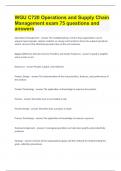
WGU C720 Operations and Supply Chain Management exam |75 questions and answers
Operations Management The multidisciplinary science that organizations use to acquire inputs (people, capital, material, or energy and transform them into outputs (products and/or services) that ultimately provide value to the end customer Biggest difference between Service Providers and Goods Producers A good is tangible and a service is not Resources People, Capital, and Materials Product Design The determination of the characteristics, features, and performance of the product Product Technology The application of knowledge to improve the product Process Describes how to accomplish a task Process Design Describes how a product is made Process Technology The application of knowledge to improve a process Teamwork Approach In managing operation can help solve quality and productivity problems Strategy Consists of the organizational goals and the methods for implementing the goals, called key procedures Business Process A set of work activities with a preferred order, and identifiable beginning and end, inputs, and clearly defined outputs that add value to the customer Plan List of actions that management expects to take Organizational Structure The infrastructure of formal relationships among different functions or subsystems, such as marketing, finance, and operations Relative Advantage The difference between the lowest cost producer and the next lower cost producer Ethics A sense of what is right and what is wrong that guide behavior Sustainability Reflects the efforts organizations are expected to make to balance their interconnected obligations to economic viability, the societies in which they operate, and the natural environment Competitive Advantage A capability that customers value, such as short delivery lead-time or high product quality that gives an organization an edge against its competition Market Share A company's sales divided by the sales of all companies in its industry Product Development A teamwork oriented process that begins with the organization's strategy and analysis of the markets as inputs Supply Chain Commonly used to refer to the network of organizations that participate in producing goods or producing services Focal Firm Directs the flow of information much like a conductor coordinates the activities of an orchestra Vertical Intergration Owning multiple assets in a supply chain Logistics Managing the movement of materials, components, and information from point to point in the supply chain Supply Chain Management Taking actions to have all members of the supply chain work together to coordinate their activities and share information Reverse Logistics When it is necessary to return defective products to the manufacturer for repair or replacement Insourcing Goods and services that are provided by the organization Outsource Goods and services obtained by outside suppliers Backward Vertical Integration When a company owns its suppliers SCOR Model Offers framework of processes and metrics to help companies monitor and control the performance of their supply chains Lean Supply Chain The company would plan to decrease days of supply Constraint Any resource whose capacity is less than or equal to demand for that resource Bottleneck Most limiting constraint on the system Most likely bottleneck to impact a lean supply chain Product Operations Management The transformation of customer expectations into products or services Quality The capacity to satisfy customers' needs Quality Function Deployment Takes customer expectations and transforms them into specific actions designed to meet those expectations 5 Dimensions of Service Quality Reliability, Responsiveness, Assurance, Empathy, Tangibles Competitive Advantage A capability that customers value, such as short delivery lead-time or high product quality that gives an organization an edge against its competition Product Development A teamwork-oriented process that begins with the organization's strategy and analysis of the markets as inputs Order Fulfillment Obtains customers' orders, enters them into the organization's information system, and finally delivers the order to satisfy customers SWOT Analysis A simple but useful technique for analyzing an organization's strengths and weaknesses and the opportunities and threats that it faces Strengths These are the characteristics of a business or project that lend an advantage within the scope of the study Weaknesses These characteristics of a business or project result in a disadvantage, relative to others Opportunities These are elements that the project could exploit to its advantage Threats These elements in the competitive environment could create trouble for the business or project Failure Costs Incurred whenever any product or component of a product fails to meet requirements Internal Failure Costs Associated with defects found before the product reaches the customer External Failure Costs Incurred after a product has reached the customer Appraisal Costs Incurred to measure quality, asses customer satisfaction, and inspect the test products Prevention Costs Result from activities designed to prevent defects from occurring Product Design This is how the product, either good or a service, functions. Process Design This is how the product, either good or a service, is produced Work Execution This is the performance of the plan created in the product and process design Inspection This is an assessment of the quality of the good or service W. Edwards Deming and Joseph M Juran Credited with major influence on the approach to quality in Japanese organizations Quality Planning The development of products and services that appeal to the ever changing customer wants and needs
Written for
Document information
- Uploaded on
- October 3, 2023
- Number of pages
- 7
- Written in
- 2023/2024
- Type
- Exam (elaborations)
- Contains
- Questions & answers
Subjects
-
wgu c720 operations and supply chain management

Also available in package deal