ATI Mobility Musculoskeletal exam| 20 questions fully solved.
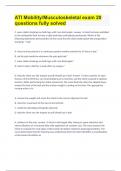
C. wear elastic stockings on both legs until I am discharged. A client has been admitted to the orthopedic floor to have a right total knee arthroplasty performed. Which of the following statements demonstrates to the nurse that the client understands the preoperative teaching? "I will A. have my knee placed in a continuous passive motion machine for 24 hours a day." B. ask for pain medicine whenever the pain gets bad." C. wear elastic stockings on both legs until I am discharged." D. have to stay in bed for a week after my surgery." D. help the client use the trapeze to pull himself up in bed A client sustains an open fracture of the left femur. An intramedullary pin is inserted, and the client is placed in skeletal traction. While performing the initial assessment, the nurse finds the client has slipped down toward the foot of the bed and the traction weight is resting on the floor. The appropriate nursing action is to A. remove the weight and move the client to the correct alignment in bed B. check for movement of the toes in the left foot C. notify the attending orthopedic physician D. help the client use the trapeze to pull himself up in bed A. coldness of the toes A client is discharged after having an open reduction and internal fixation of a fractured tibia with application of a plaster cast. The nurse teaches the client to evaluate for early signs of decreased circulation related to postsurgical edema. The nurse determines that the teaching was understood when the client identifies a manifestation of decreased circulation as A. coldness of the toes B. capillary refill of 3 seconds C. blanching of the nailbeds with pressure D. pain at the surgical site A. use a hair dryer on a cool setting to blow air into the cast A client with a radial fracture reports itching under the casted area. The appropriate nursing action to relieve itching is to A. use a hair dryer on a cool setting to blow air into the cast B. elevate the affected extremity C. provide a cotton swab to scratch the area D. explain to the client that itching is an indication the fracture is healing B. fat embolism Two days after fracturing his tibia playing lacrosse, a college student is brought to the hospital accompanied by his roommate who reports that the client is not acting like himself and seems confused. The nurse notes that the client has a long leg cast on the right leg and that the client is disoriented to time and place. Vital signs reveal that the client is tachycardic and tachypneic. The nurse should assess the client for other signs of A. hypovolemic shock B. fat embolism C. thrombophlebitis D. bone malalignment B. localized An assistive personnel at an extended care facility asks a nurse the difference between rheumatoid arthritis and osteoarthritis. The nurse responds, "Osteoarthritis is A. autoimmune B. localized C. systemic D. bilateral D. insertion of a peripherally inserted catheter line for long-term IV antibiotics A diabetic client with a non-healing wound of the heel is diagnosed with osteomyelitis. The nurse anticipates that the client's treatment regimen will include A. application of ice to the site to decrease the edema B. application of a short leg cast to limit movement of the involved ankle joint C. administration of clucocorticoids to decrease the inflammatory process D. insertion of a peripherally inserted catheter line for long-term IV antibiotics A. an actual pain sensation A nurse is caring for a client who had a below the knee amputation for gangrene of the foot. The client knows that the foot has been amputated, but reports to the nurse severe pain in the toes of the injured foot. The nurse should recognize this as A. an actual pain sensation B. a delusional belief C. a referred postoperative incisional pain D. a defense mechanism of denial D. apply cold compresses to the affected area A client with an ankle sprain is being discharged from the emergency department. To promote tissue healing and relieve discomfort, the nurse instructs the client to A. continue typical activities with the ankle immobilized B. keep the extremity in a dependent position C. keep a loose dressing on the affected area D. apply cold compresses to the affected area B. shortening of the right leg A client is 3 days postoperative following a right total hip arthroplasty. The client cries out in pain when transferred to a chair. Which of the following nursing observations should lead to the suspicion of a dislocated hip prosthesis? A. bulging in the right hip area B. shortening of the right leg C. adduction of the left leg D. external rotaiton of the right leg B. pulmonary embolus A client is on bed rest following a pelvic fracture when he suddenly becomes dyspneic and reports feeling short of breath. The nurse assesses the client and finds that tachycardia, hypotension, and tachypnea are occurring. The client's oxygen saturation level is dropping rapidly. The nurse should identify that the client is exhibiting signs consistent with A. pneumonia B. pulmonary embolus C. tension pneumothorax D. flail chest cC. rheumatoid arthritis On a health history form, a client being admitted to an outpatient surgery center for a knee arthroscopy indicates taking celecoxib (Celebrex) daily. Based on the medication, the nurse should suspect that the client has a history of A. infection B. depression C. rheumatoid arthritis D. seizures A. Suction the emesis from the client's mouth using a tonsil tip suction. A client involved in a motor vehicle crash sustained maxillofacial trauma from striking the windshield. The client receives intermaxillary fixation with interdental wiring. Postoperatively, the client vomits clear liquids. Which of the following actions is appropriate for the nurse to take? A. Suction the emesis from the client's mouth using a tonsil tip suction. B. Insert an NG tube to suction out any remaining stomach contents. C. Immediately cut the wires to allow the client to expectorate the emesis. D. Instruct the client to vomit in an emesis basin C. Tophi AA nurse is admitting a client with a history of gout. Which of the following manifestations should the nurse expect to find on the client's admission physical assessment? A. Fluctuant subcutaneous nodules B. Heberden's nodes C. Tophi D. Boutonniere deformity B. Numbness and tingling During report, a nurse is told to assess a client who was recently casted for a radial fracture for compartment syndrome. For which of the following findings should the nurse assess? A. Decreased range of motion of the fingers distal to the cast B. Numbness and tingling C. Cyanosis of the fingers distal to the cast D. Elevated client temperature
Written for
- Institution
-
Chamberlain School Of Nursing
- Course
-
ATI- Mobility
Document information
- Uploaded on
- October 3, 2023
- Number of pages
- 7
- Written in
- 2023/2024
- Type
- Exam (elaborations)
- Contains
- Questions & answers
Subjects
-
ati mobility musculoskeletal exam

Also available in package deal