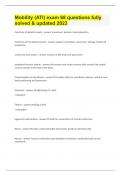
Mobility (ATI) exam| 68 questions fully solved & updated 2023.
Functions of skeletal muscle movement, posture, heat production Functions of the skeletal system support, protection, movement, storage, blood cell production central nervous system consists of the brain and spinal cord peripheral nervous system the sensory and motor neurons that connect the central nervous system to the rest of the body Proprioception or kinesthesia The bodies ability to coordinate, balance, and fine tune body positioning and movement Extension Straightening of a joint -relaxation Flexion bending a joint -contraction Ligaments and tendons Provide for connections of muscles and bones Bones Provide a solid and stable framework, produce red blood cells Nerves Control contraction and relaxation of muscles; coordinate balance and movement synovial joints Allow for flexibility and movement of bones Muscles Maintain posture and generate heat Cartilage Reduces friction between bones Body mechanics the proper use of the body to facilitate lifting and moving and prevent injury Body alignment the way the head, trunk, arms, and legs are aligned with one another; posture Proper body mechanics -stand or move as close to the object as possible -keep the abdominal muscles contracted and the lower back in its normal position -maintain the head upright with shoulders raised up -bow the hips slightly and squat -do not twist the torso, always pivot or side-step -push up from the knees and use that momentum to lift the object Ergonomics to prevent injury -the study of body mechanics in relation to the demand and design of the work environment, along with equipment used Poor= frustration, stress, workarounds, and exposure to dangerous situations -can increase work satisfaction, maximize productivity, and decrease the risk for injury and fatigue -benefits employer Moving a client -access level of mobility -get assistance -lock wheels -raise bed -position arms across chest -use draw sheet -lower bed Mobility the quality or state of being able to move about freely Prolonged immobility -reduced the load and stress on bones, contributing to a loss of mass, density, and strength -when muscles not used, they atrophy (become smaller and weaker) results in poor muscle coordination and reduced ability to perform activities of daily living -changed to structure and function of tendons, ligaments and cartilage (joints) begin after 4 days of bed rest, leads to changes in tissue tension, elasticity, and shape, leading to joint stiffness, and decreased ROM. Causes abnormal tissue both within and between joints, which restricts nourishment, cartilage deteriorates Joint contacture Abnormal fixations of the joints that occur as a result of changes to muscles and connective tissue. -flexor muscles stronger than extensor muscles -flexor muscles pull and place a joint in a bent, nonfunctional position, collagen fibers become fender and less flexible -can limit ROM, partially or permanently, may require surgery Foot drop Type of joint contracture that results in a partial or total inability to pull the toes up toward the head. Results from nerve entrapment and shortening of the calf muscles and Achilles' tendon. Foot is arched, toes pointed downward. Client unable to place the heel on the floor, causing toes to drag while walking. -result of immobility or an injury -peroneal nerve!! Sarcopenia The loss of lean muscle mass Disuse osteoporosis When bones have become thinner and weaker as a result of prolonged bed rest -fragile bones, prone to breaking under minor stress (fragility fractures) Cardiovascular system effects After only 24 hours, fluids present in lower extremities will be redistributed to the head, abdomen and chest areas -cardiac deconditioning: lowered demand from lower circulating blood volume decreasing the amount of blood Thats ejected when the heart contracts. Results in atrophy of the heart muscle Orthostatic hypotension- a drop in bp greater than 20 mmhg systolic pressure or 10mmhg diastolic pressure and symptoms of dizziness. Thrombus -monitor vitals while client is lying, sitting, and standing -monitor for dizziness -elevate head to promote blood flow to lower extremities -assist with position changes -teach to change positions slowly -apply anti embolism stockings to decrease venous pooling -implement fall precautions Deep Vein Thrombosis (DVT): -asses pulses and cap refill -observe for presence of edema -instruct to perform lower leg exercises -apply anti embolism stockings to promote venous return -compression -encourage fluid intake to prevent dehydration and decrease risk of clot -ambulated regularly -anticoagulant meds to decrease formation of clots orthostatic hypotension Decrease in blood pressure related to positional or postural changes from lying to sitting or standing positions Musculoskeletal reduced mobility Disuse osteoporosis: -monitor for increased pain (indicate fracture) -ambulate with assistance -hourly rounding to ensure needs met to decrease risk of falls Sarcopenia: -observe for finishing muscle mass, strength and coordination -monitor for weakness and unsteadiness and with increased activity -asses for fatigue with activity, could indicate loss of muscle mass or strength -encourage self care to use muscles -gradually increase activities -assist with ambulation Joint contracture: -asses for increased muscle tone, or rigidity -asses for ROM -monitor reports of stiffness and decreased ability to move the joints -encourage to perform ADLs to promote flexion and extension -ensure each joint is moved at least once every 8 hours -use splints for support and to stretch -inspect position and posture every 2 hours Foot drop: -observe foot position while at rest and ability to flex foot upward toward knee -monitor gait for toe dragging -apply splints to support and stretch -assist with ambulation Respiratory system effects Atelectasis: see slide for interventions -listen to lungs -observe chest wall movement for symmetry and depth Pneumonia: -listen to lungs for adventitious sounds, indicate secretions -observe rate, depth, and effort d -asses O2 levels -monitor swallowing -monitor lab reports for elevated white blood cells -asses vitals, elevated temp, heart rate, and respirations -use prone positioning to promote drainage -elevate head to 30-45 -encourage fluid intake to thin secretions -provide supplemental oxygen -encourage deep breathing and coughing to promote expansion and secretions -turn every 2 hours GI system effects Constipation: -listen to bowels -palpate -monitor bowel movements -asses for nausea, vomiting, pain in abdomen -encourage fluid intake -encourage consumption of high-fiber foods -increase mobility as tolerated Gastroesophageal Reflux: -asses the client for reports of heartburn or regurgitation -elevate head after meals Malnutrition: -monitor appetite and intake -asses weight daily -monitor lab values: serum albumin, serum protein, glucose, glucose, and electrolytes -instruct about high protein -help select foods -assist if needed -consult dietitian
Written for
- Institution
-
Chamberlain School Of Nursing
- Course
-
ATI- Mobility
Document information
- Uploaded on
- October 3, 2023
- Number of pages
- 16
- Written in
- 2023/2024
- Type
- Exam (elaborations)
- Contains
- Questions & answers
Subjects

Also available in package deal