Bus 395 Final Exam Questions With Correct Answers
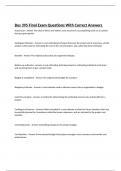
Actual Cost - Answer The total of direct and indirect costs incurred in accomplishing work on an activity during a given period Analogous Estimates - Answer A cost estimating technique that uses the actual cost of a previous, similar project as the basis for estimating the cost of the current project, also called top-down estimates. Baseline - Answer The original project plan plus approved changes. Bottom-up estimates - Answer A cost-estimating technique based on estimating individual work items and summing them to get a project total. Budget at completion - Answer The original total budget for a project. Budgetary Estimate - Answer A cost estimate used to allocate money into an organization's budget. Cash Flow Analysis - Answer A method for determining the estimated annual costs and benefits for a project. Contingency Reserves - Answer Dollars included in a cost estimate to allow for future situations that may be partially planned for. Sometimes called the known unknowns, and are included in the project cost baseline. Controlling Costs - Answer Controlling changes to the project budget. Cost Baseline - Answer A time-phased budget that project managers use to measure and monitor cost performance. Cost Management Plan - Answer A document that describes how cost variances will be managed on the project. Cost Performance Index - Answer The ratio of earned value to actual cost; can be used to estimate the projected cost to complete the project. Cost Variance - Answer The earned value minus the actual cost Definitive Estimate - Answer A cost estimate that provides an accurate estimate of project costs. Determining the Budget - Answer Allocating the overall cost estimate to individual work items to establish a baseline for measuring performance. Direct Costs - Answer Costs that can be directly related to producing the products and services of the project. Earned Value - Answer An estimate of the value of the physical work actually completed. Earned Value Management - Answer A project performance measurement technique that integrates scope, time, and cost data. Estimate at Completion - Answer An estimate of what it will cost to complete the project based on performance to date. Estimating costs - Answer Developing an approximation or estimate of the costs of the resources needed to complete the project. Indirect Costs - Answer Costs that are not directly related to the projects or services of the project, but are indirectly related to performing the project. Intangible costs or benefits - Answer Costs or benefits that are difficult to measure in monetary terms. Known unknowns - Answer Dollars included in a cost estimate to allow for future situations that may be partially planned for and are included in the project cost baseline. Learning curve theory - Answer A theory that states that when many items are produced repetitively, the unit cost of those items normally decreases in a regular pattern as more units are produced. Life cycle costing - Answer Considers the total cost of ownership, or development plus support cost, for a project. Management reserves - Answer Dollars included in a cost estimate to allow for future situations that are unpredictable. These situations are also called the unknown unknowns Overrun - Answer The additional percentage or dollar amount by which actual costs exceed estimates Parametric Modeling - Answer A cost-estimating technique that uses project characteristics in a mathematical model to estimate project costs. Planned value - Answer That portion of the approved total cost estimate planned to be spent on an activity during a given period. Profit Margin - Answer The ratio between revenues and profits. Profits - Answer Revenues minus expenses Project cost management - Answer The processes required to ensure that the project is completed within the approved budget. Rate of performance - Answer The ratio of actual work completed to the percentage of work planned to have been completed at any given time during the life of the project or activity. Rough order of magnitude estimate - Answer A cost estimate prepared very early in the life of a project to provide a rough idea of what a project will cost. Schedule performance index - Answer The ratio of earned value to planned value; can be used to estimate the projected time to complete a project. Schedule variance - Answer The earned value minus the planned value. Sunk cost - Answer Money that has been spent in the past Tangible costs or benefits - Answer Costs or benefits that can be easily measured in dollars. Top-down estimates - Answer A cost-estimating technique that uses the actual cost of a previous, similar project as the basis for estimating the cost of the current project, also called analogous estimates. 5 whys - Answer A technique where you repeatedly ask the question "WHY?" to help peel away the layers of symptoms that can lead to the root cause of a problem. Acceptance decisions - Answer Decisions that determine if the products or services produces as part of the project will be accepted or rejected Appraisal cost - Answer The cost of evaluating processes and their outputs to ensure that a project is error-free or within an acceptable error range. Benchmarking - Answer A techniques used to generate ideas for quality improvements by comparing specific project practices or product characteristics to those of other projects or products within or outside the performing organization. Capability Maturity Model Integration - Answer A process improvement approach that provides organizations with the essential elements of effective processes Cause and effect diagram - Answer Diagram that traces complaints about quality problems back to the responsible production operations to help find the root cause. Also known as fishbone diagram or Ishikawa diagram Conformance - Answer Delivering products that meet requirements and fitness for use. Conformance to requirements - Answer The project processes and products meet written specifications Control Chart - Answer A graphic display of data that illustrates the results of a process over time. Cost of nonconformance - Answer Taking responsibility for failures or not meeting quality expectations Cost of quality - Answer The cost of conformance plus the cost of nonconformance Defect - Answer Any instance where the product or service fails to meet customer requirements. DMAIC - Answer Define, Measure, Analyze, Improve, Control. __________ is a systematic, closed loop process for continues improvement that is scientific and fact based. Design of experiments - Answer A quality technique that helps identify which variables have the most influence on the overall outcome of a process. External failure cost - Answer A cost related to all errors not detected and corrected before delivery to the customers. Features - Answer The special characteristics that appeal to users Fishbone Diagram - Answer Diagram that traces complaints about quality problems back to the responsible production operation to help find the root cause. Also know as cause-and-effect diagram or Ishikawa diagram.
Written for
- Institution
- Bus 395
- Course
- Bus 395
Document information
- Uploaded on
- October 2, 2023
- Number of pages
- 19
- Written in
- 2023/2024
- Type
- Exam (elaborations)
- Contains
- Questions & answers
Subjects
- bus 395 stuvia
-
bus 395 final exam questions with correct answers
-
actual cost the total of direct and indirect costs
-
analogous estimates a cost estimating technique th

Also available in package deal