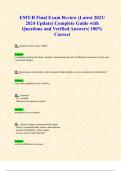
EMT-B Final Exam Review (Latest 2023/ 2024 Update) Complete Guide with Questions and Verified Answers| 100% Correct
EMT-B Final Exam Review (Latest 2023/ 2024 Update) Complete Guide with Questions and Verified Answers| 100% Correct Q: traumatic brain injury (TBI)? Answer: a traumatic insult to the brain. capable of producing physical, intellectual, emotional, social, and vocational changes Q: hypotension, tachycardia, slurred speech, dilated pupils, airway compromise (sometimes)? Answer: signs and symptoms of an overdose Q: - charcoal - O2 via NRB - Naloxone for opioid overdose? Answer: treatment for an overdose Q: - infant's tongue is proportionally larger - airway is proportionally shorter and narrower - increased flexibility of the trachea - airway can be easily blocked? Answer: newborn difference in airway Q: - breathing muscles are immature can manage normal breathing requirements easily but can become fatigued when stressed - ventilations that are too forceful can result in barotrauma - number of alveoli is lower - respiratory problems can become life-threatening? Answer: newborn difference in breathing Q: fetal. circulation through placenta --> independent circulation? Answer: newborn difference in circulation Q: normal vitals for toddler? Answer: - HR: 90-150 - RR: 20-30 - Systolic BP: 80-100 Q: normal vitals for school age children? Answer: - HR: 70-120 - RR: 15-20 - Systolic BP: 80-110 Q: normal vitals for adolescents? Answer: - HR: 60-100 - RR: 12-20 - Systolic BP: 90-110 Q: normal vitals for adults? Answer: - HR: 60-100 - RR: 12-20 - Systolic BP: 80-100 Q: dirty bomb? Answer: name given to an explosive radiologic dispersal device Q: weapon of mass destruction (WMD)? Answer: any agent designed to bring about mass death, casualties, massive damage to property and infrastructure (bridges, tunnels, airports, and seaports) Q: - appearance - work of breathing (abnormal airway noise, accessory muscle use, retractions, head bobbing, nasal flaring) - circulation to the skin? Answer: pediatric assessment triangle (PAT) Q: G: geriatric patients - present atypically - deserve respect - experience normal changes with age E: environmental assessment - what is the physical condition of the home? are there any repairs needed? - is there a fecal or urine odor in the home? - are pets well cared for? M: medical assessment - older patients tend to have a variety of medical problems; a trauma patient may have underlying conditions - obtain a medical history - primary assessment S: social assessment - assess the activities of daily living: eating, dressing, bathing, toiling? Answer: GEMS diamond Q: - calm, friendly manner - watch for signs of increased anxiety or fear - eye level - establish trust and communication - treat normally - establish what is normal and what isn't? Answer: what is important to consider when treating special needs patients? Q: hepatomegaly? Answer: abnormal enlargement of the liver
Written for
- Institution
- EMT-B - Emergency Medical Technician - Basic
- Course
- EMT-B - Emergency Medical Technician - Basic
Document information
- Uploaded on
- October 1, 2023
- Number of pages
- 56
- Written in
- 2023/2024
- Type
- Exam (elaborations)
- Contains
- Questions & answers
Subjects
-
emt b final exam review latest update
-
traumatic brain injury tbi
-
hypotension tachycardia slurred speech dilated
-
emtemt jb learning final examemt fisdap readines
-
emtemt b final examemt fisdap readines
Also available in package deal