Politics of Difference
Week 1
Lecture 1: Introduction
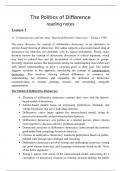
The Politics of Difference: “how power and political institutions categorize people into
groups and how this generates inequality”
Difference
- Protected in the private space
- Not present in the public sphere – public sphere is meant to be neutral
Public sphere
- Neutrality isn’t defined, it depends on the perspective and context
Take aways
- Not all differences are political, we’re interested in how and why some
differences become and remain political
- Defining what is “Normal” and what is “Different” is political
- Political scientists study differences between interests and identities
- Political theorists have often seen differences as best protected by respecting
individual freedom in the private sphere
- Critical theorists question the possibility of a neutral public sphere
- Describing difference – through statistics or otherwise – is political
Readings 2
Young
- The interest-based model of democracy presumes people cannot make claims on
others about justice or the public good
- Model of deliberative democracy
o Conceives democracy as a process that creates a public, citizens coming
together to talk about collective problems, goals, ideals, and actions.
o Mostly appears in the decision-making structures of voluntary
associations outside the state.
But also found in processes of state policy formation in
legislature or public hearings
o Participants come to a problem with an open mind, they are not bound by
prior norms or requirements
o Deliberation is both culturally neutral and universal
Lecture 2: Difference in Public
,The Public sphere is
- A communicative realm
- To discuss and debate the common interest and government
- Where the force of the better argument wins (coercion is absent)
- Where participants leave their status and identities behind
Public sphere as a realm of communication
- Places where people discuss and talk about politics
- Does not have to happen live, it can be online
Discussing the common interest
- May not be a subject of public concern
- TH Marshall: The ever going debate on who is a part of society and get to
contribute in it – who is able to have a voice?
o The first question the public faces
What is part of the common and what is the government?
- Key principle: the force of the better argument wins
o Potential for decisions to be made based on reason
A veil of ignorance
- A hypothetical state, in which decisions about social justice and the allocation of
resources would be made fairly, as if by a person who must decide on society’s
rules and economic structures without knowing what position they will occupy
in that society
Positionality
- All theory is for someone and some purpose
- Influenced by (in research):
o Method
o Gender
o Race/ethnicity
o Nationality
o Language
Bennett & Livingston
- Authoritarian stated perpetrate forms of information and use them as ways of
state control
- Three arguments on disinformation
o Confirmation bias: We begin our research with a set of beliefs. We
search for facts that confirm our beliefs
o Social media – no neutral arbiter
o State interference. The activity of foreign governments to look for
arguments
- Institutions: they prevent the proliferation of disinformation
- Loss of faith in political actors
Young
- “Deliberative democracy”
- Public = neutral sphere
, o Issues with that assumption
We are seeking arguments that can give us particular outcomes
- 3 ways to open up the public sphere
o Greeting
o Rhetoric
o Story telling
Recognizing positionality – Advantages
- Instead of encouraging pure objectivity, it encourages participants to reflect on
their positionality
- Instead of privileging the good of the (re)public, admits that the good of certain
groups may require unique solutions that go against the public interest
Take aways
- The public sphere is a realm of political debate where the better argument wins
- Political scientists debate how political truths are, but rarely whether truth is
possible
- Disinformation is the product of individual bias, social media, state interference
AND the erosion of institutions
- Communicative democracy places difference at the center of democratic debate
Week 2
Readings 3
Lecture 3: Religion
- Religion in Politics of Difference – Islam vs. west
- “Religion is on the rise”
o Driving force for politics
- More religious groups nowadays
- Religion as organized violence is a rising force
o But: religion has never gone away – foundation for modern politics
- Sovereignty: Hobbes
o Role of religion in society and politics
Religious tolerance as the foundation to the state system
- 30 years war – defining religion in your territory = sovereignty
- Diversity in religious models of tolerance
Secular politics
- Religion is thought of as a private concern
- Laicité = religion is kept outside
- Secular thought:
o Separation between church and state
Week 1
Lecture 1: Introduction
The Politics of Difference: “how power and political institutions categorize people into
groups and how this generates inequality”
Difference
- Protected in the private space
- Not present in the public sphere – public sphere is meant to be neutral
Public sphere
- Neutrality isn’t defined, it depends on the perspective and context
Take aways
- Not all differences are political, we’re interested in how and why some
differences become and remain political
- Defining what is “Normal” and what is “Different” is political
- Political scientists study differences between interests and identities
- Political theorists have often seen differences as best protected by respecting
individual freedom in the private sphere
- Critical theorists question the possibility of a neutral public sphere
- Describing difference – through statistics or otherwise – is political
Readings 2
Young
- The interest-based model of democracy presumes people cannot make claims on
others about justice or the public good
- Model of deliberative democracy
o Conceives democracy as a process that creates a public, citizens coming
together to talk about collective problems, goals, ideals, and actions.
o Mostly appears in the decision-making structures of voluntary
associations outside the state.
But also found in processes of state policy formation in
legislature or public hearings
o Participants come to a problem with an open mind, they are not bound by
prior norms or requirements
o Deliberation is both culturally neutral and universal
Lecture 2: Difference in Public
,The Public sphere is
- A communicative realm
- To discuss and debate the common interest and government
- Where the force of the better argument wins (coercion is absent)
- Where participants leave their status and identities behind
Public sphere as a realm of communication
- Places where people discuss and talk about politics
- Does not have to happen live, it can be online
Discussing the common interest
- May not be a subject of public concern
- TH Marshall: The ever going debate on who is a part of society and get to
contribute in it – who is able to have a voice?
o The first question the public faces
What is part of the common and what is the government?
- Key principle: the force of the better argument wins
o Potential for decisions to be made based on reason
A veil of ignorance
- A hypothetical state, in which decisions about social justice and the allocation of
resources would be made fairly, as if by a person who must decide on society’s
rules and economic structures without knowing what position they will occupy
in that society
Positionality
- All theory is for someone and some purpose
- Influenced by (in research):
o Method
o Gender
o Race/ethnicity
o Nationality
o Language
Bennett & Livingston
- Authoritarian stated perpetrate forms of information and use them as ways of
state control
- Three arguments on disinformation
o Confirmation bias: We begin our research with a set of beliefs. We
search for facts that confirm our beliefs
o Social media – no neutral arbiter
o State interference. The activity of foreign governments to look for
arguments
- Institutions: they prevent the proliferation of disinformation
- Loss of faith in political actors
Young
- “Deliberative democracy”
- Public = neutral sphere
, o Issues with that assumption
We are seeking arguments that can give us particular outcomes
- 3 ways to open up the public sphere
o Greeting
o Rhetoric
o Story telling
Recognizing positionality – Advantages
- Instead of encouraging pure objectivity, it encourages participants to reflect on
their positionality
- Instead of privileging the good of the (re)public, admits that the good of certain
groups may require unique solutions that go against the public interest
Take aways
- The public sphere is a realm of political debate where the better argument wins
- Political scientists debate how political truths are, but rarely whether truth is
possible
- Disinformation is the product of individual bias, social media, state interference
AND the erosion of institutions
- Communicative democracy places difference at the center of democratic debate
Week 2
Readings 3
Lecture 3: Religion
- Religion in Politics of Difference – Islam vs. west
- “Religion is on the rise”
o Driving force for politics
- More religious groups nowadays
- Religion as organized violence is a rising force
o But: religion has never gone away – foundation for modern politics
- Sovereignty: Hobbes
o Role of religion in society and politics
Religious tolerance as the foundation to the state system
- 30 years war – defining religion in your territory = sovereignty
- Diversity in religious models of tolerance
Secular politics
- Religion is thought of as a private concern
- Laicité = religion is kept outside
- Secular thought:
o Separation between church and state