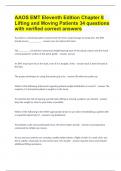
AAOS EMT Eleventh Edition Chapter 8 Lifting and Moving Patients| 34 questions with verified correct answers.docx
To protect a restrained patient and prevent him from using leverage to break free, the EMT should secure __________. one arm above the head The _________ is both the mechanical weight-bearing base of the spinal column and the fused central posterior section of the pelvic girdle. sacrum An EMT may injure his or her back, even if it is straight, if the: back is bent forward at the hips. The proper technique for using the power grip is to: lift with your palms up. Which of the following statements regarding patient weight distribution is correct? The majority of a horizontal patient's weight is in the torso. To minimize the risk of injuring yourself when lifting or moving a patient, you should: keep the weight as close to your body as possible. Which of the following is the MOST appropriate device to use when immobilizing a patient with a suspected spinal injury? Long backboard To facilitate a safe and coordinated move, the team leader should: use preparatory commands to initiate any moves. As you and your partner are carrying a stable patient down a flight of stairs in a stair chair, you feel a sudden, sharp pain in your lower back. You should: stop the move and request additional lifting assistance. When pulling a patient, you should extend your arms no more than ________ in front of your torso. 15 to 20 inches Which of the following statements regarding an emergency patient move is correct? An emergency move is performed before the primary assessment and treatment. Upon arriving at the scene of a motor vehicle crash, you find a single patient still seated in his car. There are no scene hazards. As you approach the vehicle, you note that the patient is semiconscious and has a large laceration to his forehead. You should: direct your partner to apply manual in-line support of the patient's head. The MOST serious consequence of a poorly planned or rushed patient move is: injury to you or your patient. Which of the following conditions or situations presents the MOST unique challenge to the EMT when immobilizing an elderly patient on a long backboard? Abnormal spinal curvature In contrast to typical wheeled ambulance stretchers, features of a bariatric stretcher include: increased stability from a wider wheelbase. When moving a conscious, weak patient down a flight of stairs, you should: place the wheeled stretcher at the bottom of the stairs and carry the patient down the stairs with a stair chair. It is essential that you ____________ your equipment to prevent the spread of disease. decontaminate You are attending to a 26-year-old female who is 34 weeks pregnant with her first child. Your patient has been having lower abdominal pains and cramping for the past two hours. In placing your patient on the stretcher and preparing for transport, you should place her: on her left side. You are attending to a 34-year-old male patient who requires transport to the hospital for assessment of his chronic back pain. The patient weighs over 750 pounds. Your bariatric stretcher has a wider surface area to allow for: increased patient comfort and dignity. You are attending to a 22-year-old female patient who has overdosed. The patient is unresponsive in an upstairs bedroom. The most appropriate way to bring the patient downstairs is: secured to a fracture board with the strongest provider at the head end. When carrying a patient up or down stairs, you should avoid: using a wheeled stretcher whenever possible. You should not attempt to lift a patient who weighs more than 250 lb with fewer than _______ rescuers, regardless of individual strength. four To avoid injury when pushing a patient or other object, you should: avoid pushing the patient with your elbows fully extended. You and your partner enter the residence of an elderly couple, both of whom are found unconscious in their bed. There is no evidence of trauma. As you begin your assessment, you and your partner notice the smell of natural gas in the residence. Which of the following should be your MOST appropriate action? Rapidly remove the patients from their residence using a blanket or clothes drag. Situations in which you should use the rapid extrication technique include all of the following, EXCEPT: a patient who can be properly assessed while still in the vehicle. When performing the rapid extrication technique to remove a patient from his or her vehicle, you should: apply a cervical collar and remove the patient on a long backboard. In which of the following situations would a direct ground lift be the MOST appropriate method of moving a patient? A conscious patient complaining of abdominal pain The extremity lift would NOT be appropriate to use on a patient: with a deformed humerus. The direct carry is used to transfer a patient: from a bed to the ambulance stretcher.
Written for
Document information
- Uploaded on
- September 29, 2023
- Number of pages
- 4
- Written in
- 2023/2024
- Type
- Exam (elaborations)
- Contains
- Questions & answers
Subjects

Also available in package deal