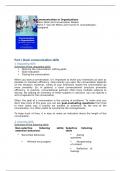
Communication in Organizations
Basic Skills and Conversation Models
Henk T. Van der Molen and Yvonne H. Gramsbergen-
Hoogland
Part I. Basic communication skills
1. Regulating skills
Overview of the regulating skills
Opening the conversation, setting goals
Goal evaluation
Closing the conversation
When you start a conversation, it is important to share your intentions as soon as
possible to maintain efficiency. How exactly you open the conversation depends
on the situation. However, clarity of your intentions makes the conversation go
more smoothly. So, in general, a clear conversational structure promotes
efficiency. In practice, conversational partners often have multiple subjects to
discuss. By making an inventory of these subjects in advance, you can specify a
sort of agenda for the conversation.
Often, the goal of a conversation is the solving of problems. To make sure you
don't lose track of this goal, you can ask goal-evaluating questions from time
to time (what was it exactly we wanted to achieve?). At the end of the
conversation, it is often useful to summarize the arrangements.
To keep track of time, it is wise to make an indication about the length of the
conversation.
2. Listening skills
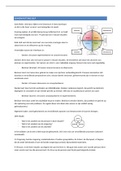
Overview of the listening skills
Non-selective listening skills; Selective listening
attentive behaviour skills
Nonverbal behaviour Asking
questions
Minimal encouragers Paraphrasing
of content
Reflection of
feelings
, Concreteness
Summarising
It is important to let your conversational partner know that they are being
listened to because:
1. It is stimulation for the partner.
2. One can avoid problems that occur when one does not listen well.
Selective listening skills are used by the listener to find out and select certain
aspects of the conversation that they find important. Non-selective skills are
hardly ever used alone. Even when one is only paying attention to somebody's
story, one often unconsciously selects what one finds important and gives more
attention to that part. That is why 'non' is in inverted commas.
According to Argyle (1981, 1988) approximately half of our communication is
composed of nonverbal behaviour, which is:
Facial expression.
Stimulation of eye contact.
You should neither have a fixed stare nor avoid the speaker's eyes
altogether.
A friendly and relaxed body posture.
Also, a relaxed conversation partner often evokes more trust.
Encouraging gestures (nodding and making supportive hand gestures).
The second non-selective way of showing interest is verbal flowing. This means
that the comments you make should be in line with what the speaker is saying,
and you don't start a new subject.
Minimal encouragers (hemming, yes... Then what?).
Ways to show selective listening are by:
Asking questions
o Open-ended questions (why?)
o Closed questions
Paraphrasing of content
o To check if you understood correctly
o Stimulating the speaker
Reflection of feelings
Concreteness
Summarising
3. Sender skills
Overview of the sender's skills
Sender skills - initiative Sender skills -
reactive
Giving information
Making requests and giving Refusing
instructions
Giving criticism Reacting
to criticism
Basic Skills and Conversation Models
Henk T. Van der Molen and Yvonne H. Gramsbergen-
Hoogland
Part I. Basic communication skills
1. Regulating skills
Overview of the regulating skills
Opening the conversation, setting goals
Goal evaluation
Closing the conversation
When you start a conversation, it is important to share your intentions as soon as
possible to maintain efficiency. How exactly you open the conversation depends
on the situation. However, clarity of your intentions makes the conversation go
more smoothly. So, in general, a clear conversational structure promotes
efficiency. In practice, conversational partners often have multiple subjects to
discuss. By making an inventory of these subjects in advance, you can specify a
sort of agenda for the conversation.
Often, the goal of a conversation is the solving of problems. To make sure you
don't lose track of this goal, you can ask goal-evaluating questions from time
to time (what was it exactly we wanted to achieve?). At the end of the
conversation, it is often useful to summarize the arrangements.
To keep track of time, it is wise to make an indication about the length of the
conversation.
2. Listening skills
Overview of the listening skills
Non-selective listening skills; Selective listening
attentive behaviour skills
Nonverbal behaviour Asking
questions
Minimal encouragers Paraphrasing
of content
Reflection of
feelings
, Concreteness
Summarising
It is important to let your conversational partner know that they are being
listened to because:
1. It is stimulation for the partner.
2. One can avoid problems that occur when one does not listen well.
Selective listening skills are used by the listener to find out and select certain
aspects of the conversation that they find important. Non-selective skills are
hardly ever used alone. Even when one is only paying attention to somebody's
story, one often unconsciously selects what one finds important and gives more
attention to that part. That is why 'non' is in inverted commas.
According to Argyle (1981, 1988) approximately half of our communication is
composed of nonverbal behaviour, which is:
Facial expression.
Stimulation of eye contact.
You should neither have a fixed stare nor avoid the speaker's eyes
altogether.
A friendly and relaxed body posture.
Also, a relaxed conversation partner often evokes more trust.
Encouraging gestures (nodding and making supportive hand gestures).
The second non-selective way of showing interest is verbal flowing. This means
that the comments you make should be in line with what the speaker is saying,
and you don't start a new subject.
Minimal encouragers (hemming, yes... Then what?).
Ways to show selective listening are by:
Asking questions
o Open-ended questions (why?)
o Closed questions
Paraphrasing of content
o To check if you understood correctly
o Stimulating the speaker
Reflection of feelings
Concreteness
Summarising
3. Sender skills
Overview of the sender's skills
Sender skills - initiative Sender skills -
reactive
Giving information
Making requests and giving Refusing
instructions
Giving criticism Reacting
to criticism