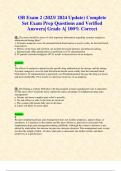
OB Exam 2 (2023/ 2024 Update) Complete Set Exam Prep Questions and Verified Answers| Grade A| 100% Correct
OB Exam 2 (2023/ 2024 Update) Complete Set Exam Prep Questions and Verified Answers| Grade A| 100% Correct Q: The nurse should be aware of what important information regarding systemic analgesics administered during labor? a. Systemic analgesics cross the maternal blood-brain barrier as easily as they do the fetal blood-brain barrier. b. Effects on the fetus and newborn can include decreased alertness and delayed sucking. c. Intramuscular (IM) administration is preferred over IV administration. d. IV patient-controlled analgesia (PCA) results in increased use of an analgesic. Answer: B The effects of analgesics depend on the specific drug administered, the dosage, and the timing. Systemic analgesics cross the fetal blood-brain barrier more readily than the maternal blood-brain barrier. IV administration is preferred over IM administration because the drug acts faster and more predictably. PCA results in a decrease in the use of an analgesic. Q: Developing a realistic birth plan with the pregnant woman regarding her care is important for the nurse. How would the nurse explain the major advantage of nonpharmacologic pain management? a. Greater and more complete pain relief is possible. b. No side effects or risks to the fetus are involved. c. The woman will remain fully alert at all times. d. Labor will likely be more rapid. Answer: B Because nonpharmacologic pain management does not include analgesics, adjunct drugs, or anesthesia, it is harmless to the mother and the fetus. However, pain relief is lessened with nonpharmacologic pain management during childbirth. Although the woman's alertness is not altered by medication, the increase in pain may decrease alertness. Pain management may or may not alter the length of labor. At times when pain is decreased, the mother relaxes and labor progresses at a quicker pace. Q: What is the correct terminology for the nerve block that provides anesthesia to the lower vagina and perineum? a. Epidural b. Pudendal c. Local d. Spinal block Answer: B A pudendal block anesthetizes the lower vagina and perineum to provide anesthesia for an episiotomy and the use of low forceps, if needed. An epidural provides anesthesia for the uterus, perineum, and legs. A local provides anesthesia for the perineum at the site of the episiotomy. A spinal block provides anesthesia for the uterus, perineum, and down the legs. Q: The obstetric nurse is preparing the client for an emergency cesarean birth, with no time to administer spinal anesthesia. The nurse is aware of and prepared for the greatest risk of administering general anesthesia to the client. What is this risk? a. Respiratory depression b. Uterine relaxation c. Inadequate muscle relaxation d. Aspiration of stomach contents Answer: D Aspiration of acidic gastric contents with possible airway obstruction is a potentially fatal complication of general anesthesia. Respirations can be altered during general anesthesia, and the anesthesiologist will take precautions to maintain proper oxygenation. Uterine relaxation can occur with some anesthesia but can be monitored and prevented. Inadequate muscle relaxation can be improved with medication. Q: What is the rationale for the use of a blood patch after spinal anesthesia? a. Hypotension b. Headache c. Neonatal respiratory depression d. Loss of movement Answer: B The subarachnoid block may cause a postspinal headache resulting from the loss of cerebrospinal fluid from the puncture in the dura. When blood is injected into the epidural space in the area of the dural puncture, it forms a seal over the hole to stop the leaking of cerebrospinal fluid. Hypotension is prevented by increasing fluid volume before the procedure. Neonatal respiratory depression is not an expected outcome with spinal anesthesia. Loss of movement is an expected outcome of spinal anesthesia. Q: Maternal hypotension is a potential side effect of regional anesthesia and analgesia. What nursing interventions could the nurse use to increase the client's blood pressure? (Select all that apply.) a. Place the woman in a supine position. b. Place the woman in a lateral position. c. Increase IV fluids. d. Administer oxygen. e. Perform a vaginal examination. Answer: B, C, D Nursing interventions for maternal hypotension arising from analgesia or anesthesia include turning the woman to a lateral position, increasing IV fluids, administering oxygen via face mask, elevating the woman's legs, notifying the physician, administering an IV vasopressor, and monitoring the maternal and fetal status at least every 5 minutes until the woman is stable. Placing the client in a supine position causes venous compression, thereby limiting blood flow to and oxygenation of the placenta and fetus. A sterile vaginal examination has no bearing on maternal blood pressure. Q: Which alternative approaches to relaxation have proven successful when working with the client in labor? (Select all that apply.) a. Aromatherapy b. Massage c. Hypnosis d. Cesarean birth e. Biofeedback Answer: A, B, C, E Approaches to relaxation can include neuromuscular relaxation, aromatherapy, music, massage, imagery, hypnosis, or touch relaxation. Cesarean birth is a method of delivery, not a method of relaxation. Q: A woman has requested an epidural block for her pain. She is 5 cm dilated and 100% effaced. The baby is in a vertex position and is engaged. The nurse increases the woman's IV fluid for a preprocedural bolus. Before the initiation of the epidural, the woman should be informed regarding the disadvantages of an epidural block. Which concerns should the nurse share with this client? (Select all that apply.) a. Ability to move freely is limited. b. Orthostatic hypotension and dizziness may occur. c. Gastric emptying is not delayed. d. Higher body temperature may occur. e. Blood loss is not excessive. Answer: A, B, D The woman's ability to move freely and to maintain control of her labor is limited, related to the use of numerous medical interventions (IV lines and electronic fetal monitoring [EFM]). Significant disadvantages of an epidural block include the occurrence of orthostatic hypotension, dizziness, sedation, and leg weakness. Women who receive an epidural block have a higher body temperature (38° C or higher), especially when labor lasts longer than 12 hours, and may result in an unnecessary neonatal workup for sepsis. An advantage of an epidural block is that blood loss is not excessive. Other advantages include the following: the woman remains alert and able to participate, good relaxation is achieved, airway reflexes remain intact, and only partial motor paralysis develops. Q: The class of drugs known as opioid analgesics (butorphanol, nalbuphine) is not suitable for administration to women with known opioid dependence. The antagonistic activity could precipitate withdrawal symptoms (abstinence syndrome) in both mothers and newborns. Which signs would indicate opioid or narcotic withdrawal in the mother? (Select all that apply.) a. Yawning, runny nose b. Increase in appetite c. Chills or hot flashes d. Constipation e. Irritability, restlessness Answer: A, C, E The woman experiencing maternal opioid withdrawal syndrome will exhibit yawning, runny nose, sneezing, anorexia, chills or hot flashes, vomiting, diarrhea, abdominal pain, irritability, restlessness, muscle spasms, weakness, and drowsiness. Assessing both the mother and the newborn and planning the care accordingly are important steps for the nurse to take. Q: While developing an intrapartum care plan for the client in early labor, which psychosocial factors would the nurse recognize upon the client's pain experience? (Select all that apply.) a. Culture b. Anxiety and fear c. Previous experiences with pain d. Intervention of caregivers e. Support systems Answer: A, B, C, E Culture: A woman's sociocultural roots influence how she perceives, interprets, and responds to pain during childbirth. Some cultures encourage loud and vigorous expressions of pain, whereas others value self-control. The nurse should avoid praising some behaviors (stoicism) while belittling others (noisy expression). Anxiety and fear: Extreme anxiety and fear magnify the sensitivity to pain and impair a woman's ability to tolerate it. Anxiety and fear increase muscle tension in the pelvic area, which counters the expulsive forces of uterine contractions and pushing efforts. Previous experiences with pain: Fear and withdrawal are a natural response to pain during labor. Learning about these normal sensations ahead of time helps a woman suppress her natural reactions of fear regarding the impending birth. If a woman previously had a long and difficult labor, she is likely to be anxious. She may also have learned ways to cope and may use these skills to adapt to the present labor experience. Support systems: An anxious partner is less able to provide help and support to a woman during labor. A woman's family and friends can be an important source of support if they convey realistic and positive information about labor and delivery. Although the intervention of caregivers may be necessary for the well-being of the woman and her fetus, some interventions add discomfort to the natural pain of labor (i.e., fetal monitor straps, IV lines). Q: A, B, C, E Culture: A woman's sociocultural roots influence how she perceives, interprets, and responds to pain during childbirth. Some cultures encourage loud and vigorous expressions of pain, whereas others value self-control. The nurse should avoid praising some behaviors (stoicism) while belittling others (noisy expression). Anxiety and fear: Extreme anxiety and fear magnify the sensitivity to pain and impair a woman's ability to tolerate it. Anxiety and fear increase muscle tension in the pelvic area, which counters the expulsive forces of uterine contractions and pushing efforts. Previous experiences with pain: Fear and withdrawal are a natural response to pain during labor. Learning about these normal sensations ahead of time helps a woman suppress her natural reactions of fear regarding the impending birth. If a woman previously had a long and difficult labor, she is likely to be anxious. She may also have learned ways to cope and may use these skills to adapt to the present labor experience. Support systems: An anxious partner is less able to provide help and support to a woman during labor. A woman's family and friends can be an important source of support if they convey realistic and positive information about labor and
Written for
- Institution
- OB
- Course
- OB
Document information
- Uploaded on
- September 27, 2023
- Number of pages
- 124
- Written in
- 2023/2024
- Type
- Exam (elaborations)
- Contains
- Questions & answers

Also available in package deal