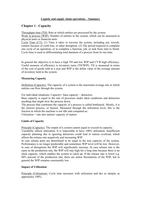
Logistic and supply chain operations – Summary
Chapter 1 - Capacity
Throughput time (TH): Rate at which entities are processed by the system
Work in process (WIP): Number of entities in the system, which can be measured in
physical units or financial units
Cycle Time (CT): (1) Time it takes to traverse the system, including any rework,
restarts because of yield loss, or other disruption. (2) The period required to complete
one cycle of an operation; or to complete a function, job, or task from start to finish.
Cycle time is used in differentiating total duration of a process from its run time.
In general the objective is to have a high TH and low WIP and CTà high efficiency.
Useful measure of efficiency is inventory turns (TH/WIP). TH is measured in terms
of the cost of goods sold in a year and WIP is the dollar value of the average amount
of inventory held in the system.
Measuring Capacity
Definition (Capacity): The capacity of a system is the maximum average rate at which
entities can flow through the system.
For individual situations: Capacity= base capacity – detractors
Base capacity is equal to the rate of processes under ideal conditions and detractors
anything that might slow the process down.
The process that constrains the capacity of a process is called bottleneck. Mostly, it is
the slowest process, or busiest. Measured through the utilization level, this is the
fraction in which the machine is not idle and computed as:
Utilization = rate into station/ capacity of station
Limits of Capacity
Principle (Capacity): The output of a system cannot equal or exceed its capacity.
Variability affects utilization. It is impossible to have 100% utilization. Insufficient
capacity planning due to ignoring detractors could lead to station overload, which
affects the release rate negatively and increasing WIP.
In case release parts are determined to be equal to the true capacity of the system.
Performance is no longer predictable and sometimes WIP level will be low. However,
in case of disruptions the WIP will significantly increase. In case release rate is the
same as the production rate, the WIP will stay high for a long time because there is no
slack capacity, which enables the system to catch up. If the release rate is lower e.g.
80% percent of the production rate, there are minor fluctuations of the WIP, but in
general the WIP remains consistently low.
Impact of Utilization
Principle (Utilization): Cycle time increases with utilization and des so sharply as
approaches 100%.
1
Chapter 1 - Capacity
Throughput time (TH): Rate at which entities are processed by the system
Work in process (WIP): Number of entities in the system, which can be measured in
physical units or financial units
Cycle Time (CT): (1) Time it takes to traverse the system, including any rework,
restarts because of yield loss, or other disruption. (2) The period required to complete
one cycle of an operation; or to complete a function, job, or task from start to finish.
Cycle time is used in differentiating total duration of a process from its run time.
In general the objective is to have a high TH and low WIP and CTà high efficiency.
Useful measure of efficiency is inventory turns (TH/WIP). TH is measured in terms
of the cost of goods sold in a year and WIP is the dollar value of the average amount
of inventory held in the system.
Measuring Capacity
Definition (Capacity): The capacity of a system is the maximum average rate at which
entities can flow through the system.
For individual situations: Capacity= base capacity – detractors
Base capacity is equal to the rate of processes under ideal conditions and detractors
anything that might slow the process down.
The process that constrains the capacity of a process is called bottleneck. Mostly, it is
the slowest process, or busiest. Measured through the utilization level, this is the
fraction in which the machine is not idle and computed as:
Utilization = rate into station/ capacity of station
Limits of Capacity
Principle (Capacity): The output of a system cannot equal or exceed its capacity.
Variability affects utilization. It is impossible to have 100% utilization. Insufficient
capacity planning due to ignoring detractors could lead to station overload, which
affects the release rate negatively and increasing WIP.
In case release parts are determined to be equal to the true capacity of the system.
Performance is no longer predictable and sometimes WIP level will be low. However,
in case of disruptions the WIP will significantly increase. In case release rate is the
same as the production rate, the WIP will stay high for a long time because there is no
slack capacity, which enables the system to catch up. If the release rate is lower e.g.
80% percent of the production rate, there are minor fluctuations of the WIP, but in
general the WIP remains consistently low.
Impact of Utilization
Principle (Utilization): Cycle time increases with utilization and des so sharply as
approaches 100%.
1