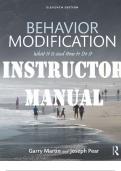
, Instructor’s Manual
for
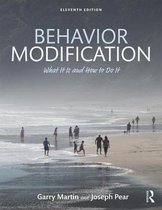
Martin and Pear
Behavior Modification
What It Is and How to Do It
Eleventh Edition
Routledge
Taylor & Francis Group
,Copyright © 2019 by Taylor and Francis. All rights reserved. Manufactured in the United States
of America. The contents, or parts thereof, may be reproduced with Behavior Modification: What
It Is and How to Do It, Eleventh Edition, by Garry Martin and Joseph Pear, provided such
reproductions bear copyright notice, but may not be reproduced in any form for any other
purpose without written permission from the copyright owner. To obtain permission(s) to use
material from this work, please visit the Rights and Permissions page at
https://www.routledge.com/info/permissions.
:
, PREFACE
Considering the extensive study aids already incorporated into the text, as well as our
own experience in using the first ten editions of the text during the past 41 years, we believe that
the most helpful additional material we can give an instructor is our detailed answer key to all of
the Questions for Learning in the text, including the Questions for Further Learning in the
Notes for Further Learning (NfFL) sections. Having such an answer key available can be a
tremendous time-saver for instructors and can greatly facilitate accurate and consistent grading
by teaching assistants. Part II of this manual, therefore, contains answers to all Q uestions for
Learning and Questions for Further Learning. The form of the suggested answers varies
somewhat according to the type of question asked.
As mentioned in the Preface to the text, the NfFL sections contain information that
might be used by instructors as springboards for lecture material. Our suggested answers to the
Questions for Further Learning in the NfFL sections, besides being helpful to course graders,
may also prove useful to instructors when elaborating or expanding on the material in the NfFL
sections.
The Questions for Learning and the Questions for Further Learning were prepared by the
authors of the text. For instructors who wish to use option-based questions, a pool of multiple-
choice and true/false questions has been provided in Part III on a chapter-by-chapter basis by
Nicole Duy, Garry Martin, Nickie Martin, and Brunata Smyk. The multiple-choice and true/false
questions are as closely related a s possible to the material contained in the answers to the
Questions for Learning and the Questions for Further Learning. This was a deliberate tactic so
that students who master the textual material by learning answers to the Questions for
Learning and Questions for Further Learning will perform well on the multiple-choice and
true/false questions.
Included in the Instructor’s Manual in Part IV are fifteen in-class practica or mini-lab
exercises that have been developed and field-tested. Each exercise is designed for completion
by a group of two or three students during a regularly scheduled class. After students have
studied and been examined on relevant chapters, completion of a practicum helps them learn
to talk about and apply behavior modification principles. Feedback from students indicates that
the exercises are an excellent teaching tool.
Also in this edition of the Instructor’s Resource Manual is a section (Part I) on the
Thinking Levels required to fully answer the Questions for Learning and the Questions for
Further Learning in the text. This information is based on research carried out by Joseph Pear
using the Questions for Learning in a Computer-Aided Personalized System of Instruction
approach (see www.capsi.org). As mentioned in Part I, there are a number of uses instructors
can make of this information.
Garry Martin and Joseph Pear
iii
for
Martin and Pear
Behavior Modification
What It Is and How to Do It
Eleventh Edition
Routledge
Taylor & Francis Group
,Copyright © 2019 by Taylor and Francis. All rights reserved. Manufactured in the United States
of America. The contents, or parts thereof, may be reproduced with Behavior Modification: What
It Is and How to Do It, Eleventh Edition, by Garry Martin and Joseph Pear, provided such
reproductions bear copyright notice, but may not be reproduced in any form for any other
purpose without written permission from the copyright owner. To obtain permission(s) to use
material from this work, please visit the Rights and Permissions page at
https://www.routledge.com/info/permissions.
:
, PREFACE
Considering the extensive study aids already incorporated into the text, as well as our
own experience in using the first ten editions of the text during the past 41 years, we believe that
the most helpful additional material we can give an instructor is our detailed answer key to all of
the Questions for Learning in the text, including the Questions for Further Learning in the
Notes for Further Learning (NfFL) sections. Having such an answer key available can be a
tremendous time-saver for instructors and can greatly facilitate accurate and consistent grading
by teaching assistants. Part II of this manual, therefore, contains answers to all Q uestions for
Learning and Questions for Further Learning. The form of the suggested answers varies
somewhat according to the type of question asked.
As mentioned in the Preface to the text, the NfFL sections contain information that
might be used by instructors as springboards for lecture material. Our suggested answers to the
Questions for Further Learning in the NfFL sections, besides being helpful to course graders,
may also prove useful to instructors when elaborating or expanding on the material in the NfFL
sections.
The Questions for Learning and the Questions for Further Learning were prepared by the
authors of the text. For instructors who wish to use option-based questions, a pool of multiple-
choice and true/false questions has been provided in Part III on a chapter-by-chapter basis by
Nicole Duy, Garry Martin, Nickie Martin, and Brunata Smyk. The multiple-choice and true/false
questions are as closely related a s possible to the material contained in the answers to the
Questions for Learning and the Questions for Further Learning. This was a deliberate tactic so
that students who master the textual material by learning answers to the Questions for
Learning and Questions for Further Learning will perform well on the multiple-choice and
true/false questions.
Included in the Instructor’s Manual in Part IV are fifteen in-class practica or mini-lab
exercises that have been developed and field-tested. Each exercise is designed for completion
by a group of two or three students during a regularly scheduled class. After students have
studied and been examined on relevant chapters, completion of a practicum helps them learn
to talk about and apply behavior modification principles. Feedback from students indicates that
the exercises are an excellent teaching tool.
Also in this edition of the Instructor’s Resource Manual is a section (Part I) on the
Thinking Levels required to fully answer the Questions for Learning and the Questions for
Further Learning in the text. This information is based on research carried out by Joseph Pear
using the Questions for Learning in a Computer-Aided Personalized System of Instruction
approach (see www.capsi.org). As mentioned in Part I, there are a number of uses instructors
can make of this information.
Garry Martin and Joseph Pear
iii