NURSING 4535L Q&A
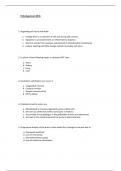
NURSING 4535L Q&A Question 1 Which lymph node assessment findings are abnormal Selected Answer: Size of 1.5 centimeters, immobile. 4 out of 4 points Correct Answer: Size of 1.5 centimeters, immobile. Response Feedback: Hard, confluent, larger than 1.5 cm and tender are abnormal findings. Question 2 After having a client perform a Romberg test, which of the following would indicate to the nurse that the test is negative? Selected Answer: Client maintains the position during the test. 4 out of 4 points Correct Answer: Client maintains the position during the test. Question 3 To test bone versus air conduction of hearing, the nurse would use which tuning fork test? Selected Answer: 4 out of 4 points Correct Answer: Rinne Rinne Question 4 4 out of 4 points True or false Malignant melanoma is related to sun exposure and has no genetic component. Selected Answer: Correct Answer: Fals e Fals e Question 5 On inspection of a client's fingernails, nailplate is detached from the nail bed. The nurse should further assess for which condition? 4 out of 4 points Selected Answer: Infecti on Correct Answer: Infecti on Response Feedback: This could be a fungal infection Question 6 4 out of 4 points This lesion is caused by tinea corporis, or ringworm, a fungal infection. It is a flat circular lesion and this example is 12 mm in diameter. Which of the terms below describes this? (If you cannot see this on your computer the description provides adequate data to distinguish the correct answer.) Selected Answer: Annul ar Correct Answer: Annul ar Question 7 4 out of 4 points A mother brings her child to the clinic reporting the child’s teacher told her the child is having difficulty seeing the words on the white board in the classroom. Which assessment method would be most appropriate initially for the nurse to use? Selected Answer: Snellen E chart Correct Answer: Snellen E Response Feedback: chart p. 236 Question 8 An adult male client visits the outpatient center and tells the nurse that he has been experiencing patchy hair loss. The nurse should further assess the client for: Selected Answer: Systemic lupus erythematosus 4 out of 4 points Correct Answer: Systemic lupus erythematosus Response Feedback: See your textbook in the section in the assessment table under patch hair loss. Question 9 The nurse is planning to assess the client's thyroid gland. To facilitate palpation, the nurse should ask the client should to: Selected Answer: swallow water. 4 out of 4 points Correct Answer: swallow water. Response Feedback: Swallowing water causes the thyroid to be more easily palpable. Question 10 4 out of 4 points Which action would be most appropriate when a nurse assesses the umbilical cord of a 3-day-old infant and finds it to be dried? Selected Answer: Recognize this as normal. Correct Answer: Recognize this as normal. Question 11 The nurse is assessing a 2-day-old infant prior to discharge home from the hospital with his 4 out of 4 points mother. When assessing the infant's eyes, what finding would the nurse consider abnormal? Selected Answer: The infant's sclerae have a yellowish tint. Correct Answer: The infant's sclerae have a yellowish tint. Response Feedback: In chapter 30, look in the "Subsequent Infant Physical Assessment" table, in the section covering eyes. Question 12 In regard to motor development, which child should the pediatric nurse suspect of having a developmental delay? Selected Answer: An 11-month-old who does not pull himself to a standing position Correct Answer: An 11-month-old who does not pull himself to a standing position 4 out of 4 points Response Feedback: See chapter 30, the section on motor development, and the pictures on the following page. Those of you who are parents or have brothers or sisters much younger than you, have the advantage with this question since you may be able to remember the infancy of your family members. The abnormally late finding is the 11-month old who is not pulling up to standing. Question 13 The nurse is assessing a newborn's rooting reflex. What action should the nurse perform during this assessment? Selected Answer: Touch the infant's lip or cheek with a gloved finger. Correct Answer: Touch the infant's lip or cheek with a gloved finger. 4 out of 4 points Response Feedback: The rooting reflex is what causes the infant to turn his head toward the side when his cheek is stroked. Box 30-1 describes this.
Written for
- Institution
- NURSING 4535L
- Course
- NURSING 4535L
Document information
- Uploaded on
- September 25, 2023
- Number of pages
- 13
- Written in
- 2023/2024
- Type
- Exam (elaborations)
- Contains
- Questions & answers
Subjects