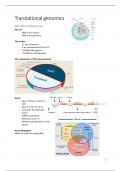
Translational genomics
Genome architecture
The cell
- DNA in the nucleus
- DNA in mitochondria
The nucleus
- 22 pair autosomes
- 2 sex chromosomes (XX or XY)
- ~20.000 coding genes
- ~25.000 non-coding genes
The components of the human genome
Genes
- Gene → from 5’ UTR to 3’
UTR
- Exon 1 → GC rich → to
encounter the right start
codon
- Different splicing in
different tissues →
different splicing factors in the
tissues
Non-coding genes
piRNA → small non-coding RNA
1
,Small ncRNA: mechanism of action
Dicer cuts the small ncRNA to
even smaller pieces
RNA in RISC complex →
recognizes mRNA and binds to it
→ inhibition of translation
initiation/elongation/mRNA
deadenylation
Feingold syndrome 2
- miR-17~92 deletion
Long non-coding RNA (lncRNA): types
2
,NATs: mechanism of action
- RNA pol II clashes on the DNA
- The gene changes the splicing
- RNA editing → nuclear retention or
RNAi that inhibits gene expression
- So: interfering with protein
expression, splicing, and regulation
the expression later on (when they
are already formed)
Regulatory sequences
Core promoter
Inr → start of transcription
Transposable elements (TEs)
- ~45% of the human genome
- <0.05% active
- Most abundant: Alu elements (10% of the human genome)
- Can cause disease if they jump into genes
- piRNA → make sure that these elements don’t cause harm
Genomic imprinting
- Present at birth and not changing throughout life
- Most extreme example of the effect of epigenetic modification of gene expression → X-
inactivation
3
, DNA methylation
- DNA methylation → imprinting → inactivation
- Compaction of the chromatin
Genomic imprinting
- Essential for normal development
- Deregulation results in complex genetic
diseases
- ~100 imprinted genetic loci
- Prader-Willi/Angelman syndrome → 15q11-
13
- Angelman syndrome
o Intellectual disability
o Laugh a lot unexpectedly
o Ataxia
o No speech
o Epilepsy
o Typical face
o Friendly
- Prader-Willi syndrome
o Neonatally → hypotonia and feeding problems
o First decade of life
▪ Obesitas
▪ Small
▪ Intellectual disability (mild)
▪ Hypogonadism
▪ Behavioral problems
Uniparental disomy: AS/PWS
4
Genome architecture
The cell
- DNA in the nucleus
- DNA in mitochondria
The nucleus
- 22 pair autosomes
- 2 sex chromosomes (XX or XY)
- ~20.000 coding genes
- ~25.000 non-coding genes
The components of the human genome
Genes
- Gene → from 5’ UTR to 3’
UTR
- Exon 1 → GC rich → to
encounter the right start
codon
- Different splicing in
different tissues →
different splicing factors in the
tissues
Non-coding genes
piRNA → small non-coding RNA
1
,Small ncRNA: mechanism of action
Dicer cuts the small ncRNA to
even smaller pieces
RNA in RISC complex →
recognizes mRNA and binds to it
→ inhibition of translation
initiation/elongation/mRNA
deadenylation
Feingold syndrome 2
- miR-17~92 deletion
Long non-coding RNA (lncRNA): types
2
,NATs: mechanism of action
- RNA pol II clashes on the DNA
- The gene changes the splicing
- RNA editing → nuclear retention or
RNAi that inhibits gene expression
- So: interfering with protein
expression, splicing, and regulation
the expression later on (when they
are already formed)
Regulatory sequences
Core promoter
Inr → start of transcription
Transposable elements (TEs)
- ~45% of the human genome
- <0.05% active
- Most abundant: Alu elements (10% of the human genome)
- Can cause disease if they jump into genes
- piRNA → make sure that these elements don’t cause harm
Genomic imprinting
- Present at birth and not changing throughout life
- Most extreme example of the effect of epigenetic modification of gene expression → X-
inactivation
3
, DNA methylation
- DNA methylation → imprinting → inactivation
- Compaction of the chromatin
Genomic imprinting
- Essential for normal development
- Deregulation results in complex genetic
diseases
- ~100 imprinted genetic loci
- Prader-Willi/Angelman syndrome → 15q11-
13
- Angelman syndrome
o Intellectual disability
o Laugh a lot unexpectedly
o Ataxia
o No speech
o Epilepsy
o Typical face
o Friendly
- Prader-Willi syndrome
o Neonatally → hypotonia and feeding problems
o First decade of life
▪ Obesitas
▪ Small
▪ Intellectual disability (mild)
▪ Hypogonadism
▪ Behavioral problems
Uniparental disomy: AS/PWS
4