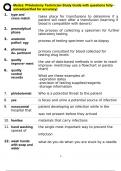
Medca: Phlebotomy Technician Study Guide with questions fully solved(verified for accuracy)
1. type and cross match 2. preanalytical phase 3. anatomic pathol- ogy 4. pharmacy de- partment 5. quality improve- ment 6. quality control records takes place for transfusions to determine if a patient will react after a transfusion (learning if blood is compatible with donors) the process of collecting a specimen for further laboratory testing process of testing specimen such as biopsy primary consultant for blood collected for testing drug levels the use of data-based methods in order to reach improve- ment(may use a flowchart or pareto chart) What are these examples of: -expiration dates -precision of testing supplies/reagents -storage information 7. phlebotomist Who is a potential threat to the patient 8. yes is feces and urine a potential source of infection 9. nosocomial patient developing an infection while in the hospital that was not present before they arrived 10. fomites materials that carry infections 11. hand washing the single most important way to prevent the spread of infection 12. wash hands with soap and water what do you do when you are stuck by a needle 13. blood pressure pressure exerted by circulating blood upon the walls of blood vessels 14. arterial blood pressure usually refers to the pres- sure of systemic circulation 15. systolic pres- is maximum while diastolic pressure is sure minimum 16. decreases blood pressure when blood moves away from the heart 17. inside blood pressure is usually measured on the of the elbow, at a person's upper arm 18. 120/80 what is the normal blood pressure reading (with systolic being the higher number, and diastolic being the lower number) 19. systolic -heart contracting -maximum arterial pressure during the contraction is in the left ventricle -also called ventricular contraction 20. diastolic -relaxation and dilation(expansion) period -minimum arterial pressure is when ventricles are filled with blood 21. diastolic sound sound heard during diastole 22. pulse rhythmical expansion of arteries due to heart contractions 23. increases when you breathe in your heart rate 24. ankle Your pulse can be felt at the wrist(radial artery), neck(carotid artery), inside elbow(brachial artery), behind knee(popliteal artery), and around the joint(posterior tibial artery) 25. index and middle the fingers can feel for the pulse 26. thumb what has a pulse of it's own 27. 120-60 what should someone's pulse rate be between 28. serum when blood clots what is the fluid called 29. homeostasis what is the steady state of the body called 30. bone marrow where is blood made 31. 95 the bone marrow produces % of the blood cells using the liver, spleen, and lymph nodes to help with cell regu- lation 32. stem cells what do blood cells originate as 33. platelets blood cells include, red blood cells(erythrocytes), white blood cells(leukocytes), and (thrombo- cytes) 34. 45 erythrocytes, leukocytes, and thrombocytes make up % of the blood tissue 35. plasma what makes up 55% of the blood tissue 36. 8 blood makes up _% of the average humans body weight 37. 5 How many liters of blood are in the body 38. pH measures the hydrogen ion concentration 39. 7.35 to 7.45 what should the normal blood pH level be 40. acidic less than the 7.35 pH blood level would be considered what 41. alkaline more than the 7.45 pH blood level would be considered what 42. carbon dioxide what does blood primarily carry out of the body tissues 43. white blood cells what cell contains a nucleus and 46 44. red blood cells blood cell that carries oxygen to body tissues 45. hemoglobin iron-containing pigment that gives erythrocytes their color 46. anemia term known as not having enough red blood cells that contain iron 47. polycythemia -term known as having too many red blood cell that con- tain iron -also known as hematochromatosis 48. 100-120 days life span of an erythrocyte 49. 2 million how many red blood cells are made par second 50. 7 days how long does it take for a red blood cell to mature 51. reticulocytes what are immature red blood cells called 52. eryptosis process of removing defective red blood cell 53. hematopoietic hormone in the bone marrow that produces blood cells 54. leukocytes what are these(use medical terminology): --granulocytes: neutrophils, basophils, eosinophils --lymphoid cells: monocytes, lymphocytes 55. lymphocytes -kills leukocytes after 13-20 days(lifespan of WBCs) -grouped in B,T,NK cells -common in lymphatic system 56. neutrophils defends against fungi, bacterial infection 57. basophils responsible for antigens and allergic reaction by releasing histamine 58. monocytes -forerunners of macrophages -becomes macrophages 24-36 hours after entering circu- latory system 59. eosinophils defends against parasites 60. immune system white blood cells are cells of the and help defend against diseases and foreign material 61. platelet cells cells responsible for clotting 62. hemorrhage what can a low amount of platelets lead to 63. blood clots too many platelets may result in formation of that can hinder blood vessels 64. 30-60 minutes how long does it take for a blood specimen to clot 65. megakaryocyte what do platelets form off of 66. thrombopoietin -the process of platelets forming is called -produced in the live & kidneys 67. 5,000-10,000 how many platelets do megakaryocytes produce 68. phagocytosis -the destruction of platelets takes place by what -it occurs in the spleen 69. spleen where are some platelets stored 70. fibrinogen and vWF platelets use as connect- ing agents to clump together 71. chemicals and water capillaries are responsible for the exchange of between blood and tissue 72. 2 how many layer do veins have 73. 3 how many layers doe arteries have 74. aortic arches what does the arterial system develop from 75. 4 after how many weeks of human development does the arterial system develop 76. 30 about how many branches branch off the aorta 77. umbilical the venous system develops from veins, the cardinal veins, and the vitelline veins 78. pulmonary and umbilical arter- ies arteries carry oxygen-rich blood away from the heart with the exception of the arter- ies 79. pulmonary and umbilical veins carry oxygen-deprived blood from tissues back to- wards the heart with the exception of the veins that carry oxygen-rich blood to the heart 80. arterioles -small blood vessels in microcirculations -gives blood to capillaries -carries oxygen-rich blood away from heart 81. capillaries -small blood vessels in microcirculations -gives blood to venules -"supply cell" -two main types: continuous, fenestrated 82. venules -small blood vessels in microcirculations -carry oxygen-deprived blood from capillaries to vein
Written for
Document information
- Uploaded on
- September 22, 2023
- Number of pages
- 27
- Written in
- 2023/2024
- Type
- Exam (elaborations)
- Contains
- Questions & answers
Subjects
-
medca phlebotomy technician study guide
-
medca phlebotomy technician

Also available in package deal