Political Science 144
Chapter 25: Nuclear Proliferation
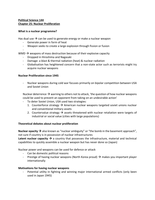
What is a nuclear programme?
Has dual use can be used to generate energy or make a nuclear weapon
- Generate power in form of heat
- Weapon seeks to create a large explosion through fission or fusion
-
WMD weapons of mass destruction because of their explosive capacity
- Dropped in Hiroshima and Nagasaki
- Damage: a blast & thermal radiation (heat) & nuclear radiation
- Globalisation has heightened concern that a non-state actor such as terrorists might try
acquire nuclear weapons
Nuclear Proliferation since 1945
- Nuclear weapons during cold war focuses primarily on bipolar competition between USA
and Soviet Union
Nuclear deterrence warning to others not to attack, ‘the question of how nuclear weapons
could be used to prevent an opponent from taking on an undesirable action’
- To deter Soviet Union, USA used two strategies:
1. Counterforce strategy American nuclear weapons targeted soviet unions nuclear
and conventional military assets
2. Countervalue strategy assets threatened with nuclear retaliation were targets of
industrial or social value (cities with large populations)
Theoretical debates about nuclear proliferation
Nuclear opacity also known as “nuclear ambiguity” or “the bomb in the basement approach”,
not sure if country is in possession of nuclear infrastructures
Latent nuclear capacity a country that possesses the infrastructure, material and technical
capabilities to quickly assemble a nuclear weapon but has never done so (Japan)
Nuclear power and weapons can be used for defence or attack
- Can be domestic political reasons
- Prestige of having nuclear weapons (North Korea proud) makes you important player
internationally
Motivations for having nuclear weapons
- Potential utility in fighting and winning major international armed conflicts (only been
used in Japan 1945)
Chapter 25: Nuclear Proliferation
What is a nuclear programme?
Has dual use can be used to generate energy or make a nuclear weapon
- Generate power in form of heat
- Weapon seeks to create a large explosion through fission or fusion
-
WMD weapons of mass destruction because of their explosive capacity
- Dropped in Hiroshima and Nagasaki
- Damage: a blast & thermal radiation (heat) & nuclear radiation
- Globalisation has heightened concern that a non-state actor such as terrorists might try
acquire nuclear weapons
Nuclear Proliferation since 1945
- Nuclear weapons during cold war focuses primarily on bipolar competition between USA
and Soviet Union
Nuclear deterrence warning to others not to attack, ‘the question of how nuclear weapons
could be used to prevent an opponent from taking on an undesirable action’
- To deter Soviet Union, USA used two strategies:
1. Counterforce strategy American nuclear weapons targeted soviet unions nuclear
and conventional military assets
2. Countervalue strategy assets threatened with nuclear retaliation were targets of
industrial or social value (cities with large populations)
Theoretical debates about nuclear proliferation
Nuclear opacity also known as “nuclear ambiguity” or “the bomb in the basement approach”,
not sure if country is in possession of nuclear infrastructures
Latent nuclear capacity a country that possesses the infrastructure, material and technical
capabilities to quickly assemble a nuclear weapon but has never done so (Japan)
Nuclear power and weapons can be used for defence or attack
- Can be domestic political reasons
- Prestige of having nuclear weapons (North Korea proud) makes you important player
internationally
Motivations for having nuclear weapons
- Potential utility in fighting and winning major international armed conflicts (only been
used in Japan 1945)