Political Science 144
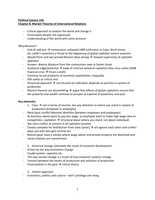
Chapter 8: Marxist Theories of International Relations
- Critical approach to analyse the world and change it
- Emancipate people, the oppressed
- Understanding of the world with some activism
Why Marxism?
- End of cold war communism collapsed 1989 (still exists in Cuba, North Korea
etc.),didn’t constitute a threat to the hegemony of global capitalist system anymore
- Would think cold war proved Marxist ideas wrong showed superiority of capitalist
approach
- Answer: divorce Marxism from the communism seen in Soviet Union
- Analytical edge/potential body of criticism aimed at capitalism thus very useful (2008
financial crisis frozen credit)
- Continue to see problems of economic exploitation, inequality
- Still useful as critical tool
- Structural approach not focused on individual, depends on position in system of
production
- Marxist theories are discomfiting argue that effects of global capitalism ensure that
the powerful and wealth continue to prosper at expense of powerless and poor
Key elements:
1. Class not in terms of income, but pay attention to where you stand in system of
production (employer vs employee)
- Most basic conflict Marxism identifies (between employers and employees)
- As business owner want to pay less wage, as employee want to make high wage (due to
competition, capitalism structural about where you stand, not about individual)
- See class conflict as present in all capitalist societies
- Classes compete for distribution from state (actor) set against each other and conflict
plays out with who gets control etc.
- Marxist goal: have a society where wage labour and private property are abolished and
social relations are transformed
2. Historical change ultimately the result of economic development
- Driven by the way economies change
- Feudal system, capitalist etc.
- The way society change is a result of how economic systems change
- Tension between the means of production and relations of production
- Emancipation is the goal critical theory
3. Holistic approach
- Economics, politics and culture – don’t privilege one thing
-
1
Chapter 8: Marxist Theories of International Relations
- Critical approach to analyse the world and change it
- Emancipate people, the oppressed
- Understanding of the world with some activism
Why Marxism?
- End of cold war communism collapsed 1989 (still exists in Cuba, North Korea
etc.),didn’t constitute a threat to the hegemony of global capitalist system anymore
- Would think cold war proved Marxist ideas wrong showed superiority of capitalist
approach
- Answer: divorce Marxism from the communism seen in Soviet Union
- Analytical edge/potential body of criticism aimed at capitalism thus very useful (2008
financial crisis frozen credit)
- Continue to see problems of economic exploitation, inequality
- Still useful as critical tool
- Structural approach not focused on individual, depends on position in system of
production
- Marxist theories are discomfiting argue that effects of global capitalism ensure that
the powerful and wealth continue to prosper at expense of powerless and poor
Key elements:
1. Class not in terms of income, but pay attention to where you stand in system of
production (employer vs employee)
- Most basic conflict Marxism identifies (between employers and employees)
- As business owner want to pay less wage, as employee want to make high wage (due to
competition, capitalism structural about where you stand, not about individual)
- See class conflict as present in all capitalist societies
- Classes compete for distribution from state (actor) set against each other and conflict
plays out with who gets control etc.
- Marxist goal: have a society where wage labour and private property are abolished and
social relations are transformed
2. Historical change ultimately the result of economic development
- Driven by the way economies change
- Feudal system, capitalist etc.
- The way society change is a result of how economic systems change
- Tension between the means of production and relations of production
- Emancipation is the goal critical theory
3. Holistic approach
- Economics, politics and culture – don’t privilege one thing
-
1